
Quick Answer: Energy and focus cannabis products rely on four key terpenes: alpha-pinene (1-4%) inhibits acetylcholinesterase for sustained alertness, limonene (2-7%) elevates dopamine and serotonin for mood-driven motivation, terpinolene (15-22%) provides sustained cognitive clarity when properly balanced, and beta-caryophyllene (5-17%) activates CB2 receptors to reduce stress-induced cognitive interference.
Optimal concentrations vary by format: vape cartridges require 5-12% total terpenes, concentrates need 8-15%, and beverages use 2-5mg per serving. Cannabis-derived terpenes with preserved minor compounds (0.1-1%) consistently outperform botanical recreations through entourage effects. Proper formulation balances stimulation with caryophyllene to prevent overstimulation and anxiety.
Key Takeaways
- Alpha-pinene, limonene, terpinolene, and beta-caryophyllene are the primary terpene candidates associated with alertness, mood elevation, and cognitive clarity.
- Alpha-pinene supports attention through acetylcholinesterase inhibition, while limonene influences dopamine and serotonin pathways involved in motivation and focus.
- Terpinolene shows dose-dependent effects, producing clarity when paired with pinene, limonene, and ocimene at 15–22 percent concentrations.
- Beta-caryophyllene activates CB2 receptors to reduce stress-related cognitive interference and offers greater formulation stability than monoterpenes.
- Focus-oriented products require different terpene loads by format, with vape cartridges using 5–12 percent, concentrates 8–15 percent, and beverages only a few milligrams per serving.
- Shop sample kits from Terpene Belt Farms to test our premium cannabis-derived terpenes to incorporate energy and focus characteristics in your product line.
Product teams aiming to create energizing, focus-driven cannabis SKUs often hit the same hurdles. Terpene ratios that seem promising on paper but fall flat in user feedback, profiles that push stimulation too far and trigger jittery effects, or ingredient costs that climb without delivering noticeable functional benefits.
Even experienced formulators struggle with predicting how certain terpene combinations will influence alertness, cognitive tightness, or sensory clarity once integrated into a finished product.
This guide addresses those challenges directly. We’re going to highlight the key terpene candidates known for supporting clean mental lift while helping you avoid common development pitfalls, whether you’re refining a vape line, building a functional edible, or optimizing a flower SKU.
How Cannabis Terpenes Affect Cognitive Function
Energizing terpenes influence cognition through acetylcholinesterase inhibition, neurotransmitter modulation, and CB2 receptor activation. Research on monoterpene inhibition activity demonstrates alpha-pinene produces potent AChE inhibition, while limonene studies show dopamine regulation in the nucleus accumbens regions controlling motivation and attention span.
Product developers formulating focus-enhancing cannabis applications require specific concentration thresholds for terpenes for productivity. Isolated terpenes at identical concentrations produce weaker effects than whole-plant extracts containing supporting minor compounds.
This synergistic relationship, what researchers call the entourage effect, explains performance differences between cannabis-derived and botanical-recreation terpene products.
Beta-caryophyllene activates CB2 receptors without psychoactivity, providing anti-inflammatory effects that reduce cognitive interference from stress. Terpinolene shows dose-dependent properties: sedating when isolated but alerting at 15-22% concentrations with supporting pinene and limonene for mental clarity.
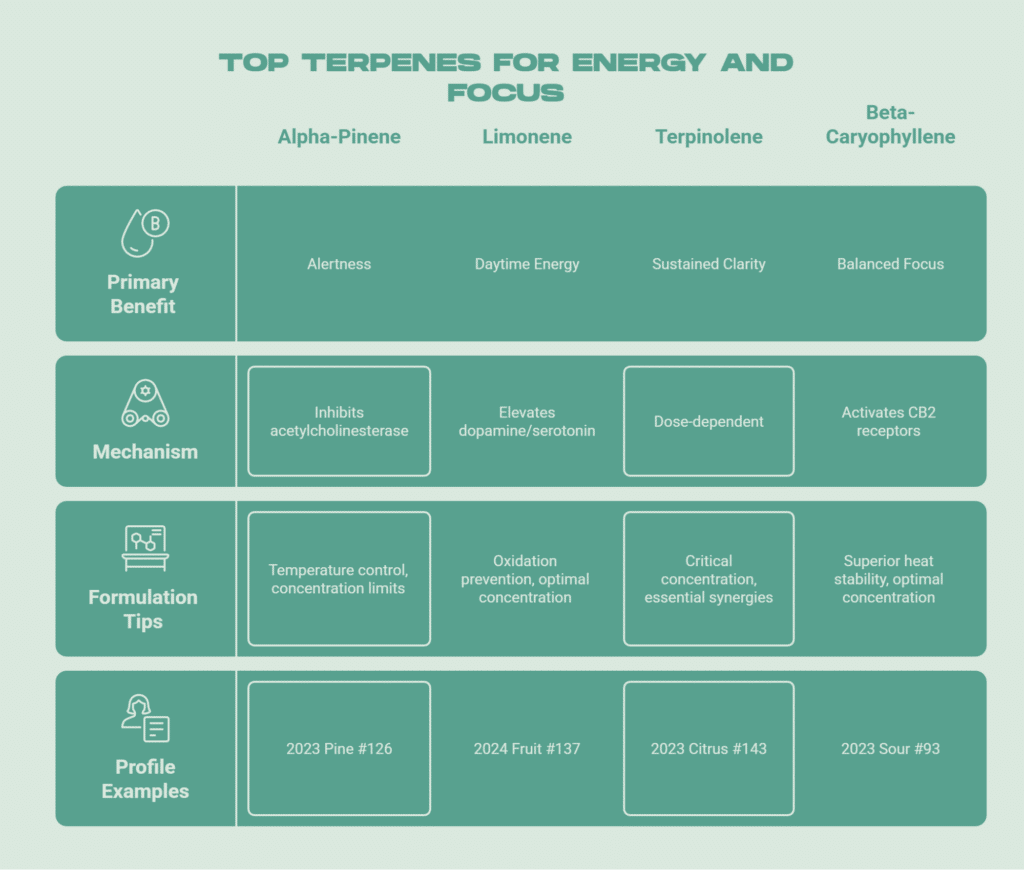
Top Terpenes for Energy and Focus
As we’ve already established, each terpene has a set of effects associated with it when you’re combining it with cannabis products. With that said, here are the top four terpenes that will come up often when you’re formulating energy and focus-oriented products.
1. Alpha-Pinene: Primary Compound for Alertness
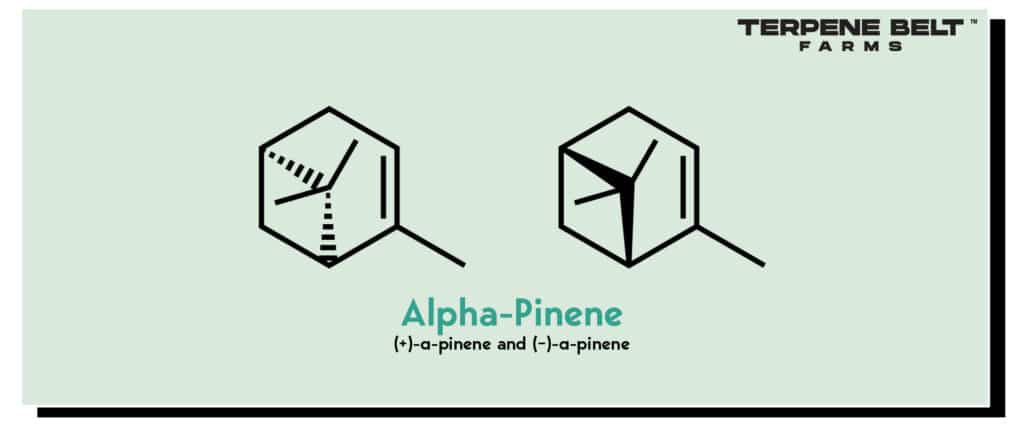
Alpha-pinene inhibits acetylcholinesterase, the enzyme that breaks down acetylcholine neurotransmitters responsible for attention and memory formation. Studies measuring bicyclic monoterpenoid inhibition confirmed that both (+) and (-) alpha-pinene isomers show strong AChE inhibitory activity.
This mechanism for mental clarity differs from stimulant-based alertness (dopamine/norepinephrine pathways) by maintaining higher synaptic acetylcholine without compensatory crashes. Mouse model research demonstrates alpha-pinene administration significantly improved scopolamine-induced cognitive dysfunction across Y-maze, passive avoidance, and Morris water-maze tests, measuring spatial memory, focus, and concentration.
Formulation Tips When Working with Alpha-Pinene
When incorporating alpha-pinene into focus-enhancing formulations, product developers should account for this monoterpene’s unique stability and processing requirements:
- Temperature Control: Keep processing temperatures below 311°F/155°C to prevent volatilization losses during manufacturing
- Concentration Limits: Target 1-4% alpha-pinene in finished products; higher concentrations create harsh throat sensations in inhalable applications
- Storage Requirements: Use amber glass containers with minimal headspace; pinene oxidizes rapidly when exposed to light and oxygen
- Synergistic Blending: Combine with 5-10% myrcene and 2-5% limonene to improve acetylcholinesterase inhibition through entourage effects
- Hardware Compatibility: Select vape hardware with voltage control (2.8-3.2V optimal) to preserve cognitive benefits without premature terpene loss
- Shelf Life Considerations: Expect 6-8 month stability in proper storage; pinene degradation accelerates above 70°F
Pinene-Rich Profiles for Product Development
2023 Pine #126 delivers 23.67% alpha-pinene with 16.33% myrcene and 9.48% limonene. This exclusive single varietal provides forest-forward complexity, root beer, sassafras, tangerine, and mint, creating authentic conifer characteristics for premium vape cartridges and concentrates.
For teams requiring pinene’s cognitive benefits without dominant pine aromatics, fruit-forward alternatives provide better consumer acceptance in mainstream markets. Fruit #505 offers 19.13% alpha-pinene alongside 15.50% myrcene and 8.07% limonene. The multi-vintage blend combines cognitive enhancement with Kahlua, Georgia peach, and apple pie aromatics, which is ideal for all-day productivity formulations targeting mainstream consumers.
2. Limonene: Uplifting Terpene for Daytime Energy
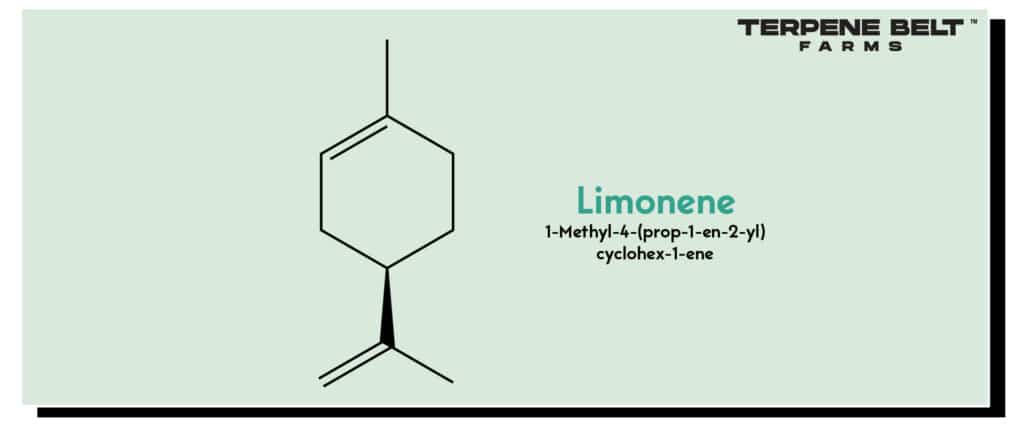
D-limonene elevates dopamine and serotonin through receptor modulation in the brain. HPLC analysis of lemon essential oil administration showed significant increases in norepinephrine, dopamine, and serotonin concentrations in the prefrontal cortex, striatum, and hippocampus regions governing executive function and motivation.
Behavioral pharmacology studies demonstrated limonene pretreatment decreased methamphetamine-induced hyperlocomotion while reversing dopamine elevation in the nucleus accumbens, indicating regulatory effects on neurotransmitter systems.
These mechanisms create mood elevation and motivational drive supporting productive cognitive work, and this is what makes limonene ideal for daytime terpene formulations without stimulant cardiovascular effects.
Formulation Tips When Working with Limonene
Product developers who use limonene for daytime energy formulations should consider these technical parameters for optimal stability and functional delivery:
- Oxidation Prevention: Store in sealed containers below 70°F away from light; limonene oxidizes within 4-6 weeks under ambient conditions
- Optimal Concentration: Target 2-7% limonene in vape products, 5-12% in concentrates for mood elevation without overwhelming sensory profiles
- Viscosity Benefits: Limonene naturally reduces oil viscosity by 15-20%, improving vape cartridge flow without additional cutting agents
- Heat Stability: Maintains integrity up to 350°F; suitable for most vape applications but shows degradation in high-temperature dabbing (450°F+)
- Synergistic Partners: Combine with 5-15% beta-caryophyllene to balance uplifting effects and prevent overstimulation in sensitive consumers
- pH Considerations: Acidic environments (pH below 5) accelerate limonene degradation; maintain neutral pH in beverage applications
Limonene-Dominant Options for Energy Applications
Maximum limonene concentration appears in 2024 Fruit #137 at 24.82%, balanced with 21.28% beta-ocimene and 10.76% beta-caryophyllene. This 2024 harvest single varietal captures Mai Tai-inspired tropical notes, pineapple, guava, lemon, coconut kefir, perfect for summer seasonal releases and mood-elevation products.
When seasonal tropical profiles don’t align with brand identity, dessert-forward formulations provide year-round relevance while maintaining high limonene content. Sophisticated dessert applications benefit from Dessert #25, featuring 26.88% limonene with 17.05% beta-caryophyllene and 6.57% alpha-humulene. Biscotti and Gelato characteristics deliver strawberry cheesecake aromatics. Substantial caryophyllene prevents overstimulation during extended work sessions.
3. Terpinolene for Sustained Cognitive Clarity
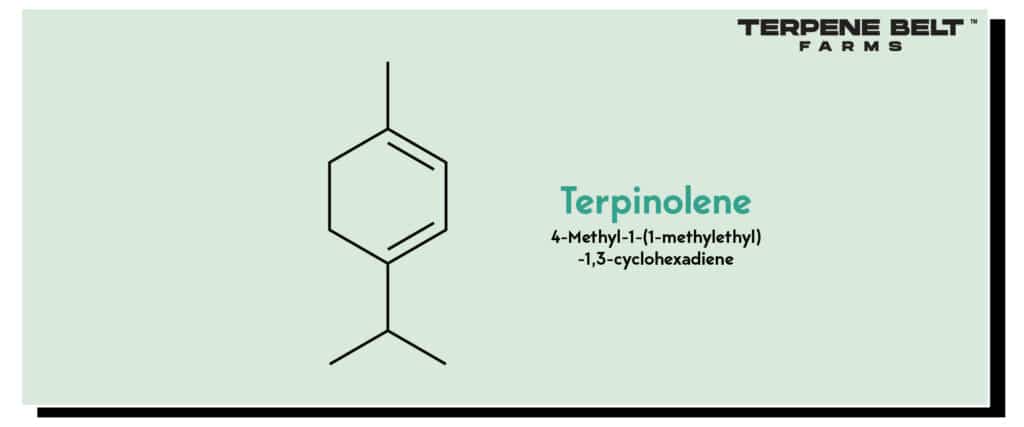
Terpinolene exhibits dose-dependent behavior, sedating when isolated but alerting at concentrations of 15-22% when supported by pinene, limonene, and ocimene. This context-dependent effect reveals why whole-plant extracts consistently outperform botanical recreations: preserved trace compounds shift terpinolene toward sustained mental clarity.
Formulation Tips When Working with Terpinolene
Formulators incorporating terpinolene for sustained cognitive clarity should account for its dose-dependent behavior and synergistic requirements:
- Critical Concentration Threshold: Maintain 15-22% terpinolene for alerting effects; concentrations below 10% may produce sedation instead of clarity
- Essential Synergies: Always combine with supporting pinene (3-8%), limonene (5-10%), and ocimene (4-9%) to achieve focus-enhancing properties
- Processing Stability: Terpinolene degrades above 450°F; avoid high-temperature dabbing applications or adjust formulation for concentrate products
- Whole-Plant Advantage: Cannabis-derived terpinolene with preserved minor compounds (0.1-1%) consistently outperforms isolated terpinolene formulations
- Storage Conditions: Requires sealed containers below 70°F; stability improves when stored with complementary monoterpenes in natural ratios
- Flavor Evolution: Multi-faceted aroma develops differently throughout consumption sessions, maintaining consumer interest across extended use
High-Terpinolene Profiles for Sustained Clarity
Product developers targeting sustained cognitive function should consider 2023 Citrus #143, which contains 22.94% terpinolene, 10.10% beta-caryophyllene, 9.39% myrcene, 8.52% limonene, and 8.02% beta-ocimene. Lemon Meringue genetics create cherry, Meyer lemon, and tangerine peel notes that effectively mask residual hemp characteristics in distillate applications.
Citrus-forward profiles work well for mainstream appeal, but some applications benefit from more distinctive aromatic positioning. Teams seeking terpinolene with savory complexity can go for Pine #606 instead, with 21.39% terpinolene with 20.50% myrcene creating Dutch Treat reminiscence. Mocha, key lime, and Spanish green olive aromatics provide unexpected depth for brands differentiating beyond conventional profiles.
4. Beta-Caryophyllene for Balanced Focus
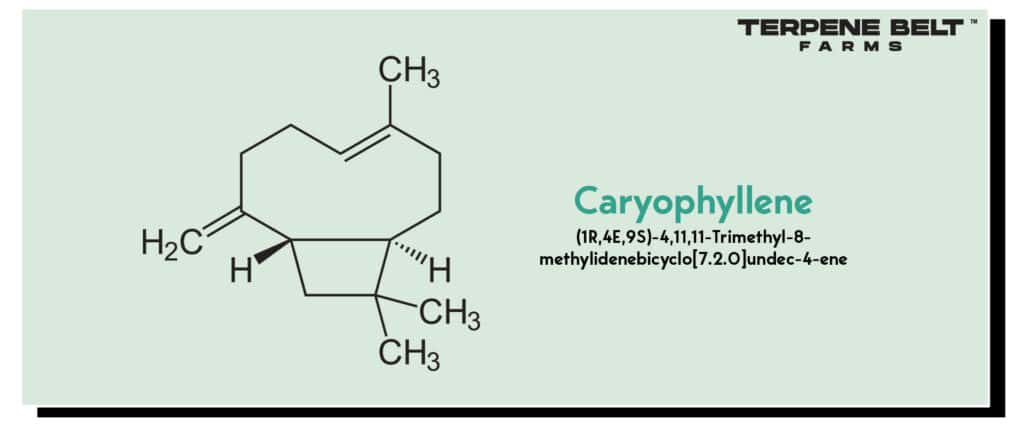
Beta-caryophyllene activates CB2 receptors without psychoactive effects, creating anxiolytic properties that support concentration by reducing stress-induced cognitive interference. This sesquiterpene (C₁₅H₂₄) differs from traditional stimulants by addressing anxiety and physical tension that commonly impair focus.
Cannabis profiles normally contain 5-17% beta-caryophyllene. This relatively high natural concentration makes it a dominant aromatic and functional component. Sesquiterpene structure provides greater stability and a higher boiling point (260°C/500°F) versus monoterpenes, creating less volatility during processing and storage. Professional formulators select caryophyllene-rich profiles for specific balanced focus applications:
Formulation Tips When Working with Beta-Caryophyllene
Product developers using beta-caryophyllene for balanced focus applications benefit from this sesquiterpene’s superior stability and unique receptor interactions:
- Superior Heat Stability: Remains stable through 500°F, making caryophyllene ideal for high-temperature dabbing and extended vaping sessions
- Optimal Concentration: Target 5-17% beta-caryophyllene for anxiolytic effects, supporting concentration without psychoactive concerns
- Extended Shelf Life: Sesquiterpene structure provides 12-18 months stability under proper storage versus 6-8 months for monoterpenes
- CB2 Receptor Benefits: Non-psychoactive cannabinoid activity enables mainstream wellness positioning and functional benefit claims
- Natural Viscosity: Higher molecular weight increases oil thickness; balance with limonene (8-12%) for optimal vape cartridge flow
- Anti-Inflammatory Synergy: Combine with 3-7% alpha-humulene to amplify stress-reduction properties supporting cognitive performance
Caryophyllene-Forward Profiles for Balanced Focus
If you’re looking into beta-caryophyllene for stress reduction, the 2023 Sour #93 is a good option. The terpene profile here is 16.38% beta-caryophyllene with 20.64% limonene, 9.17% myrcene, and 5.90% humulene. CB2 activation combines with dopamine modulation to deliver balanced cognitive enhancement without caffeine-like anxiety or overstimulation.
While bright citrus profiles suit many applications, sophisticated formulations targeting discerning consumers often require more complex aromatic architecture. Premium balanced focus applications use 2024 Savory #84 featuring 17.74% beta-caryophyllene, 15.26% limonene, and 7.37% alpha-humulene. Garlotti and Chemdawg genetics provide spearmint and mango aromatics. Elevated caryophyllene and humulene reduce physical tension that may be impairing focus.
Commercial Formulation Application Concentrations
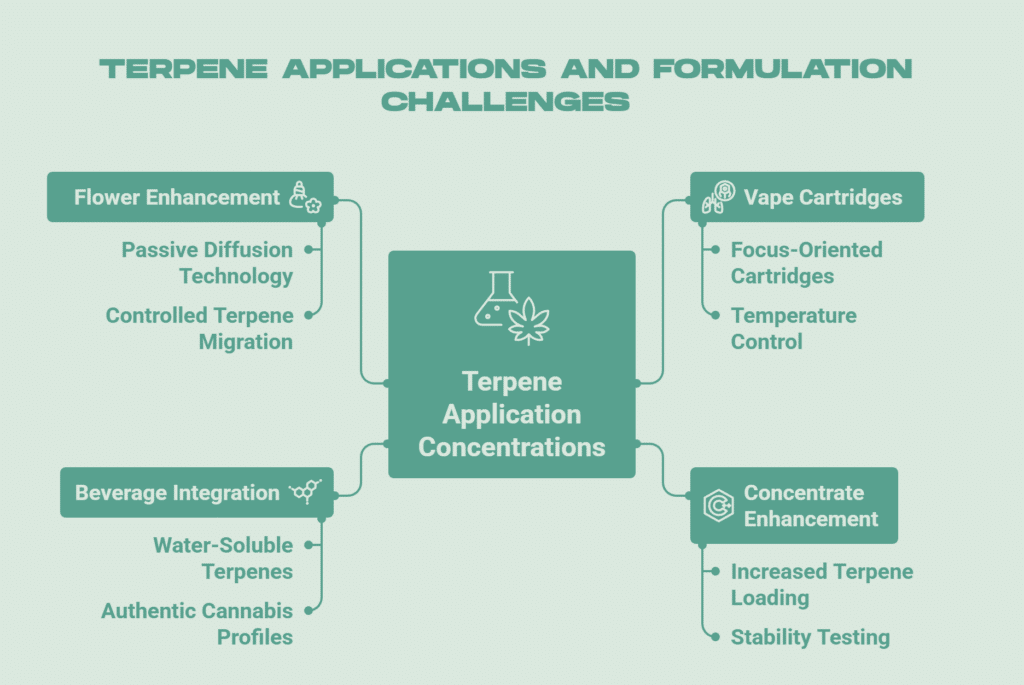
Energy and focus terpene applications vary significantly across product formats due to differences in consumption patterns, stability requirements, and sensory expectations.
While vape users take multiple small draws throughout the day, concentrate consumers experience brief high-intensity exposure, beverage drinkers expect subtle enhancement, and flower users seek aromatic restoration without overwhelming natural characteristics.
Vape Cartridge Specifications
Vape formulation presents unique challenges balancing desired cognitive effects with hardware compatibility and consumer comfort.
Inhalation delivery requires careful attention to throat sensation, where excessive monoterpene concentrations create harshness that drives negative reviews regardless of functional benefits.
Focus-oriented cartridges normally target 5-12% total terpene content, with pinene-forward formulations requiring lower ranges (5-8%) due to intense aromatic character, while limonene-dominant profiles tolerate higher concentrations (8-12%) while maintaining smooth vapor.
Temperature control proves critical for preserving cognitive enhancement properties during vaporization. Pinene’s low boiling point (311°F) means standard voltage settings (3.7V+) volatilize alertness compounds before consumers experience benefits.
Pine #37 delivers balanced vape performance with 17.17% limonene, 17.08% beta-caryophyllene, and 9.43% terpinolene, which is great for a vape formulation. The substantial caryophyllene content provides natural viscosity adjustment, improving hardware performance while creating apple-dessert characteristics with sustained energizing effects throughout the day.
Struggling with formulating your vapes? Our R&D guide for vape formulations walks formulators through the whole process with common challenges and how you can work through them.
Concentrate Enhancement Parameters
Concentrate applications differ fundamentally from vape products in consumption behavior and thermal exposure. Consumers taking larger, less frequent doses require increased terpene loading (8-15% total content) to guarantee sufficient cognitive compounds reach the brain during abbreviated exposure times.
This higher concentration range also compensates for partial terpene loss during high-temperature dabbing, where monoterpenes show measurable degradation above 450°F.
Stability testing at application-relevant temperatures identifies which terpenes survive concentrate consumption methods. Terpinolene and pinene degrade rapidly above 450°F, limiting their effectiveness in high-heat applications.
Caryophyllene and humulene remain stable through typical dabbing ranges (500-600°F), making sesquiterpene-rich profiles more suitable for concentrate applications requiring sustained cognitive clarity at standard consumption temperatures.
2023 Gas #152 provides concentrate-optimized energizing performance with 28.13% terpinolene, 20.90% myrcene, and 8.66% limonene. This gas-family profile for concentrates delivers complex diesel, pine, and citrus notes with sustained cognitive clarity through balanced ratios that maintain stability during dabbing while preventing overwhelming single-note intensity.
Beverage Integration with Energizing Terpenes
Beverage formulations face a fundamental incompatibility challenge, like hydrophobic terpenes naturally separating from water-based matrices, creating cloudiness, inconsistent dosing, and rapid degradation that compromises shelf stability.
Standard terpene oils require specialized emulsification equipment and extensive reformulation work that prevents many concepts from reaching commercial viability. Focus-oriented beverage products target significantly lower concentrations (2-5mg total terpenes per serving) than inhalable formats, reflecting consumption context as refreshment rather than therapeutic dosing.
Water-soluble terpenes solve integration challenges through pre-emulsification that maintains authentic cannabis profiles while eliminating separation issues. This technology preserves natural limonene, ocimene, and caryophyllene ratios in stable aqueous dispersions, enabling consistent flavor distribution throughout carbonated beverages, functional drinks, and ready-to-drink products without requiring specialized handling protocols during manufacturing.
Terpene Belt Farms’ water-soluble terpene formulations maintain complete cannabis-derived molecular profiles rather than simplified botanical recreations. While competitors often emulsify isolated terpenes or botanical alternatives, our water-soluble solutions preserve the full spectrum of minor compounds (0.1-1% concentrations) that drive authentic entourage effects.
This approach delivers genuine mood-elevation and focus-enhancement properties that consumers can distinguish from synthetic or botanical alternatives, creating repeat purchasing behavior that justifies premium beverage positioning.
Flower Enhancement for Aromatic Restoration
Flower infusion addresses terpene loss during curing and storage without requiring spray equipment that creates uneven distribution and surface coating. Unlike liquid application methods that concentrate terpenes on outer material while leaving interior flower untreated, passive diffusion technology allows natural migration from high-concentration sources into lower-concentration flower structure over 48 hours.
This controlled process delivers measurable terpene increases (4.18% per independent testing) while maintaining natural flower structure and consumer expectations for authentic bud characteristics.
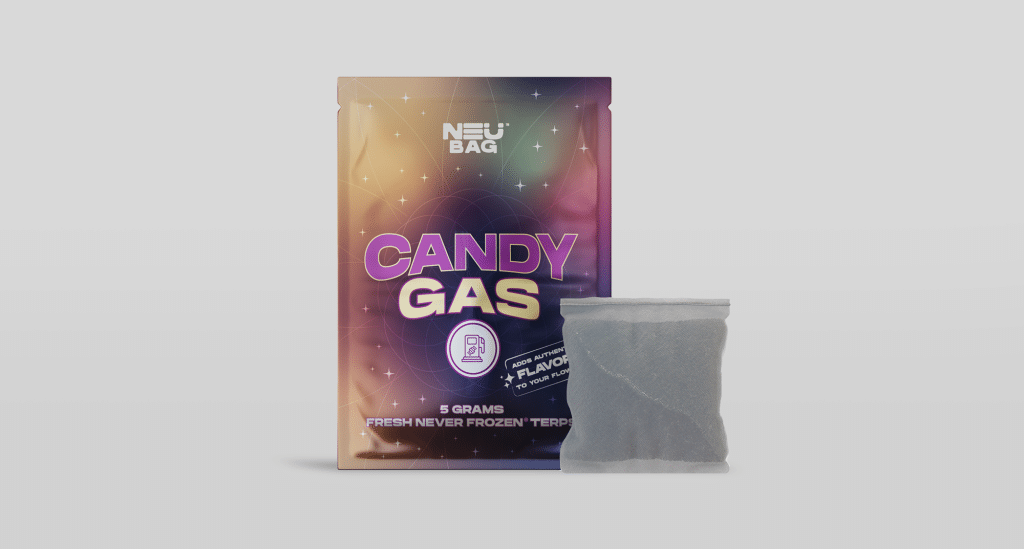
Terpene Belt Farms’ NEU Bag Infusion Packs deliver controlled terpene migration through passive diffusion rather than surface-coating spray methods that create uneven distribution. While spray application concentrates terpenes on exterior material, our mesh infusion technology allows natural migration into flower structure over 48 hours, producing the 4.18% terpene increases verified by independent testing.
This equipment-free approach using Fresh Never Frozen® cannabis-derived profiles eliminates the capital investments and cleanup requirements of spray systems while delivering pharmaceutical-grade consistency that spray methods cannot match across production batches.
Closing Thoughts — How Terpene Belt Farms Can Help with Energy-Oriented Formulations
Terpene quality determines whether focus-enhancing formulations deliver measurable cognitive benefits or simply add fragrance to products. The difference between authentic cannabis-derived profiles and botanical recreations becomes immediately apparent in consumer testing. Preserved minor compounds (0.1-1% concentrations) create entourage effects that isolated terpene blends cannot replicate, regardless of how precisely formulators match major terpene percentages.
Terpene Belt Farms addresses this quality gap through Fresh Never Frozen® extraction that captures complete aromatic spectrums immediately after harvest.
Our Byron, California cultivation in Rincon Clay Loam soil produces terpene expressions that reflect true California cannabis heritage, while our processing methods preserve volatile compounds that standard extraction loses through thermal degradation.
Each batch undergoes third-party testing with ISO/IEC 17025 certification, providing the technical documentation procurement teams require for quality validation.
Request our sample kits for your R&D to see how Terpene Belt Farms’ authentic cannabis-derived terpenes work before committing to production quantities.
Frequently Asked Questions About Energy and Focus Terpenes
What Concentration of Alpha-Pinene Provides Cognitive Enhancement for Alertness?
Research measuring acetylcholinesterase inhibition indicates alpha-pinene delivers measurable effects at 0.5-2% concentrations in finished products. Whole-plant extracts containing 1-4% pinene in natural ratios with supporting terpenes consistently outperform isolated pinene due to minor compound synergies not yet fully characterized in clinical literature on cognitive terpenes.
How Do Cannabis-Derived Terpenes Compare to Botanical Terpene Blends for Energy and Focus?
Cannabis-derived terpenes maintain complete molecular fingerprints including trace compounds (0.1-1% concentrations) that botanical recreations cannot replicate through isolated blending. Independent consumer testing consistently shows cannabis-derived profiles produce stronger cognitive enhancement and higher preference ratings for daytime energy, likely due to preserved minor compounds contributing to entourage effects.
What Total Terpene Percentage Should Focus-Enhancing Products Contain?
Optimal concentrations vary by application: vape cartridges 5-12%, concentrates 8-15%, beverages 2-5mg per serving, edibles 3-8mg per serving. These ranges balance functional effectiveness with sensory appeal and manufacturing considerations including viscosity and stability in focus terpene blends.
Do Terpene-Based Focus Products Cause Anxiety Like Caffeine Stimulants?
Properly formulated profiles incorporating beta-caryophyllene (activating anxiolytic CB2 receptors) typically avoid jittery anxiety from traditional stimulants. Profiles emphasizing only limonene and pinene without balancing sesquiterpenes may produce overstimulation in sensitive consumers. Balanced formulations including 5-15% beta-caryophyllene generally deliver mental clarity without agitation.
How Long Do Cognitive Effects From Terpenes for Focus Last?
Effects duration varies by consumption method. Inhalation (vaping/smoking) produces effects within 2-5 minutes lasting 2-4 hours. Edibles and beverages create longer onset (30-90 minutes) but an extended duration (4-8 hours). Studies on limonene brain neurotransmitter effects show sub-chronic administration produces sustained changes in dopamine, serotonin, and GABA levels.
What Storage Conditions Preserve Potency in Terpenes for Productivity?
Monoterpenes (limonene, pinene, terpinolene) degrade rapidly under ambient conditions, showing compositional changes within 4-6 weeks when exposed to oxygen and light. Optimal storage requires sealed containers, temperatures below 70°F, and darkness. Refrigeration extends stability, but products should reach room temperature before opening to prevent condensation damage.
Are There Drug Interactions With Terpene Products?
Terpenes consumed at typical product concentrations show minimal drug interactions in healthy adults. Individuals taking anticoagulants, immunosuppressants, or cytochrome P450-metabolized medications should consult healthcare providers before regular use. Safety literature indicates terpenes have GRAS (generally recognized as safe) status at food-flavoring concentrations.
Sources Used for This Article
- PubMed: “Inhibition of acetylcholinesterase activity by bicyclic monoterpenoids” – pubmed.ncbi.nlm.nih.gov/15740071/
- ScienceDirect: “Limonene inhibits methamphetamine-induced locomotor activity via regulation of 5-HT neuronal function and dopamine release” – sciencedirect.com/science/article/abs/pii/S0944711313004790
- NCBI PMC: “Beta-caryophyllene as an antioxidant, anti-inflammatory and re-epithelialization activities in a rat skin wound excision model” – ncbi.nlm.nih.gov/pmc/articles/PMC6466304/
- PMC NCBI: “Beta-caryophyllene as an antioxidant, anti-inflammatory and re-epithelialization activities in a rat skin wound excision model” – pmc.ncbi.nlm.nih.gov/articles/PMC8831077/
- ScienceDirect: “Antidepressant-like effect of lemon essential oil is through a modulation in the levels of norepinephrine, dopamine, and serotonin in mice: Use of the tail suspension test” – sciencedirect.com/science/article/pii/S1756464612001740
- Wikipedia: “Beta-caryophyllene” – en.wikipedia.org/wiki/Beta-caryophyllene