Quick Answer: Liquid terpenes are made by blending terpene extracts with a compatible carrier, steam distilling cannabis biomass, or capturing terpene fractions during extraction, but success depends on tight process control.
To maintain stability and performance, blending must stay below 40°C, terpene levels typically sit at 5–15% for vape formulations, and oxygen, heat, and UV exposure must be minimized to prevent degradation and profile drift.
Key Takeaways
- Liquid terpenes are typically produced by diluting isolated or full-spectrum terpene inputs into a compatible carrier, steam distilling cannabis biomass, or capturing fractions through cold trap collection.
- Carrier-based blending requires strict temperature control below 40°C to prevent volatilizing monoterpenes and altering the intended terpene ratio.
- Oxidation is a primary degradation risk; exposure to oxygen, heat, and UV light accelerates terpene breakdown into harsher secondary compounds and causes profile drift.
- Terpene concentration directly affects viscosity and vape hardware performance, with most cartridges functioning optimally between 5 and 15 percent terpene by weight.
- Improper carriers such as MCT, propylene glycol (PG), or polyethylene glycol (PEG) in inhalation products can generate harmful byproducts when heated.
- Stability testing using gas chromatography–mass spectrometry (GC-MS), contamination panels, and viscosity validation is critical before scaling production.
- Shop our sample kits from Terpene Belt Farms today to start formulating with batch-tested, vertically integrated, California-grown terpene inputs you can trust.
When formulators say they want to “make liquid terpenes,” they’re often describing two very different things, and confusing them leads to very different problems.
Some are talking about blending a terpene solution from scratch using isolated or extracted inputs. Others mean producing terpenes directly from cannabis plant material. Both paths are viable, but neither is plug-and-play. Terpenes are among the most chemically reactive compounds in cannabis, and they don’t tolerate sloppy handling.
The formulation literature rarely addresses what actually happens when these processes go wrong: the off-flavors that emerge from a poorly blended carrier, the profile drift that kicks in after improper storage, or the hardware failures that follow when viscosity specs don’t match the cart.
This guide covers the full picture: how liquid terpenes are made, what risks live at each stage, and what a proper production process actually looks like
What Are Liquid Terpenes?
Terpenes are naturally oily, aromatic hydrocarbons, and most of them are already liquid at room temperature.
Myrcene, limonene, and linalool, for example, are all liquids in their pure form. So when someone uses the term “liquid terpenes” in a formulation context, they’re usually referring to something more specific than a single isolated compound.
In practice, “liquid terpenes” typically describes one of three things: a diluted terpene solution prepared for infusion into a specific medium, a full-spectrum terpene oil extracted from cannabis plant material, or a blended terpene profile mixed to a target ratio and then suspended in a compatible carrier.
Each version has different handling requirements, stability profiles, and appropriate use cases.
Natural Liquid State Vs. Prepared Terpene Solutions
A raw, isolated terpene compound like beta-caryophyllene is a liquid on its own — no carrier needed.
But most formulators aren’t working with single isolates. They’re working with multi-compound profiles that need to be stabilized, diluted to a usable concentration, and made compatible with a specific product matrix. That’s where “liquid terpene solutions” become a meaningful category.
The distinction matters because it changes how you evaluate quality. A prepared terpene solution introduces additional variables, carrier purity, dilution ratio, and mixing conditions that a raw isolate doesn’t carry. If any of those variables are off, the problem compounds downstream in production.
Where Liquid Terpenes Are Used
Liquid terpene preparations are involved across nearly every cannabis product category:
- Vape Cartridges: Used to thin distillate, restore terpenes lost during extraction, and dial in viscosity for hardware compatibility
- Concentrates: Reintroduced post-processing to restore profiles stripped during THC isolation
- Infused Pre-Rolls: Applied via spray or infusion medium to improve flower prior to rolling
- Edibles and Beverages: Incorporated at ultra-low ratios (often 0.005–0.05%) with emulsification support for water compatibility
- Tinctures and Topicals: Blended with MCT or other carrier oils for sublingual or transdermal delivery
How Liquid Terpenes Are Made
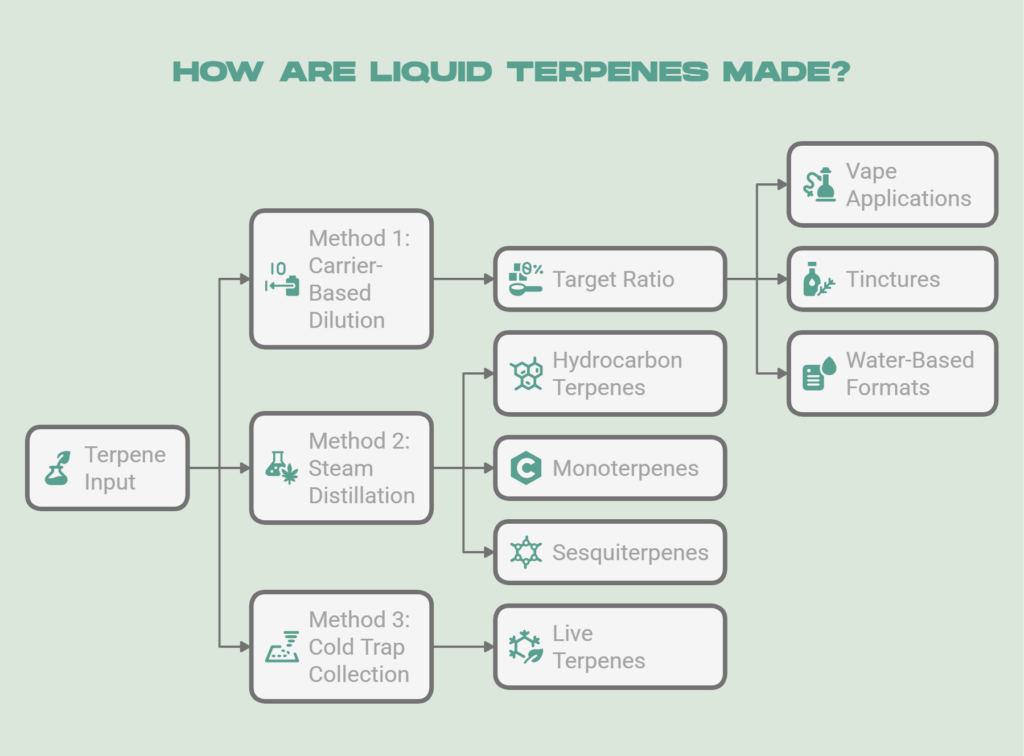
Not all liquid terpene production routes are created equal, and the method you choose directly determines what ends up in your final product. There are three methods you need to know about here.
Method 1: Carrier-Based Dilution (Blending)
This is the most common method for formulators already working with purchased terpene profiles.
You start with a terpene input, whether a full-spectrum CDT oil, an isolated compound, or a pre-blended multi-terpene profile, and combine it with a compatible carrier at a target ratio.
For vape applications, that typically means blending directly with cannabis distillate at a terpene-to-distillate ratio somewhere between 5% and 15% by weight, depending on the hardware and desired viscosity. For tinctures, MCT oil is a common carrier. For water-based formats like beverages, an emulsification step is required since terpenes are hydrophobic.
The output quality is almost entirely dependent on input quality. Blending doesn’t improve a terpene profile; it dilutes and delivers it. If the terpene input has already degraded, or if the carrier introduces contaminants, that’s what ends up in your product.
Temperature control during blending is equally important because even short exposure to excess heat at this stage can volatilize the lighter monoterpene fractions that contribute significantly to the aroma and effect complexity of the final product.
Method 2: Steam Distillation from Cannabis Plant Material
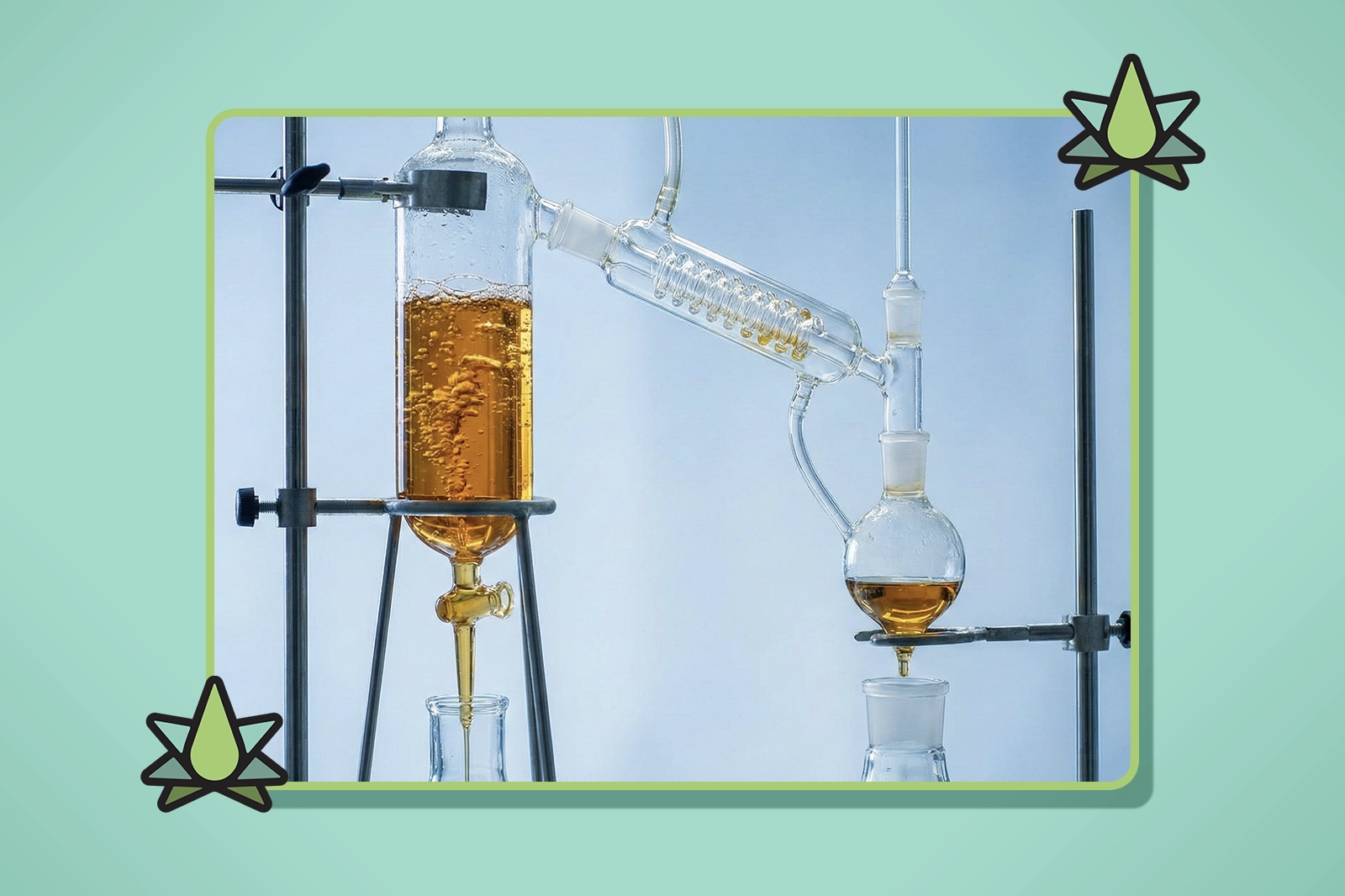
Steam distillation is a solventless extraction method where steam is passed through cannabis biomass, carrying volatile terpene molecules with it. That vapor mixture travels into a condenser where it cools and returns to liquid form and because terpenes are oils, they float on top of the water layer and can be separated cleanly.
Research published in PMC confirms that steam distillation tends to favor hydrocarbon terpenes like myrcene and beta-caryophyllene, and that monoterpenes are captured preferentially in the earliest collection phase, while sesquiterpenes come out later as distillation time extends.
The appeal here is full control over source material and a solvent-free output. For producers working with fresh, high-quality cannabis biomass, steam distillation can yield a terpene oil with a profile authentically representative of the cultivar.
Method 3: Cold Trap Collection
Cold trap collection isn’t an active production method so much as a recovery step integrated into hydrocarbon or CO2 extraction workflows. As cannabis is processed, terpene-rich vapor passes through a cold trap that condenses it into a terpene-forward liquid, often called “live terpenes” when sourced from fresh-frozen material.
This is how many cannabis processors collect native terpene fractions without a dedicated distillation setup. The resulting liquid can then be used as a terpene input for blending or reintroduction.
Risks Formulators Must Account For
The production process is only half of the equation. Where most guides stop short is in describing the failure modes that show up after production in stability testing, in hardware performance, in the final product’s sensory profile. These are the risks that cost money, waste material, and damage brand consistency. Terpene preservation starts before you fill a bottle, and the decisions made during blending and storage directly determine whether your product holds its profile across shelf life.
Oxidation and Terpene Degradation
Terpenes are unsaturated hydrocarbons. Their carbon-carbon double bonds react readily with atmospheric oxygen, breaking down into secondary compounds like aldehydes, ketones, peroxides, and epoxides that degrade both aroma and biological activity.
What makes this particularly costly in a production environment is that oxidation is autocatalytic. Once it starts, it accelerates, generating free radicals that destabilize the surrounding terpene pool.
A 2024 study in Phytochemical Analysis found that p-cymene consistently emerges as a marker of terpene aging under UV and heat stress, and that each terpene generates a unique pattern of degradation products. For example, oxidation of limonene specifically produces limonene oxide, a harsher aromatic compound associated with mucous membrane irritation.
Ratio Instability and Profile Drift
Terpene compounds in a blended solution have different vapor pressures and boiling points, meaning they don’t behave uniformly under heat or during long-term storage.
When a liquid blend is exposed to moderate heat during blending or filling, the lightest monoterpene fractions, the ones most responsible for aromatic brightness and complexity, begin leaving the solution first.
The blend you validated in R&D is not necessarily the blend that reaches the consumer six months later. Formulators working with terpenes for distillate should build stability testing into their packaging QC, not treat it as a one-time formulation checkpoint.
Solvent and Carrier Contamination
Carrier selection introduces its own risk variables, and the wrong choice for the application creates problems that can’t be corrected downstream. Key risks by carrier type:
- MCT Oil in Inhalation Products: Heating MCT in vape hardware can generate acetaldehyde and acrolein, both associated with pulmonary irritation. MCT is appropriate for tinctures and edibles only
- PG and PEG: At high voltages and temperatures, these carriers break down into formaldehyde and other harmful byproducts
- Low-Grade Distillate: Can introduce residual solvents, pesticide residues, or heavy metals that won’t be visible until a COA flags them
- Unverified Terpene Inputs: Even a clean carrier is compromised if the terpene input carries pesticide or solvent contamination
Hardware Incompatibility in Vape Applications
Terpene concentration controls viscosity, and viscosity controls everything downstream in a cartridge, like wicking performance, coil behavior, fill rate, and leak rate.
Blends above 10–12% terpene by weight typically thin the oil enough to cause flooding and leakage in standard hardware, while too little terpene creates the opposite problem: viscous oil that won’t wick properly, leading to dry hits and coil burn.
Apart from concentration, terpenes with acidic functional groups can attack metal components or degrade polymer seals over time, introducing leached compounds into the finished product.
For viscosity targets, cartridge compatibility ranges, and failure-mode triage, the R&D vape formulation best practices guide covers the production-level specifics.
Step-By-Step: Making a Liquid Terpene Blend for Formulation
For formulators preparing carrier-based terpene solutions in-house, whether for R&D testing or small-batch production, the process is more controlled than most guides suggest. Each step introduces a variable that, if left unmanaged, compounds into a quality issue later. Below is how to approach it properly.
Step 1: Select Your Terpene Input
Your input quality sets the ceiling for your final product. You can’t blend your way to a better terpene profile than the one you started with. The three primary input types carry different tradeoffs:
- Isolated Single Compounds: Highest purity and predictability, but no complexity or minor-compound interactions; best for custom profile construction in a lab setting
- Full-Spectrum CDT or HDT Oil: Preserves the native ratio of major and minor terpenes from a specific cannabis cultivar; most authentic formulation output
- Pre-Blended Multi-Terpene Profiles: Combines accuracy with convenience; quality depends entirely on supplier transparency and testing documentation
Step 2: Choose and Prepare Your Carrier
Carrier selection is application-specific. There is no universal carrier, and using the wrong one introduces risks that no amount of downstream processing can fix. General guidance:
- Distillate (Cannabis/Hemp): Best for vape cartridges; terpenes serve as both flavoring and viscosity modifier
- MCT Oil: Best for tinctures and capsules; not appropriate for inhalation applications
- Fractionated Coconut Oil: Similar profile to MCT, suitable for topicals and sublingual formats
- Water and Emulsifier: Required for beverage applications; emulsification systems designed for terpenes include lecithin, saponins, or commercial encapsulation agents
Step 3: Control Temperatures During Blending
This is the step most commonly underestimated in in-house production.
Terpenes begin volatilizing and degrading at relatively low temperatures, and the lighter monoterpene fractions are the first to go. Research on terpene recovery under heat exposure found that recovery rates dropped significantly with increasing water temperature, with terpene recoveries in the 70–80% range at 100°C, meaning you can lose 20–30% of lighter fractions just from thermal exposure during processing.
Step 4: Headspace Management and Bottling
Oxygen in the headspace of your storage container is the primary driver of post-production oxidation. Even a small air gap above the fill line creates a sustained oxidative environment that progressively degrades the terpene profile over time.
Nitrogen purging, flowing food-grade or medical-grade nitrogen into the bottle before capping, displaces the oxygen and substantially slows this process.
Use amber glass or opaque HDPE containers to block UV exposure. Store at cool, stable temperatures. Refrigeration is also an appropriate solution for long-term storage, but rapid temperature cycling between cold and ambient creates condensation that can introduce moisture into the terpene solution.
Step 5: Stability Testing Before Scale
Before committing any terpene blend to production-scale runs, it needs to be tested at the batch level. This means pulling samples at multiple time points under intended storage conditions and analyzing them by GC-MS to verify that the terpene ratios are holding.
It means testing viscosity at your filling temperature and confirming it’s within spec for your hardware. It means doing a contamination panel on the finished blend, not just the inputs.
The cost of stability testing at the R&D stage is small relative to the cost of a production batch that fails COA review or generates customer complaints. For concentrates specifically, our R&D concentrates formulation guide provides additional stability benchmarks and testing parameters worth incorporating into pre-production QC.
Product Recommendations for Liquid Terpene Formulation
When selecting a terpene profile for liquid formulation, the terpene composition directly affects how the final product performs across viscosity, volatility, stability, and sensory character. The following profiles from Terpene Belt Farms are well-matched to vape, distillate blending, and concentrate applications.
- Gas #707 leads with myrcene at 27.42%, followed by limonene and caryophyllene, creating a profile that functions well as a viscosity modifier in distillate applications while maintaining a bold, gassy aromatic character. This is a solid starting point for formulators building a premium vape line with an earthy, classic cannabis profile.
- 2023 Gas #10 is anchored by limonene at 27.68% and caryophyllene at 22.63%, with supporting humulene and linalool. The high sesquiterpene content makes this profile particularly stable under thermal processing conditions, which is advantageous for concentrate applications where blending temperatures are harder to control precisely.
- 2023 Sweet #161 brings myrcene in at a very high 36.99%, accompanied by alpha-pinene and beta-caryophyllene. The concentrated myrcene fraction makes this profile effective as a viscosity-reduction agent in high-potency distillate formulations, while the pinene secondary layer adds a brightening aromatic note that balances the heavier base character.
- Dessert #25 features limonene at 26.88% and a combined beta-caryophyllene and caryophyllene fraction of approximately 34%, plus humulene. The exceptionally high sesquiterpene loading makes this one of the more thermally stable profiles in the catalog.
How Terpene Belt Farms Delivers Consistent Liquid Terpene Inputs at Scale
One of the most persistent challenges in liquid terpene formulation isn’t technical: it’s supply. You can have a dialed process and still face batch-to-batch variance if your terpene supplier can’t deliver consistent profiles across harvests. For production teams that have spent cycles qualifying a terpene input and building a stable formulation around it, an inconsistent supplier creates rework costs that add up fast.
Terpene Belt Farms maintains full vertical integration from cultivation through extraction, which means the variables that cause profile drift, soil composition, harvest timing, and extraction parameters are managed at the source rather than absorbed by the buyer.
Batch documentation, full COAs, and fresh-never-frozen handling are standard on every order, giving formulation teams the traceability they need for QC sign-off. Whether you’re validating a new profile for an upcoming product line or looking for a long-term terpene supply partner, the place to start is a sample kit that puts the actual product in your hands.
Stop guessing at profiles and start formulating with inputs you can actually trust. Request an R&D sample kit today and experience the difference that batch-tested, California-grown terpenes make from the very first blend.
Frequently Asked Questions About Making Liquid Terpenes
What Is the Best Carrier for Liquid Terpenes?
The best carrier depends entirely on the application. Distillate is the standard choice for vape cartridges because terpenes serve a dual function as flavoring and viscosity modifier. MCT oil works well for tinctures and capsules, but should never be used in inhalation products. For beverages, terpenes require emulsification since they’re hydrophobic and will not naturally dissolve in water.
What Percentage of Terpenes Should Be in a Liquid Blend?
For vape cartridges, the standard working range is 5–15% terpene by weight relative to distillate. Above 12–15%, most standard cartridge hardware will experience leakage and wicking problems due to reduced viscosity. For tinctures blended with MCT, much lower concentrations, typically 1–5%, are appropriate to avoid overwhelming the sensory profile. Beverage applications require concentrations as low as 0.005–0.05%, paired with an emulsification system.
Are Homemade Liquid Terpenes Safe to Vape?
Safety depends on the purity of both the terpene input and the carrier. The primary concerns for inhalation products are residual solvents from extraction, pesticide contamination, and the use of unsafe carrier materials like MCT oil, PG, or PEG in inhalable formulations. DIY blends that haven’t been tested for these parameters should not be considered safe for inhalation until a full contamination COA has been completed.
What Temperature Should You Blend Terpenes At?
Keep blending temperatures below 40°C (104°F) wherever possible. If warming distillate is required for flow, allow it to cool toward that threshold before introducing terpenes. The most volatile monoterpenes, including myrcene and limonene, begin measurable evaporative loss well below 100°C, meaning even gentle excess heat during blending alters the final ratio.
Sources Used for This Article
- PMC: “Extraction of Phenolic Compounds and Terpenes from Cannabis sativa L. By-Products: From Conventional to Intensified Processes” – pmc.ncbi.nlm.nih.gov/articles/PMC8230455/
- Wiley Online Library: “Comprehensive analysis of chemical and enantiomeric stability of terpenes in Cannabis sativa L. flowers” – analyticalsciencejournals.onlinelibrary.wiley.com/doi/10.1002/pca.3432
- PubMed: “Terpene degradation and extraction from basil and oregano leaves” – pubmed.ncbi.nlm.nih.gov/17126345/