Quick Answer: Limonene is a citrus-dominant monoterpene valued for mood elevation and THC-anxiety mitigation, but it fails in formulations when oxidation, heat, or poor packaging create metallic off-notes. Successful products use defined concentration ranges, typically 5–12% total terpenes in vapes with limonene as 30–50% of the fraction, while edibles and beverages require only milligram-level dosing with nanoemulsions.
Stability depends on cool processing, late-stage addition, amber glass, nitrogen headspace, and antioxidants. When properly ratio-controlled with THC and paired with terpenes like caryophyllene or pinene, limonene enables consistent daytime, uplifting effect profiles.
Key Takeaways
- Limonene is a volatile monoterpene (C₁₀H₁₆) with two enantiomers, D-limonene (citrus-forward) and L-limonene (pine-like), requiring oxidation and heat control during formulation.
- Research shows vaporized limonene can mitigate THC-induced anxiety at defined ratios, with 15 mg limonene paired with 30 mg THC reducing anxious and paranoid responses.
- Optimal vape formulations contain 5–12% total terpenes, with limonene comprising 30–50% of the terpene fraction, while edibles and beverages typically deliver 2–8 mg per serving.
- Limonene oxidizes into off-flavor compounds such as limonene oxide when exposed to heat, light, or oxygen, necessitating amber packaging, nitrogen headspace, and storage below 20°C.
- In beverages, nanoemulsion systems and antioxidant inclusion improve dispersion and stability, particularly in acidic pH ranges where oxidation accelerates.
- Synergistic blends pairing limonene with beta-caryophyllene, alpha-pinene, or myrcene allow formulators to balance mood elevation, anxiety mitigation, and sensory intensity.
- For batch-consistent, cannabis-derived limonene profiles engineered for stability and formulation precision, partner with Terpene Belt Farms for wholesale and get access to premium terpenes and technical expertise from the best in botanical terpenes.
Limonene formulations fail when citrus profiles turn metallic within weeks, THC ratios trigger anxiety instead of mitigating it, or batch inconsistency ruins product launches. These are costly failures that erode brand trust and waste development resources. The root cause is incomplete technical data on how this volatile monoterpene behaves during manufacturing, storage, and repeated heating cycles.
Most formulation guides offer surface-level guidance that ignores critical stability parameters, precise concentration ranges for different product formats, and the neurochemical mechanisms that determine effect profiles.
R&D teams need specifics like exact temperature thresholds, validated THC-to-limonene ratios, pH stability windows, and packaging requirements that prevent oxidation. This article provides the formulation parameters, stability protocols, and application-specific dosage guidelines that address the technical gaps causing limonene integration failures in production environments.
What Is Limonene? Chemical Structure and Natural Sources
Limonene’s prevalence in both cannabis and citrus makes it one of the most recognizable terpenes by aroma, but its chemical behavior during formulation demands precision that surface-level familiarity doesn’t provide. Formulators need to account for its volatility, oxidation susceptibility, and isomeric variations when developing stable products.
Molecular Properties and Isomeric Forms
Limonene exists as a monocyclic monoterpene with the molecular formula C₁₀H₁₆ and molecular weight of 136.24 g/mol. The compound appears in two enantiomeric forms with distinct sensory profiles:
- D-limonene (R-enantiomer) which delivers the characteristic orange aroma found in citrus peels,
- L-limonene (S-enantiomer) which expresses pine-turpentine notes common in certain cannabis strains and coniferous plants
This stereochemical difference affects both organoleptic properties and receptor interactions in formulated products.
The compound’s boiling point of 176°C and density of 0.841 g/mL at 20°C inform handling procedures during extraction and integration. Its classification as Generally Recognized as Safe (GRAS) by the FDA under 21 CFR 182.60 for food additive and flavoring applications provides regulatory foundation for beverage and edible formulations.
However, GRAS status applies to food-level concentrations rather than the higher percentages used in cannabis concentrate applications, where different safety parameters apply.
Limonene Effects: Neurochemistry and Therapeutic Mechanisms
The transition from anecdotal “uplifting citrus terpene” descriptions to mechanistic neurochemistry has accelerated dramatically in recent research. Here’s what effects formulators are achieving with limonene:
Serotonin and Dopamine Modulation
Limonene’s mood-modulating properties operate through specific neurotransmitter pathways that research has now mapped with increasing precision. Rather than vague “uplifting” characterizations, formulators can reference documented receptor interactions and downstream neurochemical cascades that explain observed effects.
- Adenosine A2A Receptor Agonism: Limonene binds to A2A receptors concentrated in the striatum, triggering downstream effects on dopaminergic and GABAergic neuronal transmission with measurable increases in tyrosine hydroxylase expression and dopamine levels in the nucleus accumbens
- Serotonergic Regulation: Research demonstrates that limonene inhibits 5-HT-induced head-twitch responses in animal models, suggesting regulatory effects on serotonergic activity that complement dopaminergic actions without overstimulation risks
- Formulation Implications: Maintaining 8-15% limonene of total terpenes provides neurochemical foundation for energizing, mood-elevating character in products intended for daytime use or social settings, allowing formulators to design effect profiles based on mechanism rather than anecdotal strain descriptions
- Dual-Pathway Balance: The combination of dopaminergic activation and serotonergic modulation creates balanced mood enhancement distinct from single-pathway mechanisms, particularly valuable when developing products targeting productivity or social anxiety without sedation
Anxiety Mitigation
The most significant recent advancement in limonene research directly addresses one of cannabis’s most common adverse effects. A 2024 double-blind study conducted by Johns Hopkins University and the University of Colorado provided clinical evidence that vaporized D-limonene selectively mitigates THC-induced anxiety in a dose-dependent manner. Twenty healthy adults completed nine double-blind sessions testing various combinations of THC and limonene.
Results showed that 30mg THC combined with 15mg limonene significantly reduced subjective ratings of “anxious/nervous” and “paranoid” compared to THC alone, without interfering with THC’s desired psychoactive effects.
The reduction occurred through limonene’s adenosine A2A receptor activation rather than CB1 receptor antagonism, meaning anxiety mitigation happened downstream from cannabinoid signaling. This mechanism matters for formulators because it preserves THC’s therapeutic and recreational properties while addressing the primary deterrent to cannabis use among anxiety-prone consumers.
Additional Therapeutic Applications
Beyond mood and anxiety applications, limonene’s therapeutic properties extend to inflammation, oxidative stress, and antimicrobial activity. These secondary benefits create value in topical, edible, and wellness product formulations where mood effects aren’t the primary objective.
Other documented benefits include:
- Anti-Inflammatory Pathways: Studies in Molecular Medicine Reports demonstrate that D-limonene suppresses inflammatory markers including TNF-α, IL-1β, IL-6, and NF-κB expression in animal models. The compound inhibits cyclooxygenase-2 (COX-2) and inducible nitric oxide synthase (iNOS), both key enzymes in inflammatory cascades.
- Oxidative Stress Reduction: Limonene activates Nrf2-dependent antioxidant pathways that increase superoxide dismutase and glutathione levels. This free radical scavenging activity protects formulated products from oxidative degradation while potentially offering therapeutic benefits in topical applications targeting UV damage or age-related oxidative stress.
- Antimicrobial Properties: Research published in Journal of Pure and Applied Microbiology shows broad-spectrum antibacterial and antifungal activity. While most relevant for preservation in certain formulation types, this property also supports wound-care and acne-treatment applications in topical products.
- Digestive Support: Clinical applications include gastroesophageal reflux management and gallstone dissolution, with mechanisms involving smooth muscle relaxation and lipid solubilization. These applications remain primarily pharmaceutical rather than cannabis-related but inform edible formulation where digestive comfort matters.
| Effect Category | Primary Mechanism | Neurochemical / Biological Target | Observed Outcomes | Formulation Relevance |
| Dopamine Modulation | Adenosine A2A receptor agonism | ↑ Tyrosine hydroxylase expression; ↑ dopamine in nucleus accumbens | Enhanced motivation, reward signaling, energy | Supports daytime, productivity-focused formulations (8–15% terpene profile) |
| Serotonergic Regulation | Modulation of 5-HT activity | Inhibits 5-HT–induced head-twitch response | Mood stabilization without overstimulation | Balanced mood elevation; reduces jittery effects |
| Balanced Mood Enhancement | Dual dopaminergic activation + serotonergic modulation | Striatal A2A pathways + serotonergic circuits | Uplifting yet stable emotional tone | Useful for social anxiety or focus-oriented products |
| THC-Induced Anxiety Mitigation | A2A receptor activation (downstream of CB1) | Adenosine A2A (not CB1 antagonism) | Reduced anxiety/paranoia without blunting THC effects | Preserves psychoactivity while improving tolerability |
| Anti-Inflammatory Action | Suppression of inflammatory mediators | ↓ TNF-α, IL-1β, IL-6, NF-κB; inhibits COX-2 & iNOS | Reduced inflammation signaling | Valuable in topicals, wellness, recovery formulations |
| Antioxidant Activity | Nrf2 pathway activation | ↑ Superoxide dismutase, ↑ glutathione | Reduced oxidative stress; cellular protection | Supports skin care, anti-aging, and product stability |
| Antimicrobial & Digestive Support | Membrane disruption + smooth muscle relaxation | Broad-spectrum antibacterial/fungal; GI smooth muscle | Microbial inhibition; reflux/gallstone support | Useful in topicals, acne care, and digestive-friendly edibles |
Formulation Guidelines by Product Category
Moving from mechanisms to application requires category-specific protocols that account for different delivery systems, hardware constraints, and stability requirements. The following guidelines represent current best practices across major product formats.
Vape Cartridge Formulation
Vape applications demand precise limonene integration to balance vapor quality, hardware compatibility, and terpene stability under repeated heating cycles. The optimal concentration range of 5-12% total terpenes allows sufficient limonene presence (typically 30-50% of the terpene fraction) without compromising viscosity in standard 510-thread cartridges.
Temperature stability is the primary challenge here. Limonene maintains molecular integrity up to 350°F, but repeated heating above this threshold accelerates oxidation to off-flavor compounds.
Most quality vape hardware operates between 300-400°F across three heat settings, placing optimal usage in the 2.8-3.2V range where coil temperatures remain below degradation thresholds.
In distillate-based formulations, limonene at 8-12% provides adequate thinning for proper wicking without additional viscosity modifiers. Battery voltage recommendations should accompany finished products: 2.8-3.2V delivers optimal flavor preservation, while higher voltages (3.4-3.8V) burn off volatile terpenes and create harsh throat hits.
Concentrate Applications
Dabbable concentrate formulations tolerate higher limonene percentages than vape applications due to single-use heating and consumer control over temperature.
The recommended dosage range of 8-15% allows formulators to create distinctly limonene-forward profiles that express strain characteristics or create novel flavor experiences in distillate-based products. Integration temperature for distillate blending should remain between 45-50°C (113-122°F) to prevent terpene loss through volatilization while maintaining sufficient liquidity for homogeneous mixing.
Beverage and Edible Integration
Water-based formulation is an interesting challenge since limonene’s lipophilic nature creates solubility barriers affecting both sensory distribution and bioavailability.
Successful beverage applications require nanoemulsion technology that reduces limonene droplets to 50-200nm diameter, creating kinetically stable suspensions that resist separation. Serving size guidelines of 2-5mg for beverages and 3-8mg for solid edibles balance sensory impact with stability concerns.
pH stability concerns become critical in acidic beverage matrices (pH 2.5-4.5) where limonene oxidation accelerates compared to neutral pH systems. Formulation teams should incorporate antioxidants like ascorbic acid or mixed tocopherols at 0.01-0.05% to extend shelf life.
Dosage Recommendations and Safety Parameters
Human studies establish safety thresholds across multiple administration routes, though most research focuses on lower exposure levels than some cannabis applications involve. Understanding these parameters helps formulators stay within established safety margins while achieving desired effects.
Safety ranges for limonene depend on the consumption method:
- Oral Consumption: Humans show tolerance up to 2 grams daily without significant adverse effects, though this represents pharmaceutical dosing for gallstone dissolution rather than typical consumer product exposure. Standard edible formulations at 3-8mg per serving fall well below this threshold.
- Vaporized Applications: The Johns Hopkins anxiety study using 15mg vaporized limonene provides the most relevant benchmark for inhaled cannabis products. This dosage delivered measurable anxiolytic effects without adverse reactions, establishing effective dose parameters for vape formulation.
- Food-Grade Limits: While no specific FDA maximum exists for food use, industry practice typically caps individual terpenes at 30mg per serving in beverages and edibles to prevent sensory overwhelm and potential digestive irritation from excessive terpene load.
- Cumulative Exposure: Formulators should consider that consumers may use multiple terpene-containing products daily. Individual terpene tracking matters less than total terpene exposure, particularly for consumers using vapes, edibles, and topicals concurrently from the same brand ecosystem.
Stability and Preservation in Formulations
Limonene’s volatility and oxidation susceptibility make stability engineering critical to product success. Here’s how to preserve limonene in your formulations:
Degradation Pathways
Oxidation is the main degradation mechanism with limonene. Atmospheric oxygen reacts with limonene’s double bonds to form carveol, carvone, and limonene oxide.
These oxidation products create off-flavors described as metallic, soapy, or rancid, which is the characteristic profile of degraded citrus terpenes. The reaction accelerates in the presence of heat, light, and metal ions that catalyze free radical formation.
Light is also another issue. UV radiation (280-400nm) causes the most rapid degradation, followed by visible blue light (400-500nm). Amber glass filters UV wavelengths effectively while allowing visual product inspection.
Heat-induced volatilization becomes relevant during manufacturing and shipping: limonene begins volatilizing significantly above 25°C (77°F), with loss rates accelerating exponentially at temperatures exceeding 35°C (95°F). pH-dependent stability windows matter primarily in aqueous formulations, where acidic environments (pH < 5) accelerate oxidation compared to neutral conditions.
Storage and Handling Best Practices
Practical preservation strategies balance protection with operational feasibility and cost constraints. The following methods represent industry best practices across formulation types:
As a manufacturer prioritizing preservation, you should look into:
- Amber Glass Containers: Blocks 95%+ of UV radiation while maintaining visual inspection capability, with cost premium of 15-30% over clear glass justified through superior terpene retention for 6-12 month shelf life targets
- Nitrogen Blanketing: Displaces oxygen in container headspace, dramatically slowing oxidation
- Temperature Control: Storage below 20°C (68°F) provides baseline stability, while refrigeration (4°C/39°F) extends shelf life 2-3x compared to room temperature for all formulation types
- Shelf-Life Expectations: Vape oils and concentrates retain 85%+ terpene content for 12 months under controlled conditions, beverages face shorter timelines (3-6 months) due to water content, and topicals vary widely (6-18 months) based on formulation complexity
- COA Testing Frequency: Initial batch validation plus quarterly monitoring for products with 12-month shelf life targets, with individual terpene quantification rather than just total terpene content since degradation affects compounds differentially
Synergistic Terpene Combinations with Limonene
Limonene rarely appears as an isolated compound in natural cannabis profiles, and formulation benefits from recreating these synergistic relationships. Here are some tried and tested combinations that can work for your first limonene formulation:
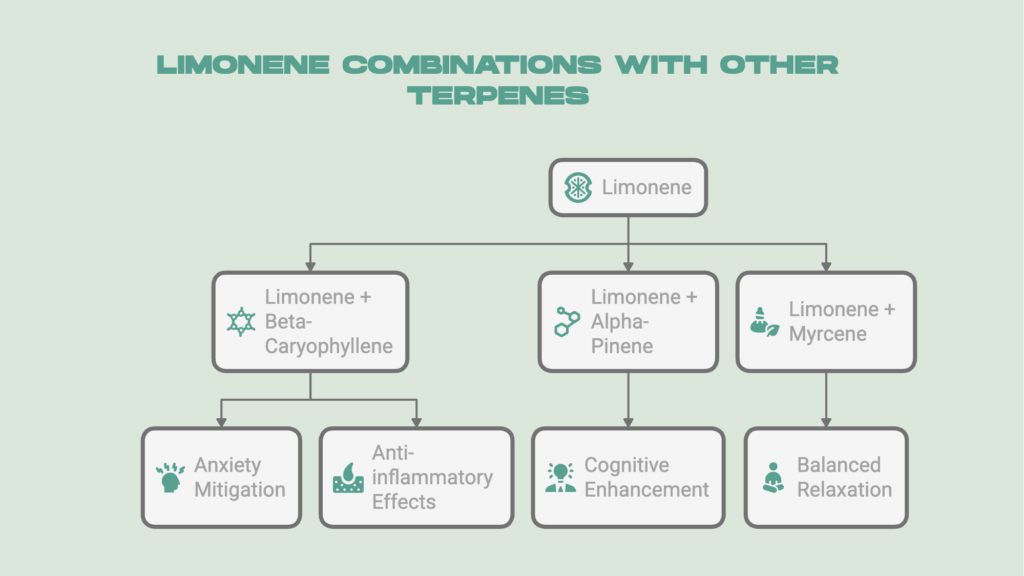
Limonene + Beta-Caryophyllene
The combination of limonene’s adenosine A2A receptor activation with caryophyllene’s CB2 receptor agonism creates complementary anxiety mitigation through parallel pathways.
Balanced formulations typically incorporate caryophyllene at 5-17% of total terpene content when limonene serves as the dominant terpene (30-50%). This ratio creates noticeable anxiety mitigation without heavy sedation, making it ideal for daytime vape products, concentrate formulations for therapeutic benefits without impairment, and beverage products designed for social settings.
The synergy has a range of effects from anxiety to anti-inflammatory: both terpenes demonstrate inflammation reduction through distinct mechanisms, creating additive benefits in topical applications targeting pain or skin conditions.
Limonene + Alpha-Pinene
Cognitive enhancement profiles emerge when limonene pairs with pinene in appropriate ratios. Pinene’s acetylcholinesterase inhibition preserves acetylcholine availability for memory and focus, while limonene provides mood elevation that prevents mental tension.
Concentration ranges of 2:1 to 3:1 limonene:pinene create balanced cognitive effects without overpowering pine aroma. For vape formulations, this translates to 30-40% limonene and 10-20% pinene within the total terpene fraction.
Limonene + Myrcene
Balancing limonene’s energizing properties with myrcene’s relaxing effects creates approachable profiles suitable for consumers seeking anxiety relief without heavy sedation.
The ratio matters significantly: myrcene-dominant profiles (40-50% myrcene, 20-30% limonene) lean toward traditional indica-style relaxation, while limonene-dominant blends (40-50% limonene, 15-25% myrcene) maintain brighter, uplifting character with gentler sedative undertones.
Product Recommendations for Limonene Infusion
Sourcing high-quality limonene profiles requires evaluating both molecular composition and practical formulation characteristics. If you’re in the market looking for a reliable limonene supplier, here are some potential product suggestions that will fit well in any product lineup:
2023 Fruit #130 presents limonene at 14.22% within a balanced profile featuring 9.13% caryophyllene, 7.79% ocimene, 5.32% pinene, and 4.69% myrcene. This multi-terpene expression creates complex fruit character with anxiety-mitigating synergy from the limonene-caryophyllene combination.
The relatively balanced distribution provides temperature stability in vape applications experiencing repeated heating cycles, making it ideal for formulators developing therapeutic products without heavy sedation.
Looking for something more gassy? The 2023 Gas #10 demonstrates how limonene integrates with dank, pungent profiles rather than existing only in bright citrus contexts.
This fuel-citrus hybrid performs exceptionally well in concentrate applications where bold flavors remain distinct even at high temperatures, making it valuable for dabbable products that maintain character across multiple consumption methods.
If your product line could use a bit of a pungent touch, the 2023 Sour #93 might be the right fit. This terpene profile delivers 20.64% limonene alongside 16.38% caryophyllene, creating pronounced citrus-forward profiles with spice undertones.
The 9.17% myrcene adds body while 5.9% humulene and 3.17% linalool contribute herbal complexity. High limonene percentage delivers impact even at conservative total terpene loads (6-8%), making it cost-effective where terpene addition significantly affects product economics.
Pine #37 offers limonene-caryophyllene synergy in nearly equal proportions, 17.17% limonene and 17.08% caryophyllene, creating balanced profiles where neither terpene dominates.
The 9.43% terpinolene and 7.12% humulene add piney, herbal dimensions. This composition works exceptionally well when formulators need anxiety mitigation properties without distinctly citrus-forward branding, allowing wellness positioning rather than flavor-focused marketing.
Ready to formulate your next limonene-enhanced product? Request samples of these profiles to evaluate sensory characteristics and stability parameters, or contact our technical team for guidance on profile selection based on your formulation objectives.
Why Partner With Terpene Belt Farms For Your Limonene Supply
Formulation success depends on consistent, high-quality terpene sources that deliver batch-to-batch reliability. Terpene Belt Farms specializes in cannabis-derived terpene profiles extracted from California-grown Cannabis Sativa L, providing formulators with the molecular complexity and authentic strain characteristics that botanical alternatives cannot replicate.
Our vertical integration from cultivation through extraction ensures quality control at every stage, while our Fresh Never Frozen methodology preserves volatile compounds that define premium terpene profiles.
Whether you’re developing anxiety-mitigating vape formulations requiring precise limonene-to-THC ratios, concentrate products with distinctive sensory profiles, or beverage applications demanding exceptional stability, our technical team provides formulation guidance backed by extensive COA documentation and batch consistency data.
We maintain production records demonstrating ±10% consistency across batches, with GC-MS analysis quantifying individual terpenes to support your quality control requirements.
Our limonene-rich profiles span fruit-forward, gas-hybrid, sour-citrus, and balanced compositions, allowing you to select the specific terpene matrix that aligns with your product positioning and target effects. Each profile includes detailed terpene percentages, application recommendations, and stability data to streamline your formulation development process.
Looking to integrate limonene in your product listing the right way? Shop our samples at Terpene Belt Farms today and see how the best in botanical terpenes can improve your products.
Frequently Asked Questions About Limonene in Cannabis Products
What Concentration of Limonene Works Best for Different Product Types?
Vape cartridges perform optimally at 5-12% total terpenes with limonene comprising 30-50% of that fraction (1.5-6% limonene by total product weight). Concentrates tolerate 8-15% total terpenes with similar limonene ratios. Beverages and edibles require lower absolute amounts (2-5mg per serving) due to sensory threshold limitations and stability concerns in water-based matrices.
How Long Does Limonene Remain Stable in Finished Products?
Under controlled conditions (amber glass, nitrogen headspace, cool storage), properly formulated products retain 85%+ limonene for 12 months. Stability degrades with heat exposure, oxygen contact, and acidic pH. Accelerated aging studies (40°C for 2 weeks) predict real-time stability at ambient conditions, helping formulators optimize preservation strategies before product launch.
Can Limonene Interact Negatively with High THC Concentrations?
Research demonstrates that limonene actually mitigates THC-induced anxiety at appropriate ratios (15mg limonene with 30mg THC showed significant anxiety reduction). However, insufficient limonene relative to THC content may not provide adequate mitigation. Formulation requires intentional ratio control rather than arbitrary terpene addition to achieve anxiety-reducing synergy.
Is Limonene Safe for Sensitive Populations Like Elderly Consumers or First-Time Users?
Limonene holds GRAS status for food applications and shows good safety profiles in human studies up to 2 grams daily oral exposure. However, sensitive populations benefit from conservative starting doses: 1-3mg for first-time edible users, 2.8V battery settings for vape consumption. Individual sensitivity varies, making gradual titration the appropriate recommendation for any new consumer demographic.
Sources Used for This Article
-
- Wikipedia: “Limonene” – en.wikipedia.org/wiki/Limonene
- EPA: “Limonene Summary” – archive.epa.gov/pesticides/reregistration/web/pdf/3083fact.pdf
- PubMed: “Limonene: A review of its therapeutic potentials and mechanisms of action” – pubmed.ncbi.nlm.nih.gov/33548867/
- ScienceDirect: “Anxiolytic-like activity of d-limonene and its structural analogue α-pinene in mice” – sciencedirect.com/science/article/abs/pii/S0944711313004790
- PMC: “Therapeutic Potential of Limonene: A Comprehensive Review of its Bioactive Properties, Mechanisms, and Applications” – pmc.ncbi.nlm.nih.gov/articles/PMC11031290/
- Spandidos Publications: “d-Limonene inhibits proliferation and induces apoptosis of gastric cancer cells via the HER2/PI3K/AKT signaling pathway” – spandidos-publications.com/10.3892/mmr.2017.6241
- PMC: “Limonene: A versatile terpene of Citrus fruits with multiple therapeutic properties” – pmc.ncbi.nlm.nih.gov/articles/PMC10968638/
- Microbiology Journal: “Journey of Limonene as an Antimicrobial Agent” – microbiologyjournal.org/journey-of-limonene-as-an-antimicrobial-agent/