There are a lot of surface-level answers to terpene questions floating around online. Most stop at “myrcene is relaxing” and “limonene smells like citrus.” That’s fine for a consumer audience, but it leaves out everything that actually matters when you’re making sourcing and formulation decisions at scale. The 10 questions below are the ones that come up most in terpene conversations, answered with the precision those conversations deserve.
What Are Cannabis Terpenes and What Do They Do?
1. What Are Cannabis Terpenes?
Cannabis terpenes are volatile aromatic compounds biosynthesized in the trichomes of the cannabis plant. They determine the smell and flavor of every strain, but their function goes further than sensory character. Terpenes interact with cannabinoids and receptors in the endocannabinoid system in ways that shape how a product’s effect profile actually behaves.
There are over 200 identified terpenes in cannabis, though most cultivars are dominated by a handful of primary compounds. Myrcene, limonene, caryophyllene, terpinolene, pinene, and ocimene are the most common. The specific ratio of these compounds defines a product’s terpene profile, and that profile determines both aroma character and functional direction.
2. What Is the Entourage Effect?
The entourage effect describes the synergistic relationship between terpenes and cannabinoids, where the combination produces effects that neither achieves alone. Research published in Frontiers in Neuroscience describes it as the positive contribution derived from adding terpenes to cannabinoids, meaning the combined effect is greater than the sum of its parts.
It’s worth being honest about the science here. Some studies show clear synergies, others find limited direct receptor-level interaction between isolated terpenes and CB1 or CB2. What’s consistently observable in practice is that terpene profile changes the character of a product’s effect, even at identical cannabinoid concentrations. A myrcene-heavy profile behaves differently from a terpinolene-dominant one, which is something any experienced formulator has seen firsthand.
3. Do Terpenes Get You High?
No. Terpenes are not psychoactive and do not produce intoxication on their own. What they do is influence the quality and character of the experience that psychoactive cannabinoids like THC create. A product with dominant myrcene will feel different than one built around limonene, even at identical THC percentages, not because the terpene is intoxicating, but because it modifies how the cannabinoid experience unfolds.
4. What Temperature Do Terpenes Evaporate?
This is where product quality gets quietly degraded in a lot of operations. Every terpene has a boiling point at which it begins to evaporate, and heat during processing, filling, or curing will strip volatile compounds before the product ever reaches a consumer.
- Ocimene: ~50°C / 122°F — lost during almost any heat exposure
- Myrcene: ~168°C / 334°F — vulnerable during distillation and hot filling
- Caryophyllene: ~130°C / 266°F — more stable than most monoterpenes
- Limonene: ~176°C / 349°F — relatively stable, common in concentrate formulations
- Linalool: ~198°C / 388°F — among the most heat-stable terpenes in common use
If finished products are coming out flat or one-dimensional despite terpene reintroduction, heat loss during processing is usually the reason. For pre-roll applications specifically, low-temperature infusion is the standard for preserving the monoterpene fraction — for more details, check out our R&D guide on pre-roll formulation.
5. Are Cannabis Terpenes Water Soluble?
Standard terpenes are hydrophobic. They dissolve readily in fats, oils, and alcohol-based carriers, but they repel water. This creates a real formulation constraint for anyone developing beverages, tinctures, or water-based topicals. The practical solution is emulsification, which encapsulates terpene molecules into a water-dispersible form using nano-emulsion technology or food-grade emulsifiers.
That said, water-soluble terpene formulations do exist and are purpose-built for exactly these applications. Our water-soluble terpenes are designed to integrate cleanly into aqueous formats without phase separation, making them a direct solution for beverage developers and topical formulators who need terpene integration without the emulsification engineering overhead.
6. How Do You Increase Terpene Levels in Cannabis Products?
There are two main routes: improving what comes off the plant or reintroducing terpenes post-processing. Both are valid, and most operations use them in combination.
On the cultivation side, terpene expression is influenced by genetics, light intensity, temperature stress during flowering, and harvest timing. Plants harvested at peak trichome development consistently test higher in terpenes than those taken too early or too late. Slow drying and low-humidity curing preserves the volatile compounds that quick drying destroys.
For concentrates and distillates, terpenes are almost always stripped during extraction and added back deliberately. The standard reintroduction range is 5–15% by weight depending on application and hardware.
7. What Terpenes Are Good for Pain?
Several terpenes have documented anti-inflammatory and analgesic properties relevant to wellness product development. Caryophyllene is the most studied — it’s the only terpene known to act as a functional agonist at the CB2 receptor, and research published in European Neuropsychopharmacology has demonstrated its analgesic effects in models of inflammatory and neuropathic pain. Myrcene has been studied for muscle-relaxant and sedative properties that contribute to pain management, particularly in musculoskeletal applications. Linalool has shown analgesic activity through its interaction with glutamate pathways, making it a common anchor in topicals and wellness formulations targeting localized discomfort.
Products formulated for pain relief typically build around caryophyllene and layer in supporting terpenes that reinforce the effect through complementary mechanisms. Choosing a profile with documented concentrations rather than a generic blend gives formulators meaningful control over the final effect character.
8. What Terpenes Are Good for Anxiety?
Anxiety-targeted formulations are one of the fastest-growing segments in wellness and hemp, and terpene selection plays a direct role in how these products perform. Linalool is the most studied terpene for anxiolytic effects. A 2018 study published in Frontiers in Behavioral Neuroscience found that linalool odor produced significant anxiolytic effects through GABAergic transmission, without motor impairment. Limonene has been studied for mood-elevating and stress-reducing properties. Terpinolene contributes a calming character at higher concentrations and pairs well with linalool in anxiety-focused profiles.
9. What Terpenes Are Good for Sleep?
Sleep formulations rely on terpenes that promote sedation and reduce cognitive arousal. Myrcene is the most consistently sedative terpene in cannabis. Profiles with myrcene above 20% of the terpene fraction tend toward heavy, relaxing effect characters. Linalool adds anxiolytic quality that addresses the mental side of sleep onset. Terpinolene shows sedative properties in research despite appearing in some uplifting profiles, and at the right concentration it reinforces the sleep-oriented effect direction.
10. Are Terpenes Bad for You?
At the concentrations used in commercial formulations, terpenes are generally recognized as safe. Many carry GRAS status from the FDA as food flavoring agents and have a long history of use in food, cosmetics, and aromatherapy. That said, concentration and delivery method both affect the risk profile.
High-concentration terpenes above 15% in inhalable products can cause irritation and adverse sensory responses in some users. Research on long-term inhalation effects at elevated concentrations is still developing, which is reason enough to stay within validated dosage ranges and run hardware compatibility testing before going to production. In oral and topical applications, the risk profile is considerably lower. The more practical concern in those formats is stability and degradation over time. What makes the most meaningful difference in every format is sourcing from suppliers who provide batch-tested certificates of analysis with full solvent and pesticide residue data. The article on the true cost of cheap terpenes covers what’s actually at stake when sourcing decisions are made on price alone.
Why Terpene Belt Farms Is the Right Sourcing Partner
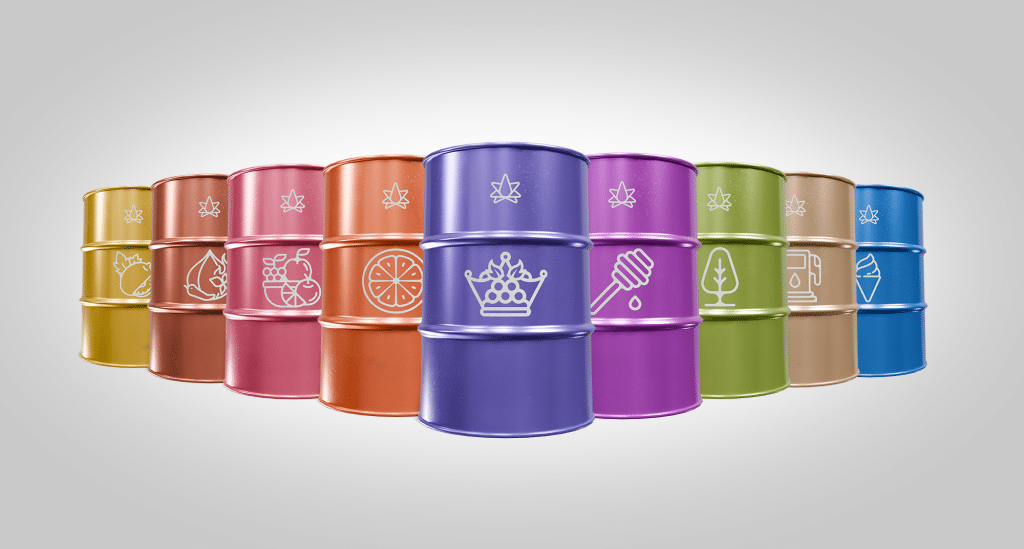
Terpene Belt Farms produces 100% cannabis-derived terpenes extracted from Cannabis Sativa L grown in California, with full traceability from cultivation through extraction. Every batch ships with a certificate of analysis documenting terpene percentages, residual solvents, and pesticide screening — the documentation that procurement teams and QA workflows actually require. The catalog spans profiles from high-myrcene Gas and Sweet expressions to complex Fruit and Dessert profiles built on limonene and ocimene, all available Fresh Never Frozen without the freeze-thaw cycles that alter volatile compound integrity.
For brands that need custom terpene profiles built around specific product objectives, the team works directly with formulation leads to develop them. For manufacturers that need consistent bulk supply with scalable lead times, the wholesale program is built for exactly that.
If you’re at the R&D stage, the right move is to request samples and test against your specific formulation before making a sourcing commitment.
Sources Used for This Article
- PubMed: “The phytocannabinoid Δ9-tetrahydrocannabivarin can decrease body weight and increase energy expenditure in mice” – pubmed.ncbi.nlm.nih.gov/31481004/
- PubMed: “Δ9-Tetrahydrocannabivarin (THCV): a review of its chemistry, pharmacology, and potential therapeutic applications” – pubmed.ncbi.nlm.nih.gov/24210682/
- PubMed: “The therapeutic potential of cannabis and cannabinoids” – pubmed.ncbi.nlm.nih.gov/30405369/