Quick Answer: Blue Dream’s terpene profile is anchored by three primary compounds: myrcene, alpha-pinene, and beta-caryophyllene. Limonene appears as a meaningful supporting terpene, and minor contributors like humulene and linalool surface in certain phenotypes. Total terpene content in quality flower typically falls between 1.5–2.5%. The ratio between these compounds, not just their individual presence, determines whether a formulation actually reads as Blue Dream or collapses into a generic fruit-pine blend.
Key Takeaways
- Blue Dream’s terpene profile is anchored by three primary compounds: myrcene, α-pinene, and β-caryophyllene, with limonene and smaller amounts of linalool or humulene appearing as supporting terpenes depending on phenotype.
- In high-quality flower, typical concentration ranges are myrcene 0.5–0.8%, α-pinene 0.2–0.4%, β-caryophyllene 0.2–0.4%, and limonene 0.1–0.2%, producing the recognizable berry-pine character associated with the strain.
- Total terpene content generally falls between 1.5–2.5%, and the ratio between terpenes, not just their presence, determines whether a formulation authentically reproduces the Blue Dream profile.
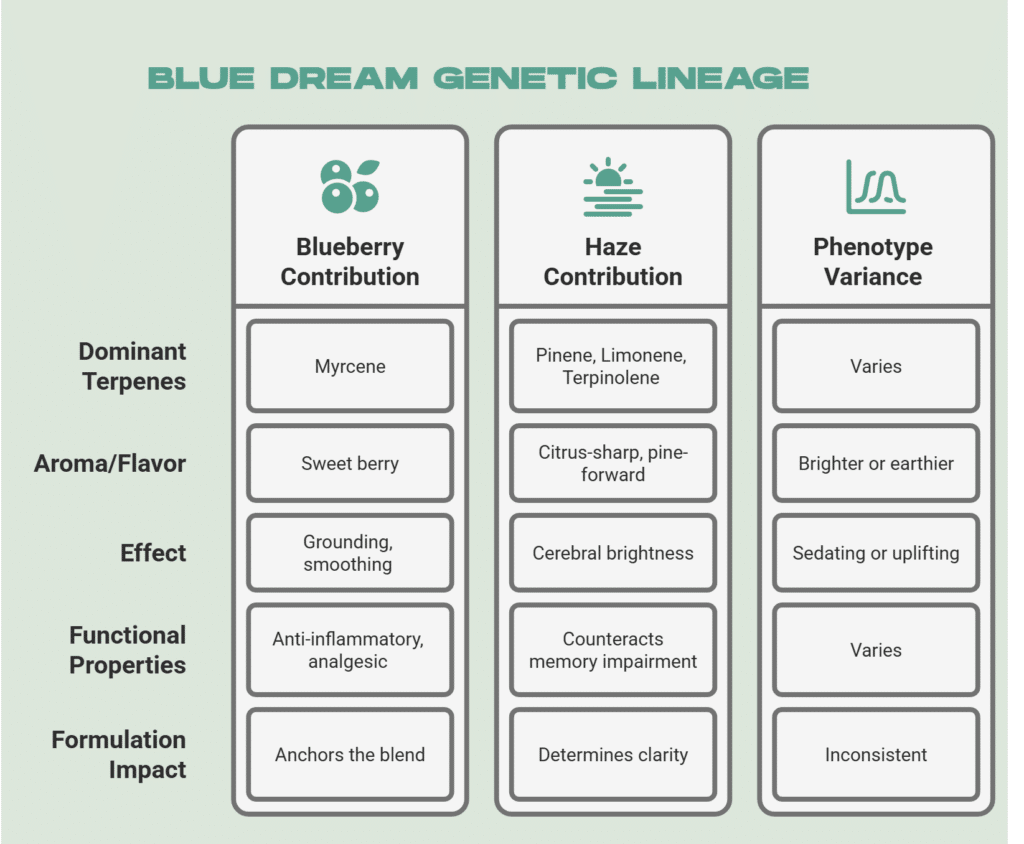
- The profile reflects the strain’s genetics: Blueberry contributes myrcene-heavy sweetness, while Haze genetics introduce pinene and limonene, which create the strain’s clear-headed, uplifting character.
- Myrcene acts as the structural base, anchoring sweetness and body; α-pinene provides cognitive brightness and clarity but is highly heat-sensitive; β-caryophyllene adds peppery depth and remains thermally stable during vaping or extraction.
- Terpene Belt Farms provides Fresh Never Frozen cannabis-derived terpene profiles with batch-level COAs, allowing formulators to replicate Blue Dream-style ratios consistently across vape, concentrate, and infused product formats. Shop our sample kits today.
Blue Dream has been one of the most searched cannabis strains for over a decade, yet most products that carry the name deliver wildly inconsistent experiences. A cart from one brand tastes like fresh blueberries with a bright, clear finish. Another reads as flat and earthy with nothing to distinguish it. Both claim Blue Dream. Neither company changed their label.
The issue is almost never the cannabinoid content. It’s the terpenes, specifically, whether the right compounds are present at the right concentrations, in the right ratios, and whether they survived the production process intact. Formulators who understand how this profile is built, and why it’s so prone to inconsistency, are in a fundamentally better position to replicate it reliably across formats.
This article breaks down the specific compounds that define Blue Dream’s terpene profile, the genetic architecture behind those ratios, and what they mean in practice when you’re working with vape hardware, concentrates, or infused flower.
The Terpene Profile of Blue Dream
Ask most people what’s in Blue Dream, and they’ll give you three names: myrcene, pinene, caryophyllene.
That’s accurate as far as it goes, but it doesn’t tell you much about concentration ranges, the role limonene plays at lower levels, or why total terpene percentage matters as much as the individual compounds.
The more useful question for formulators is what a well-expressed Blue Dream actually looks like on a COA and how much it can shift between batches even when the strain name stays the same.
The Core Terpenes and Their Typical Ranges
In quality Blue Dream flower, myrcene is consistently the dominant terpene, typically falling between 0.5–0.8% by weight in well-grown samples. It’s the earthy, musky, slightly sweet base note that most people associate with the strain’s blueberry character.
Alpha-pinene usually appears second in the profile at 0.2–0.4%, contributing to the crisp, piney brightness that keeps the strain from feeling heavy or sedating. Beta-caryophyllene rounds out the core three at 0.2–0.4%, adding peppery warmth and structural depth.
Limonene sits below these in most phenotypes, typically at 0.1–0.2%, but its contribution to the profile’s citrus brightness and perceived uplift is disproportionate to that percentage.
Minor contributors like linalool and humulene appear in batch-dependent amounts. Linalool adds floral softness in some cuts, while humulene brings woody, herbal depth in others.
- Myrcene (0.5–0.8%): Earthy, sweet, and fruity base note; the structural anchor of the entire profile
- Alpha-Pinene (0.2–0.4%): Crisp pine brightness that drives cognitive clarity; volatile under heat and the first to degrade in production
- Beta-Caryophyllene (0.2–0.4%): Peppery, woody spice; the most thermally stable compound in the stack and the only terpene here with direct CB2 receptor activity
- Limonene (0.1–0.2%): Bright citrus top note; contributes antioxidant protection that helps shield other terpenes from oxidative degradation
- Humulene/Linalool (Trace–0.1%): Woody or floral depth depending on phenotype; batch-dependent contributors to overall complexity
Why Total Terpene Percentage Matters
Total terpene content in premium Blue Dream flower typically ranges from 1.5–2.5%. This number carries real formulation implications. When you’re working with distillate that has been stripped of its native terpenes, or a concentrate with minimal residual terpenes, the percentage of terpene add-back required to hit sensory thresholds scales with what was lost.
A well-preserved CDT input with high total terpene content needs less supplementation to reach a recognizable Blue Dream character. A poorly preserved or low-terpene input requires heavier blending, and at that point, you’re building a profile from scratch rather than restoring one.
How Blue Dream’s Genetic Lineage Shapes Its Terpene Character
Most articles treat Blue Dream’s terpene profile as a fixed fact. It isn’t. The specific balance between myrcene’s heaviness and pinene’s clarity isn’t arbitrary. It’s a direct expression of two genetically distinct parent plants, and the ratio between those influences can shift dramatically depending on which phenotype was selected and how it was grown.
This is why two products with identical Blue Dream labels can smell and perform completely differently. The genetics create a range of possible expressions, not a single locked-in profile.
Blueberry’s Contribution: Myrcene Dominance
Blue Dream’s Blueberry parent, an indica-leaning strain developed by DJ Short, is the primary source of the profile’s myrcene-heavy, sweet berry character. Blueberry genetics typically produce myrcene concentrations around 16–17% of total terpene content.
In a formulation context, myrcene is the foundation compound that anchors everything else. It provides depth, body, and what formulators sometimes describe as a smoothing function. It prevents brighter top notes from feeling thin or sharp by grounding the blend in an earthy, fruity base.
Research published in Frontiers in Nutrition documents myrcene’s anti-inflammatory and analgesic properties through cannabinoid receptor mechanisms, with its effects enhanced in the presence of other terpenes through synergistic interaction.
That functional dimension is part of why myrcene-dominant profiles behave differently in consumer testing than botanical recreations that approximate the aroma but lack the full compound matrix.
Haze’s Contribution: Pinene, Limonene, and Cerebral Brightness
The Santa Cruz Haze parent brings the contrasting half of Blue Dream’s character: terpinolene, pinene, and limonene drive a cerebral, citrus-sharp, pine-forward quality that prevents the strain from reading as a pure indica despite myrcene’s dominance.
Pinene’s presence specifically is what gives Blue Dream its reputation as a daytime strain. A 2022 study in PMC examining terpene-cannabinoid interactions highlights how compounds like pinene counteract memory impairment associated with high-THC exposure, supporting alertness and working memory through complementary mechanisms.
In a formulation, pinene is the terpene that determines whether a Blue Dream product feels clear-headed or foggy. Get it right, and the profile reads as uplifting. Under-source it or lose it to heat, and you’re left with a myrcene-heavy blend that leans toward couch-lock.
Phenotype Variance: Why Two “Blue Dream” Products Can Smell Completely Different
Even within a single strain, terpene profiles can vary by 30–50% between batches depending on phenotype selection, cultivation environment, and harvest timing.
Early-harvested Blue Dream preserves more of the lighter monoterpenes, pinene and limonene, producing a brighter, crisper profile. Late harvest allows more monoterpene degradation and oxidation, shifting the profile toward the heavier sesquiterpene end. Caryophyllene becomes proportionally more dominant as pinene evaporates, and the result is a blend that reads as earthier and more sedating than the same strain harvested two weeks earlier.
Growing conditions further compound this. Light spectrum, temperature stress, soil composition, and nutrient availability all influence which terpenes a plant synthesizes at what concentrations.
Genetics only sets the range of possible expression. The environment determines where in that range a specific batch lands. For formulators, this is why strain-name sourcing alone is insufficient for product consistency. COA-verified terpene percentages at the batch level are the only reliable way to know what you’re actually working with.
What Each Terpene Actually Does in a Blue Dream Formulation
Knowing the terpene list is a starting point. The more operationally useful information is how each compound behaves once it’s in a finished product — how it degrades, how it interacts with other terpenes, and how it performs across different formats and temperatures. This is the section most articles on Blue Dream skip entirely, and it’s where the real formulation decisions get made.
Myrcene
Myrcene is the structural foundation of any Blue Dream formulation, but it’s also the most volatile compound in the stack. Its low boiling point makes it the first terpene to degrade under heat exposure, which is a meaningful problem in vape applications.
For long-term stability, blending myrcene alongside sesquiterpenes at a 2:1 ratio measurably reduces evaporation loss during storage. A 2022 preclinical study published in PMC also confirmed that myrcene reduced joint pain and inflammation in arthritic models via both CB1 and CB2 receptor mechanisms, underscoring that its role in CDT-forward formulations extends well beyond aroma.
Alpha-Pinene
Pinene is the terpene that makes Blue Dream a daytime profile. Without it, the myrcene dominance tilts the blend toward sedation, which is the very effect Blue Dream is known for avoiding.
Pinene is a monoterpene with a relatively low boiling point, making it more heat-sensitive than the sesquiterpenes in this profile. In vape cartridges operating at standard temperatures, significant pinene loss is common if hardware isn’t optimized for lighter compounds.
Ceramic coil systems generally outperform cotton wicks here, as they handle the full terpene spectrum more evenly without preferentially absorbing heavier fractions and leaving the volatiles to degrade.
Formulators building a Blue Dream-inspired vape product need to account for this upfront. The pinene percentage in the source profile should be high enough to survive the production and consumption process at the desired sensory threshold.
Beta-Caryophyllene: The Heat-Stable Anchor
Caryophyllene is the only terpene in this profile that binds cannabinoid receptors directly, functioning as a selective CB2 agonist at dietary concentrations. Its sesquiterpene structure, built from three isoprene units rather than the two that compose monoterpenes, gives it a 262°C boiling point, far above the temperatures reached in standard cartridge operation.
Where myrcene and pinene degrade during heating cycles, caryophyllene remains intact, making it the most reliable carrier of the profile through thermal stress in vape and concentrate applications.
For topical and transdermal formats, this stability translates into longer aromatic shelf life and more predictable functional delivery. Its larger molecular weight also supports the penetration of co-formulated actives in topical applications, a dual-function advantage that doesn’t require additional penetration enhancers.
Limonene and the Minor Terpenes: Supporting Notes That Define Brightness
Limonene’s citrus brightness in Blue Dream punches well above its percentage. Beyond the sensory contribution, limonene’s natural antioxidant properties protect other terpenes from oxidative degradation, which means a well-formulated Blue Dream profile that includes limonene at even low concentrations may hold its aromatic character longer on shelf than a formulation that omits it.
Linalool, when present, adds a soft floral note that rounds out the sweeter aspects of the profile without adding weight. Humulene contributes woody, herbal depth that sharpens overall complexity and adds a degree of natural grounding.
Neither is essential to a recognizable Blue Dream character, but both distinguish a complete profile from a simplified three-compound approximation. If you want to see how these minor terpenes factor into categorizing and selecting the right profiles for different applications, our piece on terpene classifications for product development is worth reviewing alongside this one.

TBF Profiles That Capture Blue Dream’s Terpene Architecture
Blue Dream’s terpene character sits in the sweet family: myrcene-dominant, with meaningful pinene expression and caryophyllene grounding. The profiles below were selected from the TBF catalog based on their terpene composition — specifically, how closely they match the structural balance that defines a well-expressed Blue Dream formulation.
2023 Sweet #16 is TBF’s most direct Blue Dream analog. The product page explicitly references Blue Dream, Dream Queen, and Double Dream as strain comparisons. At 23.84% myrcene, 20.05% pinene, and 12.12% limonene, it carries the strongest pinene expression in the sweet family. The red berry, tart cherry, and mild citrus tasting notes match the strain’s aromatic signature closely, making it the cleanest starting point for daytime-use vape and concentrate formulations.
2023 Sweet #161 leans into the Blueberry side of the genetics: 36.99% myrcene anchors a heavier, more relaxed base with floral and vanilla depth. At 7.38% alpha-pinene and 6.49% beta-caryophyllene, the monoterpene-to-sesquiterpene ratio makes it one of the more thermally stable options in the sweet family. It’s the right choice for evening-use or relaxation-oriented products that still need Blue Dream character without the sharp pinene brightness.
Sweet #710 balances all three core compounds evenly: 24.43% myrcene, 9.05% pinene, 8.93% caryophyllene, plus 9.44% ocimene for a herbal, sweet brightness that differentiates it from a strict Blue Dream recreation. For brands building their own Blue Dream-adjacent identity rather than replicating the strain directly, Sweet #710’s structural balance and commercial versatility make it a strong formulation foundation.
Why Terpene Belt Farms Is the Right Source for Blue Dream-Inspired Profiles
Blue Dream’s terpene character is among the most imitated profiles in the market and among the most poorly replicated. The challenge isn’t identifying the right compounds. It’s sourcing them in a form that preserves the volatile monoterpenes carrying the profile’s most distinctive qualities, and then working with inputs that come with the batch-level documentation needed to hold formula consistency over time.
Terpene Belt Farms produces exclusively from Cannabis Sativa L using the Fresh Never Frozen extraction methodology, which means the pinene and limonene fractions that define Blue Dream’s daytime character arrive at your facility intact, not approximated through botanical blending.
COA-verified percentages at the batch level give R&D teams a reliable starting point for formulation, and the ability to reorder to consistent terpene ratios across production runs supports the formula standardization that scaling brands require.
If you’re building a Blue Dream-inspired product line and need inputs that hold up across batches, we can help. Request samples from Terpene Belt Farms today.
Frequently Asked Questions About Blue Dream Terpenes
What Is the Dominant Terpene in Blue Dream?
Myrcene is the dominant terpene in Blue Dream, typically comprising the largest fraction of total terpene content at 0.5–0.8% by weight in quality flower. It’s responsible for the earthy, sweet, berry-adjacent base note most associated with the strain. Alpha-pinene follows as the second most prominent terpene, and beta-caryophyllene rounds out the core three. Together, these three compounds account for most of what makes Blue Dream recognizable across phenotypes.
Why Does Blue Dream Smell Different Depending on Where I Buy It?
Blue Dream’s terpene profile can vary by 30–50% between batches due to phenotype selection, growing environment, and harvest timing. The strain name covers a wide range of genetic expressions — some lean toward myrcene dominance and read as earthy and sweet, while others express more pinene and limonene, reading as bright and citrusy. Without COA-level terpene data at the batch level, the strain name alone tells you very little about the profile you’re actually purchasing.
How Much Myrcene Is Typically in Blue Dream?
In quality flower, myrcene typically falls between 0.5–0.8% by weight, representing the single largest terpene fraction in the profile. Total terpene content in well-grown Blue Dream flower sits between 1.5–2.5%, which means myrcene often accounts for roughly 30–40% of all terpenes present. Concentrations above 0.5% in flower are generally associated with more calming, body-focused effects alongside the strain’s characteristic mental clarity.
What Makes Blue Dream’s Terpene Profile Different from Other Sativa-Leaning Strains?
The distinguishing feature is the tension between myrcene’s weight and pinene’s clarity. Most sativa-leaning profiles are either pinene-forward or terpinolene-forward, producing bright, energetic character without much body. Blue Dream carries substantial myrcene from its Blueberry genetics alongside the Haze-derived pinene and limonene — that specific combination is what produces the profile’s balanced, daytime-versatile character rather than a purely stimulating one.
Does Blue Dream Have Any Caryophyllene?
Yes. Beta-caryophyllene appears at approximately 0.2–0.4% in quality Blue Dream flower, making it the third major terpene in the profile behind myrcene and pinene. It adds peppery, woody spice that balances the sweeter fruit notes, and its sesquiterpene structure makes it the most thermally stable compound in the blend. It is also the only terpene in this profile with documented CB2 receptor binding activity at dietary concentrations.
Sources Used for This Article
- Frontiers in Nutrition: “The Effects of Cannabinoids and Terpenes on Environmental Health: A Systematic Review of the Literature” – frontiersin.org/journals/nutrition/articles/10.3389/fnut.2021.699666/full
- PubMed Central (PMC): “Therapeutic Potential of Cannabis Terpenes” – pmc.ncbi.nlm.nih.gov/articles/PMC9319952/