Quick Answer: Terpene profiles in recreational cannabis products determine far more than aroma. They shape the functional character of the experience, how the product performs across formats like vape, concentrate, and edibles, and whether consumers come back for a second purchase. The right profile, selected and applied with format-specific strategy, is what separates a product that moves from one that sits.
Key Takeaways
- Terpene profiles shape both flavor and experience in recreational cannabis products, influencing aroma, perceived effects, and whether consumers return for repeat purchases.
- Terpene ratios matter more than a single dominant compound; secondary and tertiary terpenes significantly modify how the lead terpene tastes, smells, and performs in the final product.
- Monoterpenes and sesquiterpenes function as a two-layer system: monoterpenes provide bright, volatile top notes while sesquiterpenes deliver stability, depth, and thermal resilience.
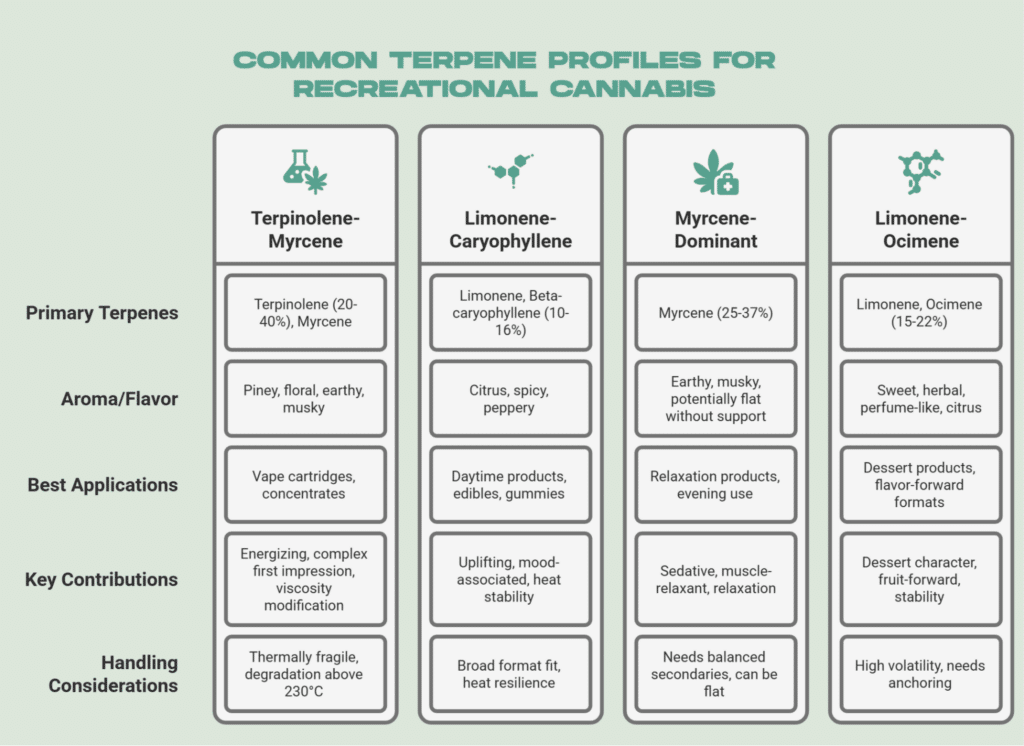
- Several profile archetypes dominate recreational formulation, including terpinolene–myrcene (gas/pine vapes), limonene–caryophyllene (citrus/daytime products), myrcene-led blends (evening relaxation), and limonene–ocimene (dessert-style flavors).
- Format-specific strategy is essential because vaporization, dabbing, and edible production expose terpenes to different heat and stability challenges that alter the final profile.
- Shop R&D samples from Terpene Belt Farms to evaluate cannabis-derived terpene profiles and build formulations that maintain flavor integrity across vape, concentrate, and edible products.
Most brands working on recreational cannabis products understand that terpenes matter. Where things break down is in the translation from that general awareness to actual formulation decisions. A profile that smells compelling when you uncap a bottle behaves completely differently once it goes into a distillate vape at 3.7 volts, gets baked into a gummy at 165°F, or gets dabbed at temperatures that would volatilize most of the top-note monoterpenes before the vapor even forms.
The result is a market full of products that launch with interesting profiles on the COA and deliver something flatter, harsher, or just inconsistent in practice. Formulators blame the terpenes. The terpenes were fine. The problem was the strategy applied to them.
This article covers how recreational terpene profiles actually work as systems, which profile archetypes fit which product types, and how to apply format-specific strategy so the profile you selected in the lab is still recognizable in the finished product.
What Makes a Recreational Cannabis Terpene Profile Work
Terpene profiles are not flavor lists. They are chemical systems where every compound affects how the others are perceived, how stable the blend stays under thermal or processing stress, and what functional character the final product carries. Before any format decision gets made, it helps to understand what a profile is actually doing as a unit.
Terpene Ratios Matter More Than Dominant Compounds
The most common mistake in recreational product development is treating the highest-percentage terpene on a COA as the profile’s identity. A terpene sitting at 28% is the structural lead, but it is not the whole story. Secondary terpenes at 8–12% and tertiary compounds at 3–5% actively modify how the dominant compound registers sensorially, and they are often the reason two profiles with similar lead terpenes taste nothing alike.
Ocimene is a clear example. It rarely leads a profile, but at 7–21%, it introduces a sweet, herbaceous lift that changes how a limonene or myrcene-dominant profile is perceived by the palate.
Profiles that carry it read as rounder and more complex than those that don’t, even when the lead compounds are nearly identical. That kind of modification is invisible on a high-level summary but completely apparent in a finished product.
This also explains why profiles built around a single dominant terpene tend to fall flat over time. Flavor fade in vape cartridges is often not a storage or hardware problem. It is a profile architecture problem. Single-lead profiles lose their character quickly because there is no layered complexity to sustain the experience once the top note dissipates.
Monoterpenes and Sesquiterpenes as a Two-Layer System
The two most practically useful categories for recreational formulators are monoterpenes and sesquiterpenes, and their structural difference resolves most common formulation problems before they happen.
Monoterpenes are ten-carbon compounds built from two isoprene units. They include limonene, terpinolene, alpha-pinene, beta-pinene, and ocimene. Because of their small molecular size, they vaporize readily, produce the bright top-note aromatics that define a product’s first impression, and are highly sensitive to heat, oxygen, and light. This volatility is what makes them powerful as flavor drivers and fragile as formulation inputs.
Sesquiterpenes are fifteen-carbon compounds built from three isoprene units. They include beta-caryophyllene, humulene, and myrcene (which, despite its earthy softness, is technically a sesquiterpene in behavior, with a boiling point and stability profile that resembles that class more than monoterpenes).
Their larger molecular weight means higher boiling points, lower volatility, and significantly better thermal stability. They are what carries a profile through heat exposure and gives it persistence rather than immediate flash.
The ratio between these two classes is the most consequential formulation variable across all recreational product formats. Research suggests that terpene biological activity also depends on total concentration in a given extract, meaning that getting the class balance right has implications beyond flavor alone.
| Class | Examples | Boiling Point Range | Best Format Fit | Primary Formulation Risk |
| Monoterpene (C10) | Limonene, Terpinolene, Pinene, Ocimene | 150–186°C | Vape, fresh concentrates | Degrades under heat; flash-volatilizes in high-temp formats |
| Sesquiterpene (C15) | Beta-caryophyllene, Humulene, Myrcene | 250–270°C | Concentrates, edibles, dabs | May require higher temps for full expression; slower initial impact |
Common Terpene Profile Types Used in Recreational Cannabis Products
Not every terpene combination serves every recreational product equally. These are the profile archetypes that appear most consistently in recreational formulations, along with what each one actually contributes and where it performs best.
1. Terpinolene-Myrcene Profiles for Gas and Pine Applications
Terpinolene leads this archetype with a monocyclic monoterpene structure that delivers piney, floral, and faintly herbal top notes. In profiles where it dominates at 20–40%, it creates a bright, complex first impression that is often associated with energizing, upward-leaning character. Myrcene sits behind it as the structural anchor, contributing earthy, musky depth that softens terpinolene’s sharpness and adds viscosity-modifying weight that matters in distillate applications.
This combination performs best in vape cartridges and concentrate formats where that initial terpinolene flash creates a strong first-hit impression. One important handling note: terpinolene is one of the more thermally fragile monoterpenes, with significant degradation occurring above 230°C.
Research on monoterpene behavior at vape coil temperatures found only 11–28% of parent terpinolene remained unchanged at higher temperature ranges, making integration temperature and hardware selection critical variables for this profile type.
Terpene Belt Farms’ 2023 Gas #152 is built on exactly this architecture: terpinolene at 28.13% and myrcene at 20.9%, with limonene at 8.66% rounding out the top layer. It is a monoterpene-forward profile with enough myrcene body to hold together through vape hardware and deliver consistent flavor from first draw to last.
2. Limonene-Caryophyllene Profiles for Daytime and Citrus-Forward Products
This pairing is the most versatile in recreational formulation because it balances two compounds that work in opposite directions and end up covering a lot of sensory and functional ground together.
Limonene is a volatile monoterpene that delivers sharp citrus character and registers quickly on first exposure. Research suggests it interacts with serotonin and dopamine pathways in ways relevant to uplifting and mood-associated recreational experiences.
Beta-caryophyllene is structurally different from every other terpene in this archetype class. It is the only dietary terpene that functions as a selective CB2 receptor agonist, meaning it has direct interaction with the endocannabinoid system beyond its aromatic contribution.
At 10–16%, it adds a spicy, peppery depth that anchors the limonene brightness without competing with it, and its sesquiterpene structure means it survives heat exposure that would erode the limonene portion of the profile.
Format fit here is broad. Vape formulations benefit from the high limonene content as an immediate flavor driver, with caryophyllene providing stability. Daytime-positioned edibles and gummies also benefit because caryophyllene’s thermal resilience means it survives baking or pasteurization temperatures where limonene would need protective handling.
2024 Fruit #6 is a clean example of this profile: limonene at 25.41%, beta-caryophyllene at 16.05%, and linalool at 4.42%, adding a floral softening note that keeps the profile from reading as one-dimensional citrus. It is built around Guava, Stardawg Guava, and Guava Gelato genetics, and the linalool contribution gives it a crossover appeal for both daytime vape SKUs and edible applications where a calming edge pairs well with the uplifting citrus base.
3. Myrcene-Dominant Profiles for Relaxation and Evening Positioning
Myrcene-dominant profiles are the backbone of evening and relaxation-positioned recreational products, and they are also the most commonly misused. When myrcene is present at 25–37% with no meaningful secondary structure, the profile reads as flat and one-note in a finished product. The earthy, musky character has real depth potential, but it needs support from secondaries that prevent it from collapsing into a generic cannabis smell without character.
Balanced secondaries do specific jobs here. Limonene at 10–12% lifts the profile’s ceiling and prevents heaviness from dominating. Caryophyllene at 6–10% adds spice and structural stability. Pinene at 5–6% contributes an alertness note that keeps the relaxation positioning from reading as sedation. Published research points to myrcene’s interaction with GABAergic neurotransmission as the mechanism behind its sedative and muscle-relaxant character, which is relevant context for brands trying to substantiate their evening product positioning.
Sweet #602 carries myrcene at 29.69% with limonene at 11.83%, caryophyllene at 6.68%, pinene at 5.78%, and ocimene at 4.91%. That secondary structure is what makes it usable across concentrates and edibles without going flat. The ocimene addition at under 5% adds a sweet, herbaceous top note that gives the profile’s first impression some lift before the myrcene body takes over.
4. Limonene-Ocimene Profiles for Dessert and Flavor-Forward Formats
Ocimene is one of the least discussed terpenes in recreational formulation despite being one of the most powerful flavor modifiers in the kit. It is a monoterpene with a very low boiling point, which makes it the first aromatic compound to express when a product is opened or heated. At 15–22% in a profile, it delivers a sweet, herbal, almost perfume-like sweetness that transforms how the dominant lead terpene reads.
Paired with limonene at similar concentrations, the result is a dessert-character profile that does not rely on artificial sweetness or botanical approximations. The limonene provides the citrus brightness; ocimene adds the sweet, rounded top note that makes the profile register as fruit-forward rather than sharp. Beta-caryophyllene at 10–12% in the base provides the sesquiterpene stability this combination needs, since both limonene and ocimene are high-volatility monoterpenes that need anchoring for heat-exposed applications.
2024 Dessert #116 runs limonene at 23.27%, ocimene at 21.78%, and beta-caryophyllene at 11.37%, with pinene at 6.64% and myrcene at 6.17% rounding out the profile. For flavor-forward vape SKUs or gummy formulations where a dessert-category product is the target, this profile covers the full sensory range, bright citrus entry, sweet herbal middle, and enough spice and earthy foundation to feel like a complete cannabis profile rather than a flavored oil.
Format-Specific Terpene Strategy for Recreational Products
Once a profile is selected, the format it goes into determines which terpene compounds will survive from production to consumption and how they should be dosed. The same profile applied without format-specific adjustment will perform well in one application and poorly in another. This is not a terpene quality problem. It is a strategy problem.
Vape Cartridges: Flavor Expression and Thermal Stability
Vaporization temperatures (typically 180–230°C) sit above the degradation thresholds of several key monoterpenes. Beta-myrcene begins meaningful degradation at approximately 168°C, and alpha-pinene above 155°C. A meaningful portion of a monoterpene-heavy profile is already breaking down before it reaches the consumer.
The professional target is 60–80% monoterpenes to 20–40% sesquiterpenes, with total terpene content at 5–12% depending on hardware and distillate base. Sesquiterpenes like beta-caryophyllene also act as emulsion stabilizers that prevent separation over time. Budget in 15–30% monoterpene loss at the filling stage for pinene and limonene-dominant profiles, and verify delivered concentration at final QC rather than assuming mixing-stage numbers hold.
If this is your first time working on vape cartridges, getting the numbers right can be tricky. Our R&D vape formulation guide contains tons of technical suggestions that could make or break your next line of vape products.
Concentrates: Sesquiterpene Ratios and Texture Dynamics
Dabbing temperatures can reach 400–600°F, which means monoterpene top notes flash off fast and sesquiterpenes carry the aromatic experience through the rest of the dab. Beta-caryophyllene’s boiling point of 262°C makes it one of the few terpenes that survives high-temp consumption with its character intact.
Terpene addition levels also directly affect concentrate texture. Shatter tolerates a maximum of 3% before terpenes begin plasticizing the structure. Wax and budder handle 3–5%, and distillate works well at 5–7% as a standard starting range. Live resin retains 60–80% of the plant’s original terpene content, while distillate retains only 10–30%, so add-back strategy for each format starts from a very different baseline.
Edibles and Gummies: Terpene Retention Across Processing
Edibles subject terpenes to three independent threats: heat during production, extended shelf life (typically 12–18 months at CPG scale), and fat matrix dispersion. A gummy processed at 165°F loses a significant portion of its monoterpene content before packaging, and that loss often goes undetected because sweeteners mask flavor changes while functional character quietly degrades.
The most reliable protection strategies are post-process addition, keeping terpenes out of any heat exposure step by adding them after active ingredients are incorporated at below 40°C, and lipid carrier systems, which improve dispersion stability without the complexity of full microencapsulation. Target concentration for recreational edibles is 3–8mg per serving.
| Format | Total Terpene Target | Preferred Terpene Class | Key Stability Risk | Notes |
| Vape cartridge | 5–12% | 60–80% monoterpene | Thermal degradation during vaporization | Account for 15–30% fill-stage loss |
| Shatter | Max 3% | Sesquiterpene-led | Texture plasticization above 3% | Higher ratios convert to pull-and-snap |
| Wax/Budder | 3–5% | Balanced | Lipid-driven oxidation over time | Lipid content provides natural solubility |
| Distillate (concentrate) | 5–7% | Balanced, sesquiterpene anchor | Viscosity mismatch, separation | Mix at 45–50°C for homogeneous integration |
| Edibles/Gummies | 3–8mg/serving | Sesquiterpene-led or encapsulated monoterpenes | Heat loss during production | Add post-process below 40°C |
Why Terpene Belt Farms Supports Recreational Product Development
The gap between a strong terpene profile on a COA and a strong product on a retail shelf is a formulation execution problem, and it is one that the right sourcing partner narrows considerably. Terpene Belt Farms operates from the ground up as a CDT supplier built for formulators who need verified profiles, consistent supply, and the trace compound complexity that only authentic cannabis plant extraction delivers.
The Fresh Never Frozen approach is the foundation of that consistency. By processing harvested material within minutes rather than days, TBF preserves the volatile minor compounds that curing and drying would otherwise reduce. California-grown source material cultivated in the San Joaquin Valley’s Rincon Clay Loam soil at sea level contributes terroir-specific terpene expression that cannot be replicated by blending isolates sourced elsewhere.
Every batch ships with ISO/IEC 17025-accredited COA documentation, giving procurement and R&D teams the verification they need to build consistent formulations without guessing.
If your recreational product line needs a terpene supplier that can hold its end of the consistency equation, we can help. Request samples for R&D and run the comparison yourself.
Frequently Asked Questions About Terpene Profiles in Recreational Products
How Much Terpene Should I Add to a Recreational Vape Cartridge?
The standard range is 5–12% total terpene content by weight, depending on hardware type and the viscosity of the cannabinoid base. Softer hardware with ceramic coils tends to handle higher concentrations better than wick-based systems. Start at 5–7%, test for flavor, vapor quality, and hardware compatibility, and adjust in 0.5% increments. Profiles heavy in monoterpenes like terpinolene require more conservative loading due to higher volatility.
What Is the Difference Between Monoterpenes and Sesquiterpenes in Cannabis Products?
Monoterpenes (C10) are smaller, more volatile compounds that produce bright, immediate aromatic impact but degrade quickly under heat. Sesquiterpenes (C15) are heavier, more thermally stable, and provide lasting aromatic depth and structural integrity in formulations. In recreational product development, monoterpenes drive the first impression and sesquiterpenes hold the profile together across heat exposure, shelf life, and processing.
Do Terpene Profiles Affect the High, or Just the Flavor?
Both, though the functional effects are profile and dosage-dependent. Terpenes like beta-caryophyllene interact directly with CB2 receptors. Others like myrcene and linalool have documented effects on GABAergic neurotransmission relevant to sedation and muscle relaxation. The entourage model, supported by published research, proposes that terpene-cannabinoid interaction modifies the overall effect of a product beyond what either compound class produces in isolation.
Why Do Terpene Profiles Change Between Batches of the Same Strain?
Terpene expression in cannabis is a function of genetics, growing environment, harvest timing, drying and curing methods, and extraction approach. The same cultivar grown in different conditions, harvested at different maturity stages, or processed with different post-harvest protocols can show terpene concentration variations of 200–400% between batches. This is why COA verification at the terpene level matters, and why single-varietal CDT profiles with documented batch data provide more reliable formulation inputs than strain-named blends.
Sources Used for This Article
- PubMed: “The Cannabis Terpenes” – pmc.ncbi.nlm.nih.gov/articles/PMC7763918/