Quick Answer: Hemp terpenes are aromatic compounds extracted from Cannabis sativa L. plants that contain less than 0.3% Delta-9 THC. Chemically, they are identical to the terpenes found in high-THC cannabis. The “hemp” designation is a legal classification, not a botanical one.
For product formulators, this matters because hemp-derived terpenes carry the same complex profile depth as cannabis-derived terpenes but can be shipped across state lines under the 2018 Farm Bill, making them the only CDT option that works at a national supply chain level.
Key Takeaways
- Hemp terpenes are aromatic compounds extracted from Cannabis sativa L. plants with less than 0.3% Delta-9 THC, and they are chemically identical to terpenes from high-THC cannabis.
- The key distinction is between hemp-derived and botanical terpenes: botanical blends may match major compounds, but they typically lack the full native minor-terpene and non-terpenoid volatile complexity.
- Extraction method strongly shapes quality; cold trap and fresh-frozen workflows preserve more volatile monoterpenes and live-plant character than standard heat-driven steam distillation.
- A strong hemp terpene certificate of analysis (COA) should show a broad terpene panel, cannabinoid testing on the extracted oil, accredited lab data, and residual solvent testing when solvents were used.
- Hemp-derived terpene oils are the only cannabis-derived terpene option that can support national supply chains, because compliant hemp products can move across state lines under federal hemp commerce rules.
- Shop samples from Terpene Belt Farms to test hemp-derived CDT profiles with full COA documentation, batch traceability, and multi-state formulation compatibility.
Most product developers working in cannabis know what terpenes are. They’ve read the glossary definitions, seen the effects lists, and gotten the pitch about the entourage effect. What they haven’t gotten is a clear answer to the more pressing operational question: what actually makes a hemp terpene oil worth buying, and how do you tell the good ones from the noise?
The hemp terpene category is full of products that look similar on the surface but diverge significantly in quality. Some suppliers lead with “cannabis-derived” marketing language while delivering botanical blends that were never extracted from a cannabis plant.
Others offer legitimate CDT profiles but use production methods that strip out the volatile compounds that give those profiles their value in the first place. For formulators trying to build consistent, differentiated products, the gap between a well-produced hemp terpene oil and a poorly made one is not theoretical. It shows up in the final product, batch after batch.
This article breaks down what hemp terpenes actually are at a chemistry level, how the extraction method shapes what ends up in the bottle, and how to evaluate what a COA is really telling you before you place an order.
What Are Hemp Terpenes?
The term “hemp terpenes” describes terpene oils extracted from Cannabis sativa L. plants that contain less than 0.3% Delta-9 THC by dry weight. That threshold is a legal definition established by the 2018 Farm Bill, not a botanical or chemical distinction.
The plant itself doesn’t “know” it’s hemp. It’s the same species, the same terpene biosynthesis pathway, and the same aromatic compound classes as high-THC cannabis.
Hemp Terpenes Vs. Cannabis Terpenes: Is There a Chemical Difference?
There is no chemical difference between a terpene molecule extracted from hemp and the same terpene molecule extracted from a THC-rich cannabis plant. Myrcene is myrcene. Beta-caryophyllene is beta-caryophyllene. The compound structure, boiling point, and sensory characteristics don’t change based on what the plant’s THC content happened to be at harvest.
What drives terpene expression is cultivar genetics and growing conditions, not the THC threshold. A high-terpinolene hemp cultivar grown in California’s San Joaquin Valley will produce a terpinolene-dominant oil because of its genetic expression and terroir, not because of anything related to its THC percentage.
This is an important distinction for formulators, because it means the quality ceiling for hemp terpene profiles is the same as for marijuana-derived CDTs. The difference shows up in sourcing and extraction, not in the plant’s legal classification.
Hemp Terpenes vs. Botanical Terpenes: Where the Real Difference Is
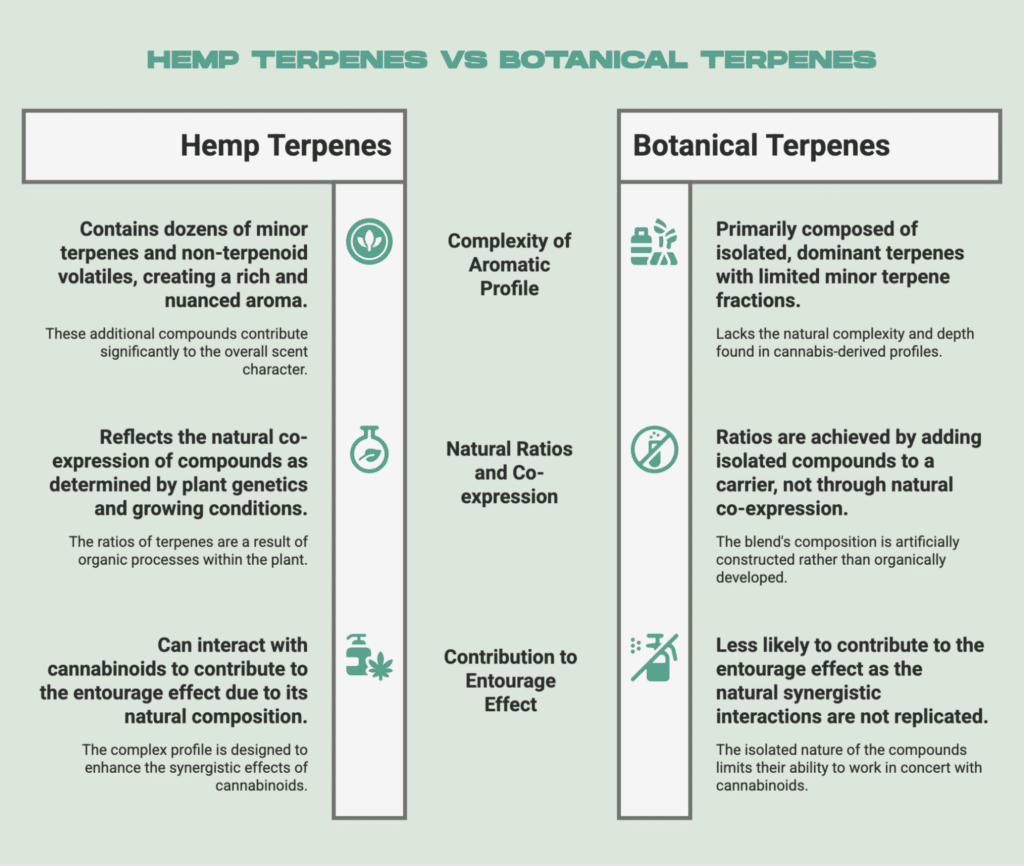
This is where the comparison that actually matters for formulators lives. Botanical terpenes are sourced from non-cannabis plants that naturally produce similar compounds: lavender for linalool, black pepper for caryophyllene, citrus peel for limonene. Individual molecules can be identical to what you’d find in cannabis, but the profile they create is not.
The gap comes from two things. First, the minor terpene fraction. A high-quality hemp terpene oil contains dozens of compounds beyond the top six that typically appear on a COA. They include minor terpenes like fenchol, borneol, guaiol, and bisabolol, and non-terpenoid volatiles like esters, aldehydes, and thiols that contribute significantly to aroma character.
These are the compounds you can smell when you crack open a fresh jar of cannabis. Botanical blends built from isolated compounds simply cannot replicate this complexity because the minor fraction exists as an organic signature of the plant it came from.
Second, the ratios matter as much as the compounds themselves. A profile showing 25% myrcene from a cannabis plant arrived at that percentage through a specific co-expression of dozens of other compounds in a natural system. A botanical blend showing 25% myrcene arrived there by adding isolated myrcene to a carrier.
The chemical formula is the same; the profile behavior, how it reads aromatically, how it interacts with cannabinoids in a finished product, is not. For brands building for the entourage effect or chasing true-to-plant experiences, the difference between botanical and cannabis-derived terpenes is not marketing language. It’s measurable.
Hemp Terpene Extraction Methods and Why the Process Matters
Two products can both be labeled “hemp-derived terpenes” and have dramatically different chemical profiles depending on how they were produced. Extraction method is where most of the quality variation in hemp terpene oils originates, and it’s often the thing that goes unexplained on supplier product pages.
The core challenge is that terpenes, especially the lighter monoterpene class, are volatile. They degrade under heat, evaporate quickly after harvest, and behave differently depending on when they’re collected and at what temperature. Knowing how a hemp terpene oil was made gives you a working hypothesis for what’s in it before you even open the COA.
Cold Trap Collection and Live Terpene Recovery
Cold trap collection is a terpene recovery method integrated into hydrocarbon or CO2 extraction workflows. As cannabis biomass is processed, volatile terpene-rich vapor passes through a collection system chilled to temperatures typically between -20°C and -40°C. At those temperatures, terpenes condense and are captured as a liquid fraction before they can escape or degrade.
The advantage of this method for profile integrity is significant. By collecting terpenes at low temperatures and early in the extraction process, cold trap systems capture the volatile monoterpenes, limonene, terpinolene, pinene, and myrcene, which are the first to evaporate off the plant and the first to degrade under heat.
When this method is applied to fresh-frozen biomass, the resulting product is often called “live terpenes,” a label that reflects both the fresh material used and the low-temperature processing. TBF’s internal benchmarks on cold trap extraction show up to 40-50% higher monoterpene recovery rates compared to steam distillation methods. This is the production method that produces the most complex, true-to-plant hemp terpene profiles.
Steam Distillation from Hemp Biomass
Steam distillation is the older, more widely used method for extracting terpenes from plant material. Steam is passed through dried cannabis biomass, carrying volatile compounds with it into a condenser where the vapor cools and separates into an oil-water mixture. The terpene fraction floats above the water layer and is collected.
Research published in PMC confirms that steam distillation preferentially captures hydrocarbon terpenes like myrcene and beta-caryophyllene, and that monoterpenes are extracted primarily in the earliest phase of the distillation, while sesquiterpenes emerge later as processing continues.
What this means in practice is that steam distillation tends to produce a profile that skews toward sesquiterpenes and the more heat-stable terpene compounds. The lighter monoterpene fractions, the compounds most responsible for top-note aromatics and profile brightness, are more vulnerable to thermal degradation during the process, which typically runs at temperatures of 100°C to 130°C over extended processing windows.
Reading Your COA After Extraction
A COA is the most direct window into what extraction method was likely used and how well the profile survived processing. The signal isn’t always labeled explicitly — it shows up in the terpene ratios themselves.
Key things to read for:
- Monoterpene-To-Sesquiterpene Ratio: A COA heavily weighted toward caryophyllene and humulene with low limonene, terpinolene, or pinene numbers often indicates heat damage or a steam distillation process that wasn’t optimized for monoterpene recovery. A well-preserved profile should show meaningful monoterpene percentages alongside the heavier sesquiterpene fraction.
- Compound Count: A COA listing only four or five terpenes by name, with the rest labeled as “other,” tells you very little about profile complexity. Quality suppliers report a broader compound panel through GC-MS analysis, which gives you a more complete picture of what you’re buying.
- Residual Solvent Panel: If extraction involved hydrocarbon solvents, a residual solvent test should appear on the COA. Its absence isn’t necessarily a red flag for steam-distilled products, but for cold-trap or BHO-adjacent extractions, it’s a non-negotiable data point.
- Cannabinoid Panel: Hemp-derived terpene oils should contain no detectable or trace-only cannabinoids. A COA without a cannabinoid panel leaves an open compliance question for multi-state distribution.
| Extraction Method | Terpene Classes Preserved | Solvent-Free | Profile Characteristics |
| Cold trap collection | Strong monoterpene recovery, full minor fraction | Yes (if CO2 or vacuum-based) | High aromatic complexity, live-plant character |
| Steam distillation | Sesquiterpene-dominant, monoterpene loss under heat | Yes | Cleaner output, profile skews heavier |
| Subcritical CO2 | Selective toward low-molecular-weight compounds, good monoterpene retention | Yes | Consistent, broad but not always full-spectrum |
| Hydrocarbon extraction | Wide spectrum capture when cold-run | No (solvent testing required) | Profile-accurate when run at cold temps, yield-efficient |
Hemp Terpenes and Interstate Commerce: The Regulatory Reality
From a chemistry standpoint, hemp terpenes and marijuana-derived CDTs are effectively the same material. At a supply chain level, they operate in entirely different legal realities, and that gap is significant for any brand building products across more than one state.
Why Marijuana-Derived CDTs Cannot Cross State Lines
Cannabis, including cannabis-derived terpenes extracted from plants that exceed the 0.3% Delta-9 THC threshold, remains a Schedule I controlled substance under federal law.
This classification doesn’t change based on state-level legalization. A brand operating in California that sources CDTs from a licensed marijuana processor cannot legally ship those terpenes to a manufacturing facility in Colorado, Arizona, Michigan, or any other state, regardless of whether cannabis is legal there. Federal jurisdiction applies to interstate commerce, and that overrides state-level permissions for controlled substances.
This creates a real constraint for multi-state operators and nationally distributed brands. Sourcing marijuana-derived CDTs locks you to in-state suppliers, which limits your options for volume, consistency, and pricing leverage, particularly in states where the licensed cannabis market is small or where CDT-specific extraction infrastructure is limited.
How the 2018 Farm Bill Applies to Hemp Terpene Supply
The 2018 Farm Bill removed hemp — defined as Cannabis sativa L. with no more than 0.3% Delta-9 THC by dry weight — from the definition of marijuana under the Controlled Substances Act. Section 10114 specifically prohibits states from blocking the transportation or shipment of legally produced hemp and hemp-derived products across state lines. This is the provision that makes hemp-derived terpene oils shippable from a California extraction facility to a manufacturing operation in any other state.
It’s worth flagging that the federal hemp framework has been significantly amended since 2018. On November 12, 2025, President Trump signed H.R. 5371 into law, which rewrites the federal definition of hemp effective November 12, 2026.
The new standard shifts from a Delta-9-only THC threshold to a total THC standard, inclusive of THCA and other THC isomers, and imposes a 0.4mg total THC per container cap on finished hemp-derived cannabinoid products. The legislation is primarily aimed at intoxicating hemp-derived products like Delta-8 edibles and THCA flower, not terpene oils.
A pure hemp terpene oil with no detectable cannabinoids falls outside the scope of “hemp-derived cannabinoid product” as the law defines it, and the interstate commerce framework for non-intoxicating hemp materials remains intact.
That said, this is a fast-moving area of law, and brands with any cannabinoid content in their formulations should be reviewing their compliance posture against the November 2026 deadline with qualified legal counsel.
What “Hemp-Derived” Requires on a COA
The hemp-derived label on a terpene oil carries specific compliance implications that should be validated through documentation, not taken at face value. At minimum, a compliant hemp terpene product should be backed by:
- A COA confirming the source plant tested below 0.3% total THC (inclusive of THCa under the updated federal standard) at harvest
- A cannabinoid panel on the extracted oil itself shows no detectable or trace-only cannabinoids
- A terpene composition breakdown from an ISO/IEC 17025 accredited laboratory
- Batch-level traceability that connects the oil to a specific harvest and extraction run
If a supplier can’t produce these documents on request, the “hemp-derived” claim can’t be independently verified. When it comes to multi-state distribution, these compliance gaps are worth taking seriously before you build a product around a particular source.

Recommended Hemp Terpene Profiles For Formulations
Once you know what to look for on a COA and how the extraction method shapes what’s in the bottle, the next step is matching profiles to your actual product format. The three profiles below represent different ends of the category spectrum: gas-forward, tropical fruit, and sweet, and each illustrates something specific about how profile structure translates into formulation utility.
Gas #152
For formulators working with gas-forward or fuel-forward product positioning, 2023 Gas #152 is a profile worth evaluating closely. At 28.13% terpinolene and 20.9% myrcene, it’s a high-monoterpene oil with a notable dual-dominant structure.
Terpinolene provides the bright, complex floral-piney top notes associated with Pink Diesel-type profiles, while the myrcene foundation anchors the aromatic depth without pushing the profile into a heavy or dull register. For vape and concentrate applications where you need a gas profile that doesn’t flatten after heat exposure, this oil’s monoterpene density is the differentiating factor.
Fruit #137
Tropical and fruit-forward categories tend to benefit from profiles that balance high limonene with a strong secondary compound rather than riding a single dominant terpene. 2024 Fruit #137 does this well with 24.82% limonene and 21.28% ocimene running nearly parallel in the profile, with 10.76% caryophyllene providing structure underneath.
The ocimene fraction is what gives this oil its pineapple-guava character. Ocimene’s sweet herbal notes and limonene’s citrus peel brightness create layered tropical complexity that reads as authentic fruit rather than candy.
For distillate add-back or vape applications where a tropical positioning needs to read as premium rather than artificial, this co-dominant structure is more useful than a simple limonene-dominant profile.
Sweet #164
In the sweet category, complexity across five named terpenes is often a proxy for production quality. Sweet #164 carries myrcene at 23%, pinene at 17.69%, limonene at 14.02%, caryophyllene at 9.02%, and ocimene at 6.13%.
What makes this profile interesting from a formulation standpoint is the pinene fraction sitting at nearly 18%. Pinene is one of the most heat-sensitive monoterpenes in cannabis, and its presence at that level on a COA is a direct indicator that extraction preserved the volatile top-note compounds rather than sacrificing them to processing heat.
For formulators building sweet products where they want brightness and lift alongside the myrcene base, the pinene-limonene combination here gives you that without pushing the profile into citrus or pine territory.
Why Terpene Belt Farms for Hemp Terpene Supply
Finding a hemp terpene supplier that actually delivers on what “cannabis-derived” implies is harder than it looks from the outside. Terpene Belt Farms is a vertically integrated hemp terpene producer based in Byron, California, operating under the 2018 Farm Bill.
Every oil in the catalog is extracted from Cannabis sativa L. grown on-site in San Joaquin Valley Rincon Clay Loam soil and processed using the Fresh Never Frozen® methodology, a cold-preservation approach designed specifically to protect the volatile monoterpene fraction that makes a hemp terpene profile meaningfully different from a botanical blend.
Every batch ships with full COA documentation, including terpene composition panels, cannabinoid testing confirming sub-threshold results, and batch-level traceability from harvest through extraction. For R&D teams evaluating CDT profiles for multi-state production, that documentation isn’t a bonus. It’s the baseline for building a compliant product with a replicable input.
Looking for terpene profiles for your next formulation? Terpene Belt Farms can help. Request samples through the R&D sample program to test profiles before committing to volume.

Frequently Asked Questions About Hemp Terpenes
Are Hemp Terpenes the Same as Cannabis Terpenes?
Chemically, yes. Hemp terpenes and cannabis terpenes are identical molecules produced by the same plant species through the same biosynthetic pathway. The “hemp” label reflects a legal classification based on Delta-9 THC content below 0.3%, not a difference in terpene chemistry. The same compound — myrcene, limonene, caryophyllene — behaves identically whether it was extracted from a hemp plant or a high-THC cannabis plant.
Do Hemp Terpenes Contain THC?
A properly extracted and tested hemp terpene oil should contain no detectable or trace-only cannabinoids, including THC. Terpenes and cannabinoids are distinct compound classes, and good extraction methods capture the terpene fraction without pulling cannabinoids into the final oil. Buyers should always request a cannabinoid panel on the terpene extract itself, not just documentation of the source plant’s THC level.
What Is the Difference Between Hemp Terpenes and Botanical Terpenes?
Hemp terpenes are extracted from Cannabis sativa L. plants and carry the full native terpene profile of that specific cultivar, including minor compounds and non-terpenoid volatiles that contribute to aromatic complexity. Botanical terpenes are sourced from non-cannabis plants — lavender, citrus, black pepper — and may contain identical individual molecules but cannot replicate the full minor compound fraction that makes a cannabis-derived profile distinct.
How Are Hemp Terpenes Extracted?
The most common methods are cold trap collection, steam distillation, and subcritical CO2 extraction. Cold trap collection captures volatile terpenes at low temperatures during hydrocarbon or CO2 extraction, preserving the monoterpene fraction most effectively. Steam distillation uses heat and water vapor and tends to favor sesquiterpenes while degrading lighter monoterpenes. The extraction method used by a supplier directly affects the profile complexity of the final oil.
Are Hemp Terpenes Legal to Ship Across State Lines?
Hemp-derived materials, including terpene oils extracted from compliant hemp, fall under interstate commerce provisions established by the 2018 Farm Bill. Section 10114 of that legislation prohibits states from blocking the transportation of legally produced hemp products across their borders. This makes hemp terpene oils shippable across state lines in a way that marijuana-derived CDTs — controlled substances under federal law — are not.
What Should I Look for on a Hemp Terpene COA?
Look for a full terpene compound panel from an ISO/IEC 17025 accredited lab, not just a top-four or top-five summary. A cannabinoid panel on the extracted oil is also critical for multi-state compliance. Residual solvent testing should appear if the extraction method involved solvents. Pay attention to the monoterpene-to-sesquiterpene ratio — profiles that show strong sesquiterpene dominance with low monoterpene counts may indicate heat damage during production.
Sources Used for This Article
- National Center for Biotechnology Information: “The ‘Entourage Effect’”: Terpenes Coupled with Cannabinoids for the Treatment of Mood Disorders and Anxiety Disorders” – pmc.ncbi.nlm.nih.gov/articles/PMC8230455/
- Arnold & Porter: “Major Changes to Federal Regulation of Hemp-Derived Products” – arnoldporter.com/en/perspectives/advisories/2025/12/major-changes-to-federal-regulation-of-hemp-derived-products
- DLA Piper: “New federal restrictions on hemp and hemp-derived products” – dlapiper.com/en-us/insights/publications/2025/11/new-federal-restrictions-on-hemp-and-hemp-derived-products