Quick Answer: Cannabis terpenes are volatile aromatic compounds produced naturally within the plant’s trichomes. They are responsible for the distinct smell and flavor of each strain, but their role goes well beyond sensory character. Terpenes interact with cannabinoids and receptors throughout the body, influence how a product feels in use, and vary significantly based on genetics, growing conditions, and how the material was processed. For formulators, they are one of the most consequential inputs in product development.
Key Takeaways
- Cannabis terpenes are volatile aromatic compounds produced in trichomes that shape strain aroma, flavor, functional character, and product performance.
- Terpenes are built from isoprene units; monoterpenes are lighter and more volatile, while sesquiterpenes are heavier, more stable, and better suited to heat exposure.
- Cannabis plants produce terpenes for survival functions including pest deterrence, UV protection, pathogen resistance, and pollinator attraction.
- Terpenes differ from cannabinoids because most do not bind CB1 or CB2 receptors directly, except caryophyllene, which has documented CB2 activity.
- Major cannabis terpenes include myrcene, limonene, caryophyllene, pinene, terpinolene, ocimene, and linalool, each with distinct formulation behavior and stability considerations.
- Reliable terpene sourcing depends on batch-specific COAs, compound-level testing, ISO/IEC 17025 lab methods, and verification beyond total terpene percentage.
- Shop samples from Terpene Belt Farms and see how Fresh Never Frozen® cannabis terpenes perform in real formulations, with full compound transparency, batch-specific COAs, and farm-level traceability.
If you have spent time sourcing terpenes for a cannabis or hemp product, you have probably encountered the same frustrating cycle. Supplier claims sound similar across the board. COAs vary wildly in what they actually report. And the information available online tends to land in one of two places: either a consumer-facing overview that does not get into the chemistry, or a dense research paper that is not written with product development in mind.
The result is that a lot of formulation decisions get made on incomplete information.
Terpenes get treated as interchangeable flavor additives when they are actually one of the more complex and consequential inputs in the stack. Getting this right requires understanding what terpenes actually are, why they behave differently across sources and formats, and what to look for when the claims do not match the data.
What Are Cannabis Terpenes?
Terpenes are found in thousands of plant species, but cannabis produces them in exceptional variety and concentration. They are the compounds behind every recognizable strain aroma, from the sharp citrus of a Lemon Haze to the earthy musk of a Kush.
More than that, they are biologically active molecules that interact with the body in ways the cannabis industry is still working to fully map.
Cannabis Terpene Chemistry, Simplified
Terpenes are volatile organic compounds built from repeating five-carbon isoprene units. The way those units combine determines the terpene’s classification: monoterpenes are made from two isoprene units (C10), sesquiterpenes from three (C15), and diterpenes from four (C20).
This structural difference matters in formulation because it affects volatility, boiling point, and how a terpene behaves at processing temperatures.
More than 200 terpenes have been identified in cannabis, though the different types of terpenes that show up in meaningful concentrations across most cultivars are a much smaller set. Monoterpenes like myrcene, limonene, and pinene tend to dominate by percentage and drive most of the top-note character in a finished product. Sesquiterpenes like caryophyllene and humulene are heavier, less volatile, and contribute to base-note depth.
All of these compounds are produced in the secretory cells of trichomes, the resin glands that coat the cannabis flower and, to a lesser extent, the leaves and stems. The same glands that produce cannabinoids also produce terpenes.
The two compound classes share a biosynthetic precursor but diverge early in the pathway. Cannabinoids go through the cannabinoid-specific pathway, terpenes through either the MEP or MVA route. That co-location in the trichome is part of why the relationship between terpenes and cannabinoids is closer than it would be if they were produced separately.
Why Cannabis Plants Produce Terpenes
Cannabis does not make terpenes for the benefit of the people who consume it. Terpene production is a survival mechanism, and the plant ramps it up when exposed to environmental pressure.
This is worth knowing as a formulator because it explains why cultivation conditions have such a strong effect on terpene output. This is also why two batches from the same genetics can produce profiles that differ meaningfully.
- Pest and Herbivore Deterrence: Many terpenes are irritants or repellents to insects and grazing animals. Strains grown under heavy pest pressure often test higher in certain defensive terpenes as a result.
- UV Radiation Protection: Terpenes in the trichome layer act as a sunscreen of sorts, absorbing and scattering UV light before it damages the plant’s reproductive material. Controlled UV exposure during flowering is one of the more reliable cultivation levers for pushing terpene concentration higher.
- Pathogen Resistance: Several terpenes, including caryophyllene and pinene, have documented antimicrobial and antifungal properties. The plant produces them in part to defend against fungal infection and bacterial attack.
- Pollinator Attraction: Some terpenes, particularly floral monoterpenes like linalool and ocimene, serve the opposite function. They attract beneficial insects that facilitate pollination rather than repelling threats.
Harvest timing sits alongside these ecological drivers as one of the most direct variables affecting final terpene composition. Terpene concentrations peak at different points in the flowering cycle depending on the cultivar, and cutting too early or too late shifts the profile in ways that are difficult to predict without COA data across multiple harvest windows.
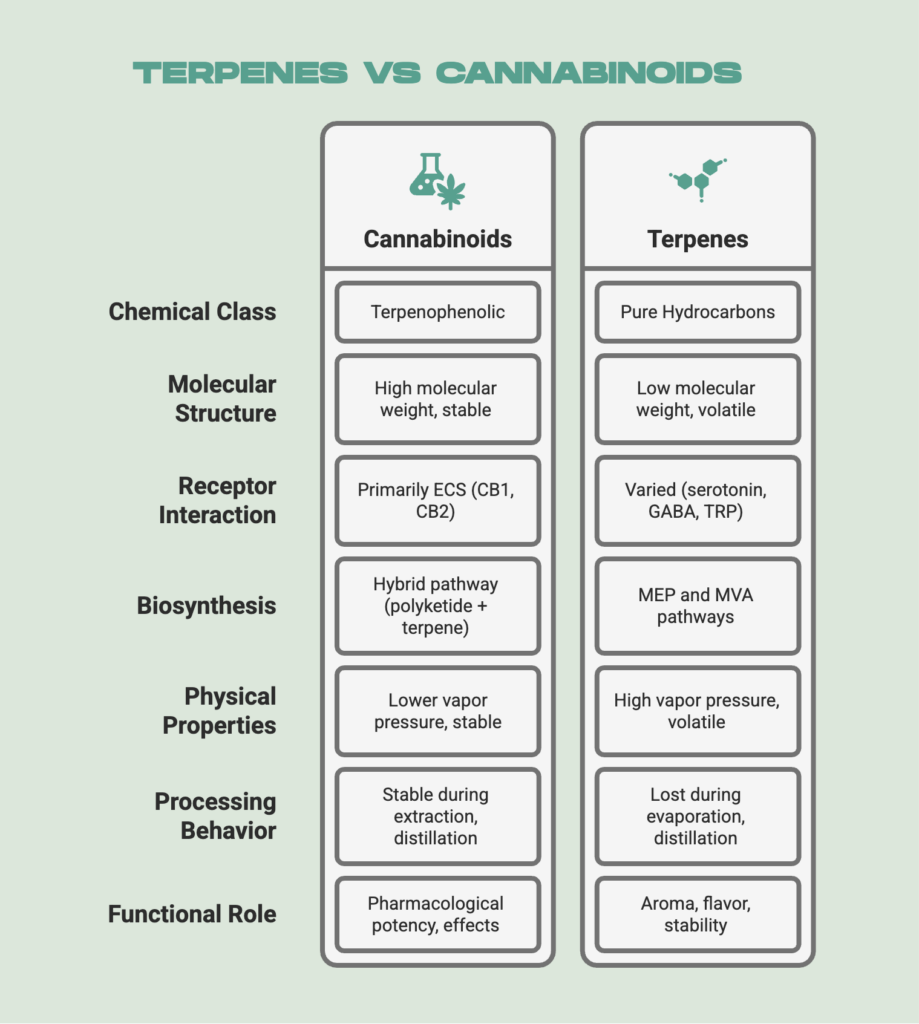
Cannabis Terpenes Vs. Cannabinoids: Key Differences
Terpenes and cannabinoids get grouped together constantly in product marketing, and while they do work in relationship with each other, they are chemically and functionally distinct in ways that matter for how you formulate.
The distinction between the two shows up at the receptor level, in the biosynthesis pathway, in how they behave during processing, and ultimately in how they should be treated as separate levers in product development.
- Receptor Activity: Cannabinoids like THC, CBD, and CBG bind directly to CB1 and CB2 receptors in the endocannabinoid system. Most terpenes do not bind these receptors at all. They work through other pathways, including serotonin receptor activity, GABA signaling, and ion channel interaction. Caryophyllene is the one documented exception, binding CB2 directly.
- Biosynthetic Origin: Both compound classes are produced in the trichome, but they follow separate biosynthetic routes. Cannabinoids develop through the cannabinoid-specific pathway; terpenes branch off through the MEP or MVA route. Co-location in the trichome is why they end up in the same extract, not because they share a production pathway.
- Thermal Stability: Cannabinoids are relatively stable at moderate processing temperatures. Most terpenes are volatile and begin degrading well before cannabinoids are affected. This is why distillation strips terpenes from the extract and why adding them back is a separate, temperature-sensitive process.
- Formulation Behavior: Adjusting terpene content fundamentally alters product character in ways that differ from adjusting cannabinoid ratios. The two levers are not interchangeable. Relying on cannabinoid data alone to predict how a finished product will perform leaves out a significant portion of what drives consumer experience.
Major Cannabis Terpenes and Their Formulation Properties
Over 200 terpenes have been identified in cannabis, but in most commercial cultivars, a core group of six to eight compounds accounts for the majority of total terpene content. These are the terpenes formulators will encounter most consistently and the ones worth understanding in depth, both for their sensory contribution and for what the research says about their functional properties.
Myrcene
Myrcene is the most abundant terpene across the widest range of cannabis cultivars. Its character is earthy, musky, and faintly herbal, and it typically serves as the aromatic backbone in finished products. It is stable enough to survive distillate add-back applications reasonably well compared to more volatile monoterpenes.
Research published in PMC documents its sedative, muscle-relaxant, analgesic, and anti-inflammatory properties, and samples above 0.5% myrcene are consistently associated with more sedating effects in cannabis literature.
Limonene
Limonene brings the bright, zesty top note found in strains like Lemon Haze and Tangie. It is a high-volatility monoterpene that burns off faster under heat than myrcene or caryophyllene.
This is important when choosing between vape and edible applications. Research in PubMed has documented anxiolytic activity through dopaminergic and GABAergic modulation, and a 2021 PMC study identified antidepressant-like effects in animal models. Limonene-dominant profiles have more research behind them than most supplier descriptions acknowledge.
Caryophyllene
Caryophyllene is a sesquiterpene, heavier and far less volatile than the monoterpenes, and it is the only terpene known to bind directly to CB2 receptors. A widely cited ScienceDirect study demonstrated analgesic effects in animal models of inflammatory and neuropathic pain through CB2-dependent mechanisms.
That receptor interaction is documented, not marketing language, and it makes caryophyllene one of the more defensible terpenes to include in products where functional claims are part of the positioning.
Pinene
Pinene comes in two isomers: alpha and beta. Alpha-pinene is more common in cannabis and has higher research documentation. It has an estimated inhalation bioavailability of around 60% and documented bronchodilatory effects in humans at low exposure levels.
There is also evidence that it acts as an acetylcholinesterase inhibitor, sharing a mechanism with several dementia medications. For formulators working with high-THC products, pinene’s documented relationship with THC-induced short-term memory impairment makes it more than a background terpene.
Terpinolene
Terpinolene does not have a single dominant aroma note. It reads as floral, piney, herbal, and slightly citrusy depending on context. It is the compound most associated with the aromatic lift in strains like Jack Herer and Durban Poison.
From a formulation standpoint, its high volatility is what matters most. It degrades faster than most terpenes at room temperature, making it sensitive to heat, light, and storage conditions. It expresses strongly in cold-fill vape applications and loses character quickly in high-temperature processing.
Ocimene
Ocimene is a sweet, herbal monoterpene that shows up regularly in fruit and citrus cannabis profiles. It contributes to aromatic complexity rather than base character, layering on top of heavier terpenes to prevent a profile from reading as flat.
Like terpinolene, it is highly volatile, which limits its effectiveness in heat-intensive formats. It performs best in cold-fill vape and flower infusion applications where delivery does not involve significant temperature exposure.
Linalool
Linalool is a floral, lavender-adjacent monoterpene that tends to appear at lower concentrations than myrcene or limonene in most cultivars, but it carries some of the strongest research documentation in the set.
Research in PMC found that inhaled linalool produced anxiolytic effects comparable to benzodiazepine reference drugs in behavioral testing. A separate ScienceDirect study documented anxiolytic properties alongside reduced aggressive behavior. It is most commonly found in wellness, topical, and sleep-positioned product formats.
| Terpene | Aroma Profile | Classification | Primary Formulation Use | Stability |
| Myrcene | Earthy, musky, herbal | Monoterpene (C10) | Distillate add-back, concentrates, vape | Moderate |
| Limonene | Bright citrus | Monoterpene (C10) | Edibles, vape, tinctures | Low (high volatility) |
| Caryophyllene | Peppery, spicy, woody | Sesquiterpene (C15) | Concentrates, vape, topicals | High |
| Pinene | Sharp pine, fresh resin | Monoterpene (C10) | Vape, topicals, full-spectrum formats | Moderate |
| Terpinolene | Floral, piney, herbal | Monoterpene (C10) | Cold-fill vape, flower infusion | Low (very volatile) |
| Ocimene | Sweet, herbal, floral | Monoterpene (C10) | Top-note layering, flower infusion | Low (very volatile) |
| Linalool | Floral, lavender | Monoterpene (C10) | Wellness, topicals, sleep formulations | Moderate |
The Entourage Effect: How Terpenes Interact with Cannabinoids
The entourage effect has become one of the most repeated phrases in cannabis marketing, which has made it easy to dismiss as hype.
That would be a mistake. The underlying science is real. It just tends to get oversimplified in ways that strip out the nuance that actually matters to formulators.
Dr. Ethan Russo’s 2011 paper in the British Journal of Pharmacology laid the most rigorous groundwork to date, documenting how specific terpene-cannabinoid combinations could produce synergistic effects relevant to pain, inflammation, anxiety, and several other clinical endpoints.
Russo’s framework was not about terpenes making products feel better in some vague, unquantifiable way. It was about specific compounds interacting through documented mechanisms to produce outcomes that neither compound achieves as effectively in isolation.
Those mechanisms include things like terpenes modulating receptor sensitivity, influencing blood-brain barrier permeability, and, in the case of myrcene, potentially enhancing the rate at which THC is absorbed. This is why two products with identical cannabinoid profiles can feel meaningfully different — the terpene layer is doing real work, not just adding flavor.
For formulators, the entourage effect has a direct application: a product that is engineered around both the cannabinoid profile and the terpene composition will behave differently than one where terpenes are treated as a finishing touch. Full-spectrum approaches that preserve the terpene matrix through processing are functionally distinct from isolate-based products with terpenes added back at low concentrations.
How Cannabis Terpene Profiles Are Measured and Verified
A terpene percentage on a product label is only as reliable as the testing methodology behind it, and the industry is inconsistent enough that knowing how to read a COA is a practical sourcing skill, not a technical nicety.
Most cannabis terpene testing uses one of two methods: GC-MS (gas chromatography-mass spectrometry) or GC-FID (gas chromatography-flame ionization detection).
- GC-MS identifies individual compounds by matching their mass spectra against reference libraries. It tells you what is actually in the sample.
- GC-FID measures concentration with high precision but requires knowing what compounds are present before it can report them.
Because GC-FID cannot identify unknowns, a COA based solely on GC-FID analysis may be missing compounds that were never targeted in the first place. GC-MS is the higher-value method for full terpene characterization, and knowing which one your supplier uses tells you a lot about the depth of the data you are getting.
That method question feeds directly into what a complete COA should actually contain. Individual compound percentages for all identified terpenes, not just the three or four dominant ones, the analytical method used, the lab’s accreditation status, and the specific batch or lot number being reported.
A COA that shows only a total terpene figure tells you nothing about the profile’s composition, nothing about the minor compound layer, and nothing that allows you to compare batches or suppliers in any reliable way. Labs carrying ISO/IEC 17025 accreditation have had their methods independently validated, which is the baseline worth requiring when evaluating a supplier.
Once you have reliable compound-level data to work from, the next step is translating those percentages into actual formulation ratios. If you’re a first-time formulator who is having trouble figuring out the percentages, our Terpene Mixing Calculator can help.
Enter your base volume, target addition rate, and the compounds you are working with, and it calculates the amounts you need across the blend. It is a practical tool for modeling a formulation before committing to bench work and for scaling a ratio developed at a small volume without doing unit conversions manually.
If you are building a multi-terpene blend from COA data, running the math here before you start pulling from inventory saves time and material.
Terpene Recommendations for Your Formulations
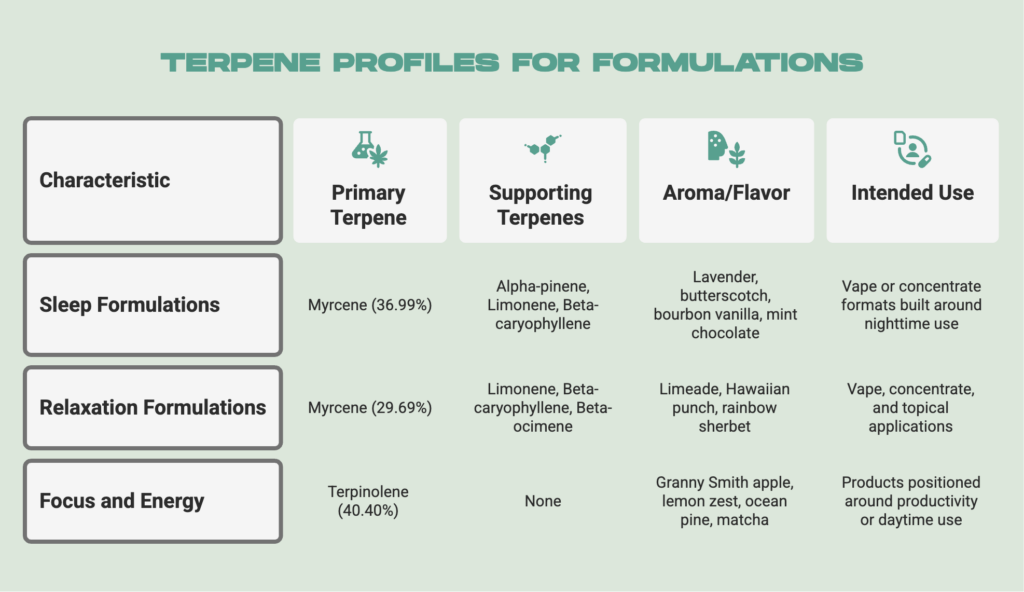
Choosing a terpene profile starts with knowing what you are building toward. The four profiles below are organized by intended use case to give R&D teams a practical starting point based on terpene composition rather than strain name alone.
Sleep Formulations
2023 Sweet #161 leads with 36.99% myrcene, well above the 0.5% threshold associated with sedating effects in cannabis literature, supported by alpha-pinene (7.38%), limonene (7.12%), and beta-caryophyllene (6.49%).
Its aromatic expression runs through lavender, butterscotch, bourbon vanilla, and mint chocolate, giving it the kind of indulgent complexity that works well in vape or concentrate formats built around nighttime use.
Relaxation Formulations
Sweet #602 is a myrcene-forward multi-vintage blend at 29.69% that stays calming without crossing into sleep-forward territory. Limonene (11.83%) keeps it lifted enough for daytime relaxation positioning, while beta-caryophyllene (6.68%) and beta-ocimene (4.91%) add tropical depth.
Its flavor range, limeade, Hawaiian punch, and rainbow sherbet, translates cleanly across vape, concentrate, and topical applications.
Focus and Energy
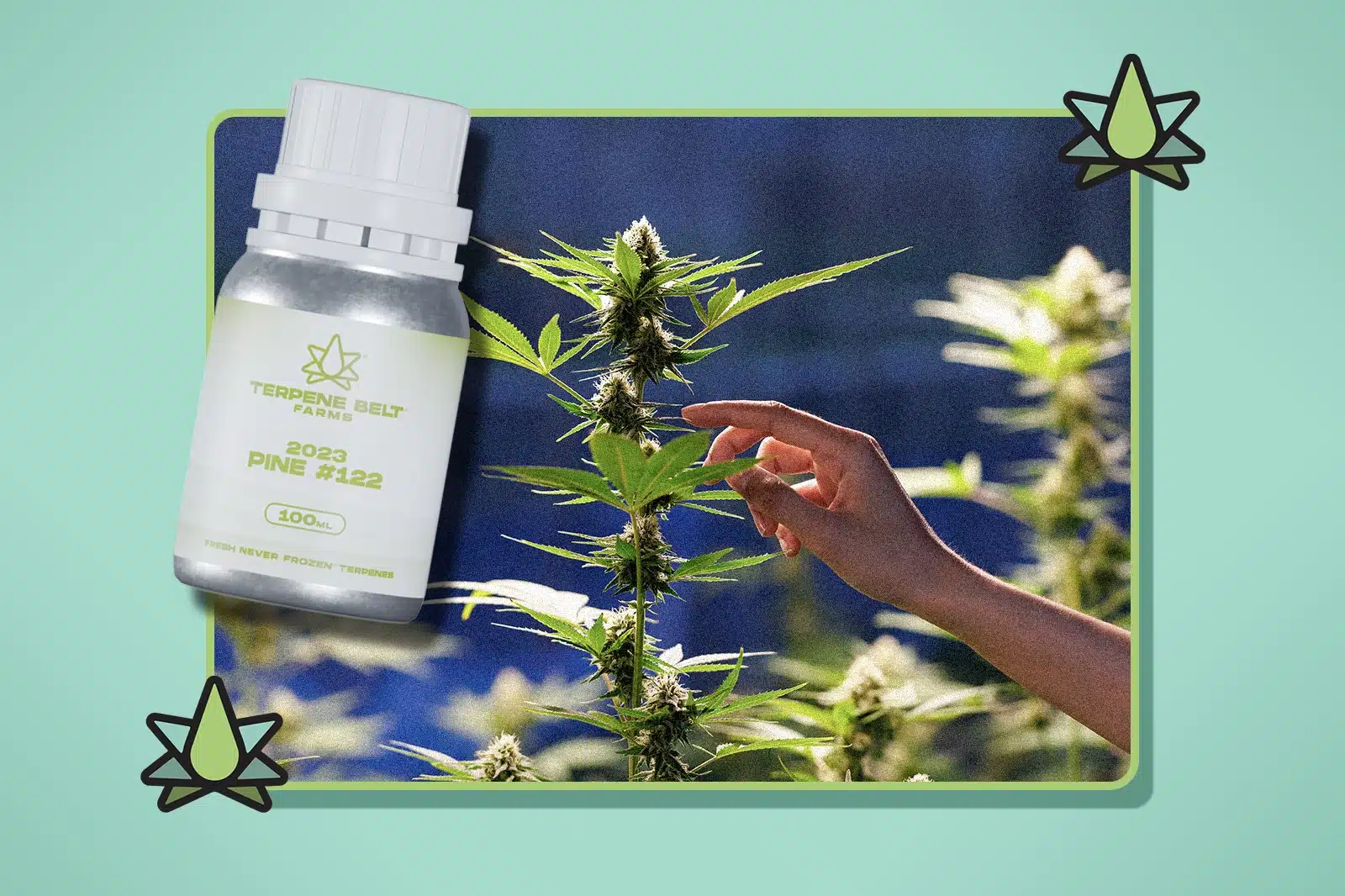
2023 Pine #122 carries 40.40% terpinolene, one of the highest single-varietal concentrations available in the catalog.
Terpinolene is consistently associated with the uplifting, alert character of sativa-leaning cultivars, and at this concentration, it defines the profile cleanly. Its expression reads as Granny Smith apple, lemon zest, ocean pine, and matcha.
Pine #122 creates a crisp, energizing profile well suited for products positioned around productivity or daytime use. For more on working with profiles like these in vape applications, the R&D vape formulation guide covers integration protocols in detail.
Why Terpene Belt Farms Delivers for Cannabis Formulators
Most terpene suppliers can provide a COA and a flavor description. What is harder to find is a source that can tell you exactly where the material came from, how it was extracted, what the full compound profile looks like at the minor terpene level, and that can back all of that up with documentation that holds up to supplier qualification review.
Terpene Belt Farms grows cannabis at sea level on California’s San Joaquin Valley floor using a Fresh Never Frozen® extraction process designed to capture terpenes before degradation begins, not from dried or cured material that has already lost a portion of its profile.
Every product ships with batch-specific COAs showing individual compound percentages, and the lab work follows ISO/IEC 17025 accredited methods. For formulators who have been burned by inconsistent terpene supply or supplier claims that do not match the data, the first step is testing the material against your actual formulation requirements.
Want to see how terpenes can up your formulation game? Request samples from Terpene Belt Farms to learn more today.
Frequently Asked Questions About Cannabis Terpenes
What Is the Most Common Terpene Found in Cannabis?
Myrcene is the most abundant terpene across the broadest range of cannabis cultivars. It regularly accounts for the largest share of total terpene content in COA data, often appearing at concentrations above 20% of the terpene fraction. Its earthy, musky character is part of what gives many cannabis strains their recognizable base aroma, and its sedative properties are among the more documented in terpene research.
Do Terpenes Get You High?
Terpenes do not produce intoxication in the way THC does. They do not bind CB1 receptors and do not trigger psychoactive effects on their own. However, they are biologically active and interact with neurotransmitter systems in ways that can influence mood, relaxation, and energy level. Their effects are subtle compared to cannabinoids and are best understood as modulating or shaping the overall experience rather than driving it.
Are Terpene Profiles Consistent Across Cannabis Strains?
No. Even plants grown from the same genetics can produce meaningfully different terpene profiles depending on cultivation conditions, harvest timing, and processing method. Strain names are not a reliable indicator of terpene composition — two products labeled with the same strain can have profiles that differ substantially. COA data from the specific batch you are sourcing is the only reliable basis for formulation decisions.
How Do Terpenes Affect Flavor in Vape Cartridges?
Terpenes are the primary driver of flavor character in vape products. They volatilize at different temperatures, which is why a profile that reads well in a cold-fill system may behave differently at higher operating temperatures. High-volatility monoterpenes like limonene and terpinolene contribute top-note brightness but are more prone to degradation. Heavier sesquiterpenes like caryophyllene are more stable and contribute base-note depth that persists through the vapor production process.
How Should Cannabis Terpenes Be Stored to Preserve Potency?
Terpenes should be stored in airtight, dark glass or food-grade containers, away from heat, light, and oxygen. Refrigeration is not required for short-term storage but extends shelf life for volatile profiles. High-terpinolene and high-ocimene products are the most sensitive and should be used within a shorter window after opening. Headspace management, minimizing the air above the liquid in the container, is one of the most practical steps to slow oxidation between uses.
Can Terpenes Be Added to Any Cannabis Product Format?
Terpenes can be incorporated into most product formats, but the method and timing of addition depends on the format. Vape and concentrate applications typically involve direct blending with distillate at controlled temperatures. Edibles and beverages often require emulsification or encapsulation to achieve stable dispersion in water-based matrices. Flower infusion uses vapor-phase transfer rather than direct liquid contact.
Sources Used for This Article
- National Center for Biotechnology Information: “Terpenes/Terpenoids in Cannabis: Are They Important?” – pmc.ncbi.nlm.nih.gov/articles/PMC8489319/
- PubMed: “The Entourage Effect: Terpenes Coupled with Cannabinoids for the Treatment of Mood Disorders and Anxiety Disorders” – pubmed.ncbi.nlm.nih.gov/33548867/
- National Center for Biotechnology Information: “Cannabis sativa L. (hemp) for the management of epilepsy and sleep disorders” – pmc.ncbi.nlm.nih.gov/articles/PMC7864762/
- ScienceDirect: “The phytocannabinoid Δ9-tetrahydrocannabivarin can decrease body weight and increase energy expenditure in mice” – sciencedirect.com/science/article/pii/S0924977X13003027
- ScienceDirect: “Alpha-Pinene” – sciencedirect.com/topics/agricultural-and-biological-sciences/alpha-pinene
- National Center for Biotechnology Information: “The Effect of Alpha-Pinene on Neuroinflammation and Oxidative Stress” – pmc.ncbi.nlm.nih.gov/articles/PMC6206409/
- ScienceDirect: “Antitumor activity of balsam fir oil: Production of reactive oxygen species induced by alpha-humulene as possible mechanism of action” – sciencedirect.com/science/article/pii/S0944711309002578
- National Center for Biotechnology Information: “Taming THC: potential cannabis synergy and phytocannabinoid-terpenoid entourage effects” – pmc.ncbi.nlm.nih.gov/articles/PMC3165946/