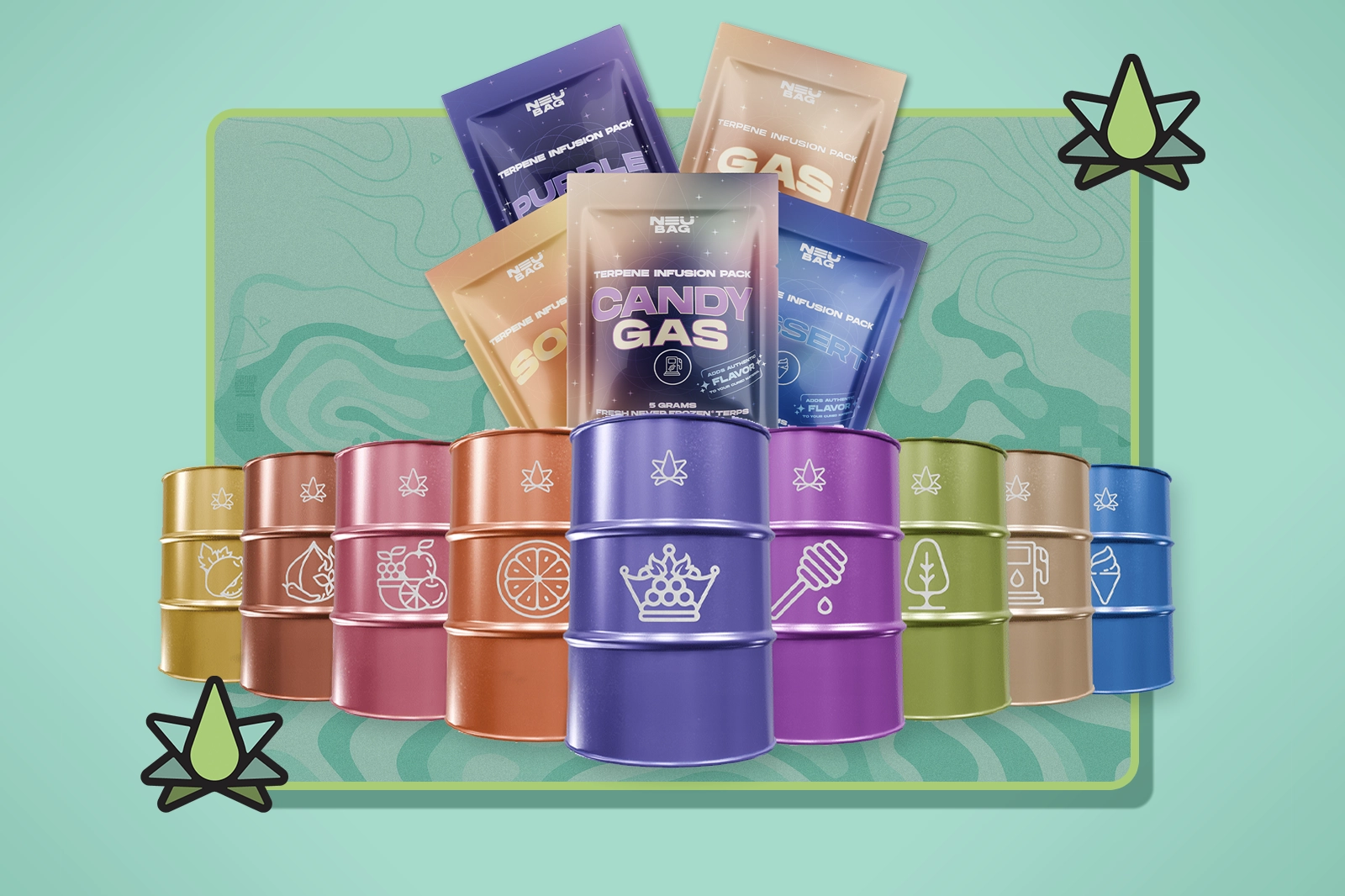
Quick Answer: The three main cannabis terpene infusion methods are direct spray application, vapor-phase diffusion (commonly done with infusion bags), and enclosed chamber machines. Choosing between them isn’t purely a question of scale. Terpene class, flower condition, target profile, and your tolerance for batch variability all determine which method actually delivers repeatable, COA-defensible results in production.
Key Takeaways
- Cannabis flower naturally loses terpenes after harvest; cited research reports about 31% loss after one week, 45% after one month, and 55% after three months.
- Infusion performance depends on terpene class and flower condition: monoterpenes absorb faster in vapor-phase systems, while sesquiterpenes absorb more slowly but remain more stable.
- The three main infusion methods are direct spray application, vapor-phase diffusion, and enclosed chamber machines, each with different tradeoffs in uniformity, cost, throughput, and variability.
- Direct spray can work at scale with closed-loop equipment, but poor calibration risks uneven coverage, solvent issues, trichome disruption, and batches exceeding intended terpene levels.
- Vapor-phase diffusion uses a sealed headspace to transfer terpenes passively, and cited data showed it preserved terpene content and reduced batch profile variance across harvests.
- Shop our NEU infusion bags and find the right CDT profile for your flower to build a repeatable infusion program with lower operational complexity.
Most operators treating terpene infusion as a straightforward “spray and bag” operation are eventually surprised by inconsistent batches, off-flavor complaints, or COA results that don’t match what they intended to add.
The problem usually isn’t the terpenes themselves. It’s that the method, the flower condition, and the profile selection were all treated as separate decisions when they need to be made together.
Terpene infusion has real commercial utility. It restores aromatic expression in aged or over-processed flower, standardizes batch-to-batch profiles, and adds targeted character to base materials that lack distinctiveness. But getting consistent results requires knowing what’s actually happening chemically during infusion, not just which bag or nozzle to use.
This guide covers the mechanics behind each method, what the research says about infusion rates, and the formulation decisions that most articles skip entirely.
Why Cannabis Flower Loses Terpenes in the First Place
Before choosing an infusion method, it’s worth being clear about what you’re trying to restore or add. Terpene loss isn’t a sign of poor quality. It’s an unavoidable consequence of how volatile these compounds are. The real question is how much has been lost, and whether your infusion method can actually replace what’s missing in a way that holds over time.
Research suggests that cannabis inflorescence stored post-harvest loses approximately 31% of its terpene content after one week, 45% after one month, and 55% after three months of air storage. That rate of loss isn’t uniform across all terpenes — and that distinction has direct consequences for how you formulate a restoration blend and which method you use to apply it.
Monoterpenes Vs. Sesquiterpenes: The Volatility Split
The terpene compounds in cannabis fall into two primary structural categories, and their behavior during infusion is meaningfully different.
Monoterpenes, myrcene, pinene, limonene, terpinolene, ocimene are built from two isoprene units (C₁₀H₁₆). They’re lighter, more volatile, and degrade fastest during drying, processing, and storage.
Sesquiterpenes, caryophyllene, humulene, are built from three isoprene units (C₁₅H₂₄), making them heavier, less volatile, and more thermally stable.
The Journal of Cannabis Research referenced above confirmed that the infusion rate in a vapor-phase system is dependent on terpene class: monoterpenes showed the highest absorption rate, followed by monoterpene alcohols, with sesquiterpenes absorbing the slowest.
Both isomers of alpha-pinene produced the most pronounced terpene content increase of the eight compounds tested. The likely explanation is vapor pressure. More volatile compounds release into the headspace more readily, which means more of them are available for the flower to absorb.
Why does this matter? If you’re running a vapor-phase infusion and measuring total terpene content at 24 hours, you’re mostly measuring monoterpene uptake. The sesquiterpene contribution catches up more slowly.
Calibrate your dosing and sampling protocol accordingly, and don’t assume that early COA checks reflect the final profile composition. Live terpenes vs. cured terpenes also differ significantly in their monoterpene-to-sesquiterpene ratios, which is a factor worth accounting for when selecting your source material.

The State of Your Flower Before You Start
The condition of your base material sets a ceiling on what infusion can accomplish. Moisture content is the most important pre-infusion variable. Flower with moisture content above 62% RH during infusion traps humidity alongside terpenes, creating microbial risk during subsequent packaging.
Flower that’s been over-dried will absorb terpenes faster but may do so unevenly, with outer surfaces saturating before inner flower structure has had time to equilibrate.
Ground and milled flower presents a different challenge: more surface area means more opportunity for uniform terpene contact, but it also means a higher oxidation risk post-infusion because the structural protection of intact buds is gone.
For pre-roll production specifically, the material needs to be ground before infusion to achieve homogeneous distribution. Intact buds in the milled product create concentration hot spots. For more detail on operating protocols in pre-roll workflows, check out our R&D cannabis flower enhancement guide.
The Three Cannabis Terpene Infusion Methods Compared
Each method moves terpenes into flower through a fundamentally different mechanism. The mechanism determines not just the outcome, but the failure modes. Operators who understand why a method works are the ones who can troubleshoot it when something goes wrong.
Direct Spray Application
Direct spray is the simplest method on paper: a terpene solution is misted onto cannabis flower, coating the surface with aromatic compounds. In practice, the gap between simple and consistent is where most operators run into problems.
The professional standard for spray infusion uses a 5–10% terpene solution in a volatile carrier solvent like ethanol. The ethanol serves as a dispersal agent, allowing the terpenes to spread more evenly across the flower surface before flashing off and leaving the terpene behind.
Without a carrier solvent, raw terpene oil applied by spray will bead on the surface of the bud rather than penetrating the flower structure, leading to surface oversaturation while inner material absorbs nothing.
- Mechanism: Liquid contact, surface-level absorption via diluted terpene solution
- Recommended Dose: 0.5–1% terpene by dry flower weight. Above 1%, you risk harsh flavor and unintended moisture addition
- Best Application: Large-scale operations with closed-loop spray chambers and calibrated delivery systems. Hand-spray in open environments produces uneven coverage across any batch larger than a few ounces
- Pros: Fast turnaround; compatible with high-volume commercial production when properly equipped
- Cons: Ethanol carrier introduces residual solvent risk if not fully allowed to flash off; uneven distribution without closed-loop equipment; trichome heads can be disturbed by direct liquid contact; difficult to audit coverage uniformity without analytical testing
The practical ceiling for spray accuracy is determined almost entirely by your equipment. With precision nozzles, rotation, and closed-system delivery, spray can be highly repeatable. Without them, it’s the most variable method in the category.
Vapor-Phase Diffusion (NEU Bags)
Vapor-phase diffusion is a fundamentally different mechanism. Rather than applying terpenes directly to the flower surface, this approach creates a concentration gradient between a terpene-saturated source and the surrounding flower.
Terpenes off-gas from the source material into the sealed headspace. The flower, which contains lower terpene concentration, passively absorbs those vapors over time. The idea is the same as a paper towel absorbing water from a wet surface without being submerged.
Referencing the Journal of Cannabis Research again, it validated this approach across multiple cannabis chemotypes, storage durations, and terpene types. In every preservation trial, all samples stored in the presence of an external volatile source maintained a higher terpene content than controls.
The method also demonstrated an ability to standardize batch-to-batch profiles: inflorescence samples from two harvests separated by approximately one year showed a 55.8% variance in terpene profiles before infusion. After four weeks of vapor-phase storage with an 8-part terpene blend, that variance dropped to 16.3%, a 39.5% reduction.
That’s not just restoration. It’s a path toward consistent, reproducible product profiles across harvests.
The TBF NEU Bags deliver this process without specialized equipment. Each bag uses a mesh structure saturated with cannabis-derived terpene oil. One bag per pound of flower, placed in an airtight vessel with the bud material, is the operating standard. Over 48 hours, substantially all of the terpene content migrates from the bag into the surrounding flower.
The seal on the vessel is not optional. Even a slightly loosened lid allows terpene vapor to escape the headspace rather than absorb into the flower, measurably reducing the final uptake.
- Mechanism: Passive vapor-phase diffusion via concentration gradient
- Recommended Dose: 1 NEU Bag per pound of flower; R&D data confirms approximately 1% terpene content increase over 48 hours with diminishing returns above that threshold
- Best Application: Any batch size, intact or ground material, single-variety or multi-variety blends
- Pros: No liquid contact, no trichome disruption, no carrier solvent risk, scalable from small batches to thousands of units, ships internationally, no equipment investment required
For more detailed formulation steps and best practices in flower enhancement workflows, check out the R&D cannabis flower enhancement guide.
Chamber Machines (e.g., Remediation Machines)
Enclosed chamber systems use controlled mechanical spray within a sealed environment to distribute terpenes across large volumes of flower simultaneously. The enclosed environment eliminates the open-room variability that makes hand-spray so inconsistent. Coverage is more uniform, and the operator has adjustable parameters for spray intensity and duration.
The case for chamber machines is strongest at very high throughput volumes where the capital expenditure can be amortized across many production runs. The case against them is grounded in realistic operational context. The machine itself is a significant upfront investment.
Beyond the purchase price, training time for operators is substantial, and the accuracy of the method depends entirely on that training being maintained. Staff turnover is one of the most common failure points in operations that use chamber machines — when the trained operator leaves, dosing accuracy often degrades until the next operator is fully calibrated.
For producers outsourcing to a third-party Box owner rather than owning the equipment themselves, the per-lot cost can scale poorly at mid-market batch sizes, eroding the economic case relative to a vapor-phase approach that requires no capital.
- Mechanism: Controlled mechanical spray in an enclosed environment
- Best Application: Very high-volume commercial processors with dedicated trained staff and sufficient throughput to justify the equipment investment
- Pros: High throughput, controlled distribution environment
- Cons: High capital cost, training dependency, maintenance requirements, not accessible for mid-scale operations
| Method | Mechanism | Trichome Impact | Dose Control | Cycle Time | Ideal Scale |
| Direct Spray | Liquid surface contact | Moderate | Low–Medium | Minutes | Commercial (closed-loop) |
| Vapor-Phase (NEU Bags) | Passive vapor diffusion | Minimal | High | 48 hours | Any scale |
| Chamber Machine | Controlled enclosed spray | Moderate | High | Variable | High-volume industrial |
Common Infusion Mistakes That Hurt Your COA and Your Product
These are the failures that only become visible after you’ve committed to a batch — or, worse, after it’s shipped. They’re also the mistakes that most infusion guides don’t cover because they require understanding the chemistry, not just the process.
Over-Applying Without Post-Infusion Testing
Operators who add terpenes by feel rather than by measured weight against dry flower mass consistently end up above the 1% threshold without realizing it. The consequence is a COA that shows terpene percentages above what your label claims.
In regulated markets, that’s a compliance issue. In any market, it’s a trust issue with your customers. Encore Labs has documented that oversaturated terpene applications can introduce not just flavor problems but oxidation products that change the aromatic character of the final product entirely.
Running a headspace GC-MS analysis after infusion and before packaging is the only way to confirm what actually transferred. Post-infusion COA testing should be a standard step in any commercial infusion program, not an optional quality check.
Not Sealing Your Vessel Properly
This is the most common operational failure in vapor-phase infusion programs. The diffusion gradient that drives terpene absorption into the flower depends entirely on the terpene vapor being confined to the headspace of the sealed container.
Any gap, a loose-fitting lid, or a bag that wasn’t fully sealed allows vapor to escape to ambient air rather than absorbing into the flower. The result is measurably lower final terpene uptake and a skewed profile because more volatile monoterpenes escape preferentially. Eliminating headspace within the vessel also improves efficiency: less dead air volume means more of the available terpene vapor stays in contact with the flower surface.
Applying to Flower That Isn’t Ready
Flower outside the 55–62% RH range during infusion produces predictable problems in both directions. Flower above that range absorbs terpenes alongside residual moisture. The terpene may integrate, but the water content increase creates conditions for mold during subsequent sealed storage.
Flower significantly below target RH may be too structurally brittle to absorb uniformly, with outer surfaces taking on terpene concentration while inner material stays dry.
Measure moisture before you start, not after you’ve already applied. 2024 Fruit #6, a limonene-dominant CDT at 25.41% with caryophyllene at 16.05% and linalool at 4.42%, is a profile that works well for operators infusing into properly conditioned tropical-forward base material.
Its caryophyllene anchor provides the sesquiterpene stability that holds the profile’s shape over shelf life, while the high limonene front end delivers the immediate aromatic impact that makes the infusion worth doing. Always confirm your flower is within specification before committing a full batch.
For guidance on preserving terpene quality before and after infusion, the terpene preservation guide covers storage conditions, packaging requirements, and degradation timelines in detail.

Why Terpene Belt Farms Solves the Consistency Problem in Flower Infusion
Infusion consistency starts with the terpene source. Variable inputs produce variable outputs, and most operators don’t see that problem until they’re three batches in with an inconsistent supplier.
Terpene Belt Farms controls the full production chain, from California-grown hemp cultivated in Byron’s San Joaquin Valley terroir through Fresh Never Frozen extraction, which means every batch shipped reflects the same chemistry, the same ratios, and the same COA documentation that makes quality audits straightforward rather than stressful.
The NEU Bag system takes that consistency further by packaging those CDT profiles specifically for vapor-phase flower infusion with no equipment, no carrier solvents, and no specialized training required. One bag per pound, seal the vessel, rotate every 12 hours, and let the chemistry do what it’s designed to do. Whether you’re infusing 10 pounds or 10,000, the protocol scales without the operational complexity that comes with spray systems or chamber machines.
Build your infusion program on a source that’s designed for it. Shop our NEU infusion bags and find the right CDT profile for your flower.
Frequently Asked Questions About Cannabis Terpene Infusion Methods
Can You Infuse Terpenes Into Pre-Ground Flower?
Yes, and for pre-roll production, it’s actually recommended. Ground material distributes terpene absorption more evenly than intact buds, which can have uneven surface exposure to the diffusion gradient. The tradeoff is increased oxidation risk post-infusion due to higher exposed surface area.
Does Terpene Infusion Affect the THC Percentage on a COA?
Not directly. Adding terpenes doesn’t change the absolute amount of THC in the flower. It does change the percentage by dilution effect: adding mass to the sample (via terpene absorption) at the same absolute cannabinoid content lowers the THC percentage expressed as a proportion of total weight. The effect is small at the 0.5–1% addition rate, but it’s worth accounting for if your product label makes a specific THC percentage claim. Test post-infusion before finalizing label content.
Can the Same Terpene Profile Work for Both Flower Infusion and Concentrate Formulation?
The same CDT profile can technically be used in both applications, but the dosing parameters and performance characteristics differ significantly. Flower infusion targets 0.5–1% by dry weight; concentrate formulations typically run 1–2.5% depending on the extract type and starting material. Viscosity behavior in distillate is also a different consideration than absorption into a fibrous flower matrix. If you’re cross-applying a profile, test separately for each format rather than assuming the same dose translates.
Does Terpene Infusion Change the Moisture Content of the Flower?
In a well-managed vapor-phase process, the effect on moisture is minimal — you’re adding terpene oil vapor, not water. The risk arises when base flower moisture is already at the high end of the acceptable range, or when infusion is conducted in a humid environment where moisture enters the vessel alongside the terpene vapor.
What Is the Shelf Life of Terpene-Infused Flower?
Infused flower doesn’t have meaningfully different shelf life than properly stored uninfused flower when the application is within spec. The same degradation drivers apply: heat, light, oxygen, and humidity imbalance. Infused material that was oversaturated, or that was infused while outside the optimal moisture range, will degrade faster due to oxidation and microbial exposure.
Sources Used for This Article
- Journal of Cannabis Research: “The preservation and augmentation of volatile terpenes in cannabis inflorescence” – link.springer.com/article/10.1186/s42238-020-00035-z
- Encore Labs: “Terpene Degradation in Cannabis” – encorelabs.com/terpene-degradation-in-cannabis/