



Quick Answer: Terpene infusion restores lost aroma and “strain character” in commercial flower by reintroducing volatile compounds that degrade during curing and distribution. The most reliable approach is vapor-phase diffusion, where terpene vapors migrate into flower in a sealed environment over 48–72 hours, avoiding wet spots and harsh combustion.
Controlled misting can work at scale but requires droplet-size control and strict humidity management. Success comes down to conservative dosing (typically 1–2% w/w), stable temperature/RH, minimal oxygen/light exposure, and post-infusion packaging that preserves the refreshed profile.
Key Takeaways
- Vapor-phase diffusion is the commercial gold standard for uniform uptake because it avoids direct liquid contact, sticky residue, and “hot spots” common with spray methods.
- Controlled misting scales well when you can consistently produce fine droplets (10–50 microns), apply in light cycles, and hold 58–62% RH during integration.
- Dosing matters more than hype. Most “restoration” work lands at 1–2% terpene addition by flower weight; pushing >3% often creates harsh burn, artificial intensity, and irreversible product damage.
- Environment + packaging decide ROI: integrate at 15–20°C and 55–65% RH, then package immediately in opaque, oxygen-barrier materials with minimized headspace and humidity control packs to preserve monoterpenes.
- Source quality drives authenticity and repeatability: cannabis-derived profiles deliver fuller strain-like complexity (minor compounds included) and more predictable sensory outcomes than “approximate” botanical blends.
- If you want equipment-free, repeatable infusion at commercial scale, Terpene Belt Farms NEU Bags deliver uniform vapor-phase terp infusion with lab-tested cannabis-derived profiles. Request our sample kits for R&D today.
Product developers face a persistent challenge: cannabis flower that smells like hay instead of the premium genetics customers expect. Standard curing removes 30-60% of native terpenes, with further losses during storage and distribution. What starts as aromatic, trichome-rich flower arrives at retail with muted profiles that fail to justify premium pricing or differentiate products in competitive markets.
This degradation creates real business problems.
Wholesale buyers reject batches based on weak aromatics regardless of cannabinoid content. Retail customers bypass products with disappointing nose appeal, choosing competitors with stronger sensory characteristics. Brand consistency suffers when harvest-to-harvest variations produce unpredictable aromatic profiles that confuse loyal consumers and complicate marketing narratives around specific strain experiences.
Professional terpene infusion solves these problems through controlled reintroduction using vapor-phase diffusion or precision misting. When executed correctly, infusion restores aromatic intensity, unifies batch-to-batch consistency, and enables targeted profile development that supports specific brand positioning.
Here’s how you can infuse terpenes in your flower the right way:
Terpene Infusion Methods for Scalable Manufacturing
When it comes to flower infusion, there are three methods that manufacturers can use to add terpenes to their products.
1. Vapor-Phase Diffusion Method
Vapor-phase diffusion represents the commercial standard, using controlled environments where terpene oils volatilize and integrate through natural diffusion rather than mechanical application. This eliminates direct liquid contact, preventing uneven distribution and surface residues.
We, Terpene Belt Farms, are a California-based producer with vertical integration from cultivation through extraction, and developed NEU Bags as the industry standard for equipment-free vapor-phase infusion.
These mesh packs saturated with cannabis-derived terpene oils eliminate the capital requirements and technical complexity of chamber systems while delivering professional-grade results that competing methods cannot match at comparable investment levels.
Our approach stems from production experience rather than theory. Controlling cannabis genetics, cultivation conditions, and extraction processes enables formulation of terpene profiles specifically optimized for vapor-phase diffusion characteristics, volatility curves, compound stability, and integration rates that generic terpene suppliers cannot address without direct cultivation knowledge.
This vertical integration translates to profiles that perform predictably across different flower types, moisture contents, and storage conditions.
Our NEU Bags work through controlled diffusion: placed with flower in sealed containers, the saturated packs release terpene vapors that penetrate the product structure over 48-72 hours without direct liquid contact.
This vapor-phase mechanism prevents surface residues, sticky handling issues, and uneven distribution that plague spray methods. Small to mid-scale operations achieve professional results without misting equipment, environmental chambers, or specialized technical training, reducing barriers to quality flower infusion.
These bags are available in various profiles, including:
- Candy Gas NEU Bag: Sweet fuel aromatics with Terpinolene (28.13%), Myrcene (20.9%), Limonene (8.66%)
- Dessert Infusion Pack: Complex sweet profile with Limonene (23.16%), Ocimene (15.31%), Caryophyllene (13.9%)
- Gas Infusion Pack: Fuel-forward restoration with high-myrcene expression
- Purple Infusion Pack: Balanced Myrcene/Terpinolene for purple strain characteristics
- Sour Infusion Pack: Citrus-dominant profile for sour diesel genetics
If you’re not sure which pack to go with, we also have a NEU Bag sample pack that features five of our variants for your R&D.
2. Controlled Misting Application
Controlled misting systems deliver atomized droplets at 10-50 micron particle sizes that facilitate absorption while minimizing surface accumulation.
Professional equipment generates precise particles through pressurized atomization or ultrasonic nebulization, unlike consumer spray bottles producing large droplets that coat rather than penetrate.
Application Protocol:
- Flower Preparation: Thin layers on perforated trays for 360-degree exposure
- Misting Cycles: Multiple light applications separated by 6-12 hour rest periods
- Humidity Control: 58-62% RH prevents premature evaporation while maintaining flower moisture
- Post-application: Controlled environment storage locks terpenes before packaging
2023 Fruit #130 performs exceptionally in misting applications due to its balanced volatility and fruity top notes with a stable sesquiterpene base that guarantees even distribution during application while maintaining aromatic intensity through extended integration.
Quality control samples throughout runs detect uniformity issues before completing batches. Representative flower from different tray positions undergoes sensory and analytical testing to confirm consistent uptake, enabling real-time protocol adjustments.
3. Cotton Ball Diffusion for Small Batch Testing
Small-scale protocols use cotton ball diffusion to evaluate profiles before production runs. This creates miniature vapor-phase environments replicating commercial processes at testing scale.
Testing Setup:
- Containers: Glass with airtight seals
- Dosing: 0.3-0.8mL terpene oil per 28g flower
- Application: Terpenes saturate cotton balls in tea diffusers (no direct flower contact)
- Duration: 48-72 hours with daily agitation
- Environment: Temperature-controlled storage
Cannabis-derived profiles like 2023 Sweet #161 demonstrate clear superiority in testing. The myrcene-rich composition (36.99%) creates recognizable cannabis aromatics that botanical isolates cannot duplicate at equivalent concentrations. This sensory distinction validates the quality premium of authentic cannabis-derived oils.
| Key Factor | Vapor-Phase Diffusion (NEU Bags) | Controlled Misting Application | Cotton Ball Diffusion (Testing) |
| Primary Use | Commercial flower infusion | Large-scale commercial production | R&D / profile testing |
| Application Method | Terpene vapor diffusion (no liquid contact) | Atomized liquid mist | Vapor diffusion via cotton |
| Equipment Needed | None (sealed containers only) | Specialized misting / nebulization systems | Minimal (jars, cotton balls) |
| Integration Time | 48–72 hours | Multiple cycles + stabilization | 48–72 hours |
| Distribution Quality | Very even and consistent | High if properly controlled | Even at small scale |
| Operational Complexity | Low | High | Very low |
| Capital Cost | Low | High | Very low |
Why NEU Bags Are the Superior Method of Terpene Infusion
While multiple infusion approaches exist, NEU Bags deliver advantages that competing methods cannot match for most commercial operations. Our production testing across hundreds of batches and dozens of client implementations reveals consistent performance benefits that translate directly to bottom-line results.
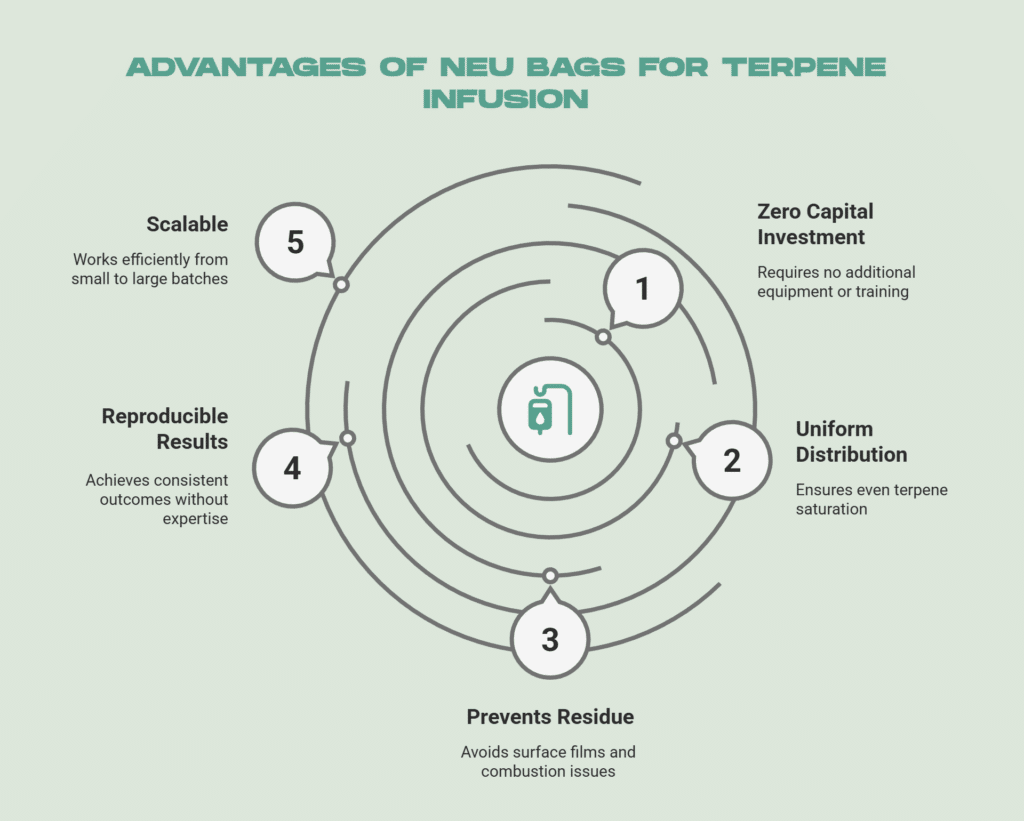
Zero Capital Investment Required
Misting systems demand $5,000-25,000 in equipment plus dedicated environmental chambers and technical training. NEU Bags require only sealable containers you already own. Operations producing 10-500 pounds of product weekly achieve professional results without the need for machinery purchases, maintenance costs, or specialized operator certification.
Eliminates Distribution Uniformity Issues
Spray methods create concentration gradients where direct contact points receive excessive terpenes while shadowed areas remain under-dosed. Vapor-phase diffusion saturates the entire sealed environment, allowing terpene molecules to migrate uniformly throughout flower structure regardless of position.
This eliminates hot spots, sticky patches, and the batch inconsistency that creates customer complaints and wholesale rejections.
Prevents Surface Residue and Combustion Problems
Liquid application leaves terpene films on flower surfaces that combust harshly and gum up consumption devices. NEU Bags deliver terpenes through vapor absorption into flower matrix, which is molecular integration rather than surface coating. The result burns cleanly with aromatic enhancement that doesn’t compromise smoking characteristics or create residues on hardware.
Reproducible Results Without Technical Expertise
Misting requires operator skill to control droplet size, application distance, and pass timing, which are all variables that shift between technicians and create training overhead.
NEU Bags follow simple protocols: seal flower with infusion pack, maintain ambient temperature, wait 48-72 hours. Consistent outcomes don’t depend on technique refinement or experienced personnel, reducing labor costs and quality variance.
Scales Efficiently From Testing to Production
The same vapor-phase principles that work in quart jars for R&D testing scale directly to 5-gallon buckets or commercial turkey bags for production runs. Unlike misting systems that require recalibration and technique adjustment when scaling volumes, NEU Bags maintain identical protocols across all batch sizes. What works at 1oz works at 10lbs with proportional dosing.
Need some assistance to test your vapor-phase infusion? Partner with Terpene Belt Farms for our wholesale services and get access to our supply as well as technical direction for your formulations.
Best Practices for Terpene Infusion for Flower
Apart from the infusion method itself, there are a few other factors that affect the quality of your infusion as well.
Formulation Ratios and Concentration Guidelines
Professional infusion operates within concentration parameters, balancing aromatic enhancement with product functionality and safety.
| Flower Condition | Target Concentration | Purpose | Example Profile |
| Fresh/Recently Cured | 0.5-1% | Subtle enhancement | 2023 Pine #120 |
| Standard Restoration | 1-2% | Replace curing losses | 2023 Gas #150 |
| Aged Inventory | 2-3% | Significant aroma restoration | 2023 Sour #93 |
| Over 3% | ❌ Not Recommended | Risk of harsh combustion | — |
Calculation must account for flower moisture content and water weight affects final percentages as well. Flower at 10% moisture requires adjusted dosing compared to 5% moisture material. Professional operations use moisture analyzers for accurate weights before calculating terpene additions.
Over-concentration issues also causes a long list of issues that may include:
- Harsh combustion and smoke characteristics
- Residues on consumption devices
- Unnatural aromatic intensity
- Cannot be reversed once applied
Integration Timelines and Environment Control
Proper integration requires controlled environments maintained throughout 48-72 hour absorption periods.
Critical Environmental Parameters:
- Temperature: 15-20°C (prevents rapid monoterpene volatilization)
- Humidity: 55-65% RH (maintains flower moisture without microbial growth)
- Containers: Food-grade HDPE with humidity regulation packets and one-way valves
- Evaluation Point: 48 hours for initial assessment of integration progress
The 48-hour mark represents a critical checkpoint where initial terpene integration becomes apparent. Professional protocols sample representative flower, assessing aromatic intensity and distribution. Insufficient integration indicates environmental control issues or inadequate volatilization.
Extended integration beyond 72 hours rarely improves outcomes. Terpene molecules reach equilibrium distribution within 2-3 days under proper conditions, with additional time providing minimal incremental absorption. This finite window enables production planning around predictable timelines.
Post-integration storage must maintain achieved levels through packaging and distribution. Nitrogen-flushed packaging with oxygen-absorbing elements extends retention by minimizing oxidative degradation. Proper storage practices protect the terpene investment throughout shelf life. We’ll talk about storage a little later.
Terpene Source Selection
The source distinction determines infusion authenticity and commercial positioning. Cannabis-derived oils contain complete strain profiles with 40-60+ compounds, including minor terpenes and aromatic alcohols that botanical products cannot replicate through isolated compound blending.
2023 Sour #93 is a great example here with limonene at 20.64%, caryophyllene at 16.38%, plus humulene and linalool. Botanical alternatives attempting “sour” profiles combine isolated compounds producing citrus aromatics lacking characteristic fuel undertones and spicy complexity defining authentic sour cannabis strains.
Pricing Cannabis-derived terpenes command 2-4x premium pricing justified by superior authenticity. This premium generates ROI when targeting consumers willing to pay for authentically restored flower. Budget operations may use high-quality botanical blends when authentic strain recognition isn’t a primary positioning element.
Sourcing reliability affects production consistency. Established producers like Terpene Belt Farms maintain consistent batches through controlled cultivation and standardized extraction, enabling repeatable formulations with predictable outcomes.
Storage and Preservation After Infusion
Terpene infusion represents a significant material and labor investment that gets wasted through improper post-integration storage.
Volatile monoterpenes, the aromatic compounds that justify premium pricing, degrade rapidly when exposed to heat, light, oxygen, or humidity fluctuations. Studies on terpene stability demonstrate that proper storage maintains 70-85% aromatic intensity at 90 days, while uncontrolled conditions lose 40-60% in the same period.
The critical window begins immediately after infusion completion. Flower exits controlled integration environments with maximum terpene content, but handling and packaging decisions in the next 24 hours determine whether that investment persists through distribution or evaporates before reaching customers.
Temperature spikes during packaging, oxygen exposure from oversized containers, and light penetration through clear materials all accelerate degradation that cannot be reversed once it occurs.
Immediate Post-Infusion Protocol
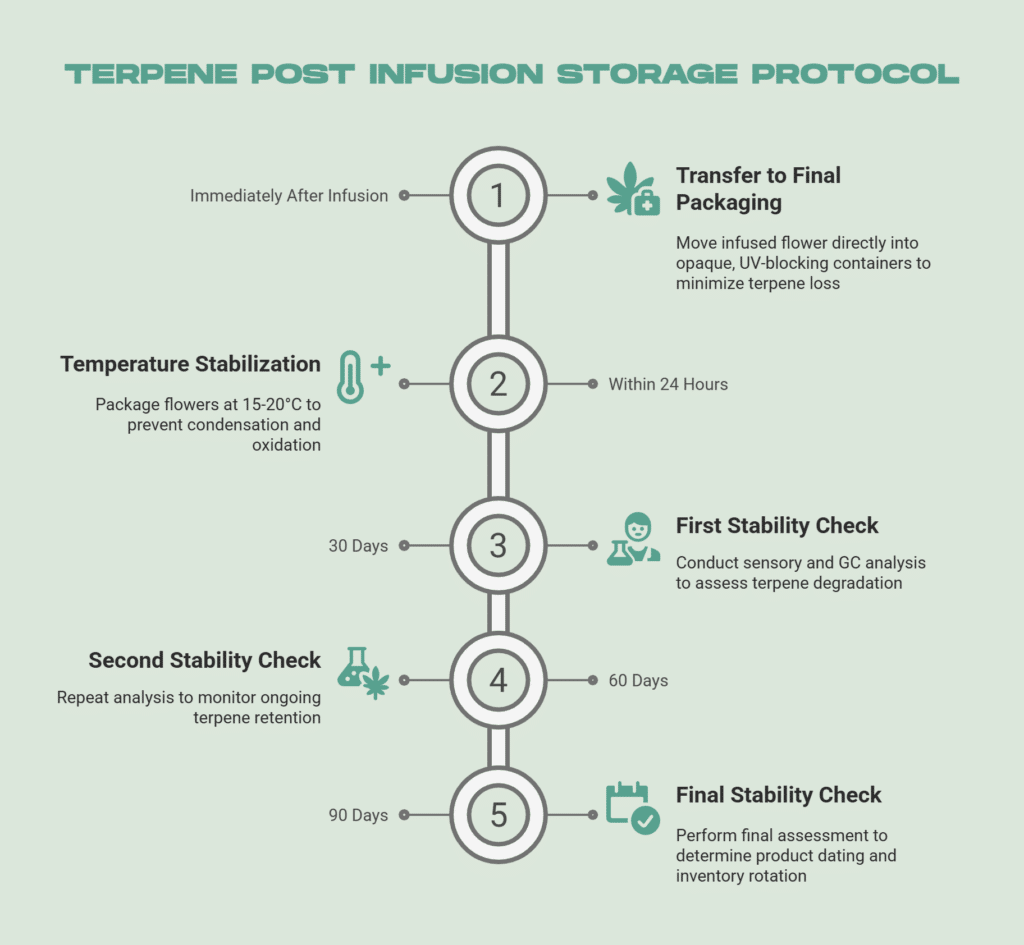
Move infused flower directly from integration containers into final packaging without intermediate storage steps. Each transfer exposes the product to ambient conditions that volatilize light terpenes. For example, limonene and pinene evaporate within minutes at room temperature. Minimize handling time between infusion completion and sealed packaging.
Package flowers at stable temperatures between 15-20°C. Avoid packaging in warm rooms or near heat sources. Temperature fluctuations create condensation cycles inside containers that promote microbial growth while accelerating terpene oxidation. Maintain consistent cool temperatures throughout packaging operations.
Packaging Material Selection
Mylar bags with opaque, UV-blocking exteriors prevent light-induced degradation while providing oxygen barriers that clear plastic cannot match. Light exposure degrades terpenes through photochemical reactions, and even indirect ambient light in storage areas causes measurable losses over weeks. Choose packaging materials that block all light transmission.
Size containers appropriately to minimize headspace. A half-full jar contains oxygen that oxidizes terpenes during storage. Use capacity-matched packaging where flower fills 80-90% of volume, leaving minimal air exposure. For partial quantities, transfer to smaller containers rather than storing in oversized packaging.
Integrate two-way humidity control packs, maintaining 58-62% RH automatically. Boveda or Integra Boost packs prevent moisture loss that makes the flower brittle while avoiding excess humidity that enables mold. These systems compensate for humidity fluctuations without requiring active monitoring.
Long-Term Storage Requirements
Store packaged flower at 15-18°C in dark locations. Basement temperatures are the sweet spot here, not refrigeration. Freezing creates ice crystal formation that ruptures trichomes and cellular structures. Refrigeration causes condensation when packages move to room temperature. Cool ambient storage provides optimal preservation without moisture complications.
For extended storage beyond 60 days, consider nitrogen flushing before sealing. This displaces oxygen that drives oxidative degradation, significantly extending aromatic retention. Small nitrogen generators or pre-filled nitrogen cylinders enable this protection at a reasonable cost for operations storing significant inventory.
Monitor stored batches through periodic sampling at 30, 60, and 90-day intervals. Sensory assessment combined with GC analysis (when available) establishes actual degradation rates for your specific conditions, enabling data-driven decisions on product dating and inventory rotation. Don’t rely on arbitrary timelines here. Document actual stability under your storage conditions.
Terpene Oil Storage Parallels
Storage guidelines for concentrated terpene oils before infusion mirror post-infusion requirements. Keep oils in amber glass bottles with minimal headspace, stored cool and dark.
Nitrogen-purge bottles when opening for partial use, minimizing oxygen exposure. Degraded input terpenes produce inferior infusion results regardless of technique quality. Protecting oils throughout inventory periods ensures consistent starting materials.
Common Infusion Mistakes and Solutions
Commercial infusion requires precision across multiple parameters. These common errors compromise quality and waste expensive terpene inputs.
- Over-Application: Most frequent commercial error—attempting maximum aromatic intensity through excessive concentrations. Saturated flower produces harsh combustion, unnatural aromatics, and consumer rejection despite high terpene content. Conservative dosing with potential secondary applications delivers superior outcomes.
- Direct Spray Without Diffusion: Creates uneven distribution and surface residues compromising quality. Terpene droplets concentrate in contact points rather than penetrating material structure, producing inconsistent experiences and handling difficulties. Vapor-phase diffusion or controlled misting with adequate integration eliminates these issues.
- Botanical Substitution for Authenticity Claims: Using botanical terpenes when positioning drives brand identity creates trust issues. Brands marketing “strain-specific” or “authentic” flower must use cannabis-derived profiles like 2024 Dessert #116, genuinely replicating target genetics.
- Inadequate Environmental Control: Variable temperature and humidity produce unpredictable integration outcomes. Investing in controlled environments or standardized protocols generates long-term value through consistent results and reduced waste.
- Skipping Analytical Verification: Relying on subjective sensory assessment varies between individuals and cannot document compliance. Professional operations require GC testing confirming content, distribution, and absence of contamination. This establishes defensible quality records and enables continuous improvement.
Closing Thoughts — Why Terpene Belt Farms is the Right Choice for Terp Infusion
Professional terpene infusion requires more than purchasing concentrated oils. It demands sourcing from suppliers who understand both the agricultural foundations of cannabis aromatics and the technical realities of commercial production.
Here at Terpene Belt Farms, our vertical integration from California cultivation through proprietary extraction enables formulation insights that generic terpene distributors simply cannot provide. We’ve developed profiles specifically optimized for vapor-phase diffusion characteristics because we control the entire production chain, not because we’re blending purchased isolates.
NEU Bags represent the culmination of this integrated approach: cannabis-derived profiles formulated for reliable diffusion kinetics, packaged in systems that eliminate equipment barriers while delivering professional results.
Operations from small-batch artisanal producers to mid-scale commercial facilities achieve consistent outcomes using protocols we’ve refined through hundreds of production cycles across diverse flower types and market conditions.
When flower quality directly impacts your brand reputation and revenue, terpene sourcing becomes a strategic decision rather than a commodity purchase.
Partner with Terpene Belt Farms for wholesale services that provide not just products, but the formulation expertise and technical support that separates successful infusion programs from expensive failures.
Frequently Asked Questions About Terpene Infusion for Flower
Can You Add Terpenes to Old or Dry Cannabis Flower?
Yes. Terpene infusion effectively restores aromatics in aged or over-dried flower. Dried material absorbs terpenes more readily than fresh product due to reduced moisture competition. Target 1.5-2% concentration for meaningful restoration without oversaturation. Learn more about terpene preservation.
What’s the Ideal Terpene Ratio for Flower Infusion?
Professional restoration uses 1-2% terpene content by flower weight (dry weight basis). Calculate from actual flower weight after accounting for moisture—not container weight. Start conservatively around 1% and assess before potential secondary application. Use our dosing calculator for precision.
How Long Does Terpene Infusion Last on Flower?
Properly integrated terpenes retain 70-85% aromatic intensity for 90 days under proper storage (15-18°C, nitrogen-flushed packaging, humidity control). Factors include terpene source quality, integration method, storage temperature, and light exposure.
Are Cannabis-Derived Terpenes Better Than Botanical for Infusion?
Cannabis-derived provide superior strain authenticity through complete profiles (40-60+ compounds) that botanical isolates cannot replicate. While botanicals offer cost advantages, cannabis-derived sources deliver recognizable strain characteristics supporting premium positioning. Quality premium justifies cost for sophisticated markets.
Is Terpene-Infused Flower Safe to Consume?
When using food-grade terpenes at appropriate concentrations (under 3%), infused flower presents no additional safety concerns. Terpenes are GRAS (Generally Recognized As Safe) compounds already present in cannabis and food products. Ensure sources provide analytical testing confirming purity and absence of contaminants.
Do Terpenes Make Cannabis Stronger or More Potent?
No. Terpenes do not increase THC or cannabinoid content. However, research on the entourage effect suggests certain terpenes may modulate cannabinoid effects, potentially influencing subjective experience intensity without changing actual cannabinoid levels.
Source Used for This Article
- PubMed Central: “A High-Throughput Method for the Comprehensive Analysis of Terpenes and Terpenoids in Medicinal Cannabis Biomass” – pmc.ncbi.nlm.nih.gov/articles/PMC7407962/


