Quick Answer: Live terpenes and live resin are not interchangeable, even though both come from fresh-frozen cannabis. Live terpenes are cannabinoid-free aromatic isolates, used as formulation ingredients to precisely dose 5–10% terpene content into vapes, beverages, or topicals without affecting THC potency.
Live resin is a full-spectrum hydrocarbon extract, typically 60–90% THC with 4–12% terpenes, designed for direct consumption like dabbing or infused products. The core difference is control: live terpenes let manufacturers independently adjust aroma and potency, while live resin locks cannabinoids and terpenes together in one concentrate.
Key Takeaways
- Live terpenes are isolated aromatic compounds extracted from fresh-frozen cannabis, containing no cannabinoids and enabling precise terpene dosing in formulated products.
- Live resin is a full-spectrum hydrocarbon extract from fresh-frozen material, typically containing 60–90% THC and 4–12% terpenes for direct consumption or minimal processing.
- The primary compositional difference affects procurement and formulation: live terpenes provide independent control over terpene percentages, while live resin locks cannabinoids and terpenes together.
- Live terpene production requires strict cold-chain handling and separation processes, while live resin manufacturing depends on cryogenic hydrocarbon extraction and extended solvent purging.
- Formulators use live terpenes in vape cartridges, beverages, and topicals requiring 5–10% terpene addition, whereas live resin is preferred for dabbing, infused pre-rolls, and specialty cartridges.
- Shop samples from Terpene Belt Farms today to see what difference high-purity, cannabis-derived live terpenes with batch consistency and technical formulation support do for your brand.
You’re comparing supplier quotes and one offers “live resin terpenes” at $45/gram while another lists “live terpenes” at $80/gram.
The COAs look similar with both showing high terpene percentages from fresh-frozen cannabis. But when the shipments arrive, one product contains 75% THC alongside its terpenes, while the other is a pure terpene isolate with zero cannabinoid content. Your vape formulation needs a precise 7% terpene addition to distillate. One of these products just derailed your production schedule.
This terminology confusion costs R&D teams weeks of reformulation when suppliers deliver the wrong compositional profile. A beverage developer orders “live terpenes” expecting cannabinoid-free compounds, only to receive a viscous resin concentrate impossible to emulsify.
The market uses these terms interchangeably, but they describe fundamentally different products. One provides pure aromatic fractions for precise dosing control. The other delivers complete strain chemistry as a standalone concentrate. Confusing the two affects equipment compatibility, regulatory compliance, and profit margins. Here’s everything you need to know about live terpene and live resin, and which you need to add to your
What Live Terpenes Are and How They’re Extracted
Before evaluating suppliers or writing specifications, processors need clarity on what “live terpenes” actually means in compositional terms.
The designation refers to concentrated aromatic fractions isolated from fresh-frozen cannabis material without cannabinoid content. Unlike botanical terpenes sourced from non-cannabis plants, live cannabis terpenes preserve the full molecular complexity of living cannabis plants, including trace compounds such as thiols and esters that contribute to authentic strain characteristics.
This compositional purity creates the fundamental value proposition. Processors can reintroduce specific terpene percentages into distillates, beverages, or topicals without adding THC or affecting potency calculations. R&D teams can build products with precise cannabinoid-to-terpene ratios optimized for hardware compatibility and targeted experiences.
Vape manufacturers, for instance, combine high-purity distillate with carefully measured live terpene additions to achieve 5-8% terpene content while maintaining consistent THC percentages. But achieving this level of purity requires specialized extraction protocols that differ significantly from conventional concentrate production.
Fresh-Frozen Extraction Requirements
The extraction begins immediately after harvest when plant material undergoes flash-freezing to -20°C to -40°C within hours of cutting.
This isn’t just the best practice or a nice-to-have. It’s required for preserving volatile compounds that justify the “live” designation. The rapid temperature reduction halts enzymatic degradation that would otherwise eliminate terpenes through oxidation and evaporation. Studies show that conventional drying eliminates 31-55% of terpenes within one week, primarily affecting lightweight monoterpenes like myrcene and terpinolene.
Once frozen, material remains that way until extraction. Processors use steam distillation, CO2 extraction, or microwave technologies to isolate terpene fractions while maintaining cold temperatures throughout separation.
Each method offers distinct advantages here. Steam distillation captures hydrocarbon terpenes with high selectivity, while CO2 extraction enables gentler separation with minimal thermal stress but higher capital costs.
The cold chain can’t break here even once. Facilities must maintain frozen storage, handle material in temperature-controlled environments, and complete extraction without thaw cycles. Transportation requires refrigerated trucks with temperature monitoring. Even brief temperature excursions above 0°C initiate terpene volatilization, compromising the bright top notes that distinguish live terpene profiles.
Live Terpene Production Characteristics
When extraction protocols execute properly, the resulting live terpenes preserve aromatic complexity that processors not only see in the COA but also taste and smell in the final product.
Live terpenes retain complete molecular diversity extending beyond major terpenes to include trace compounds contributing disproportionately to strain-specific character. Thiols provide distinctive garlic and fuel notes, while floral esters deliver sweet fruity nuances. Both typically vanish during traditional drying but are retained through fresh-frozen processing.
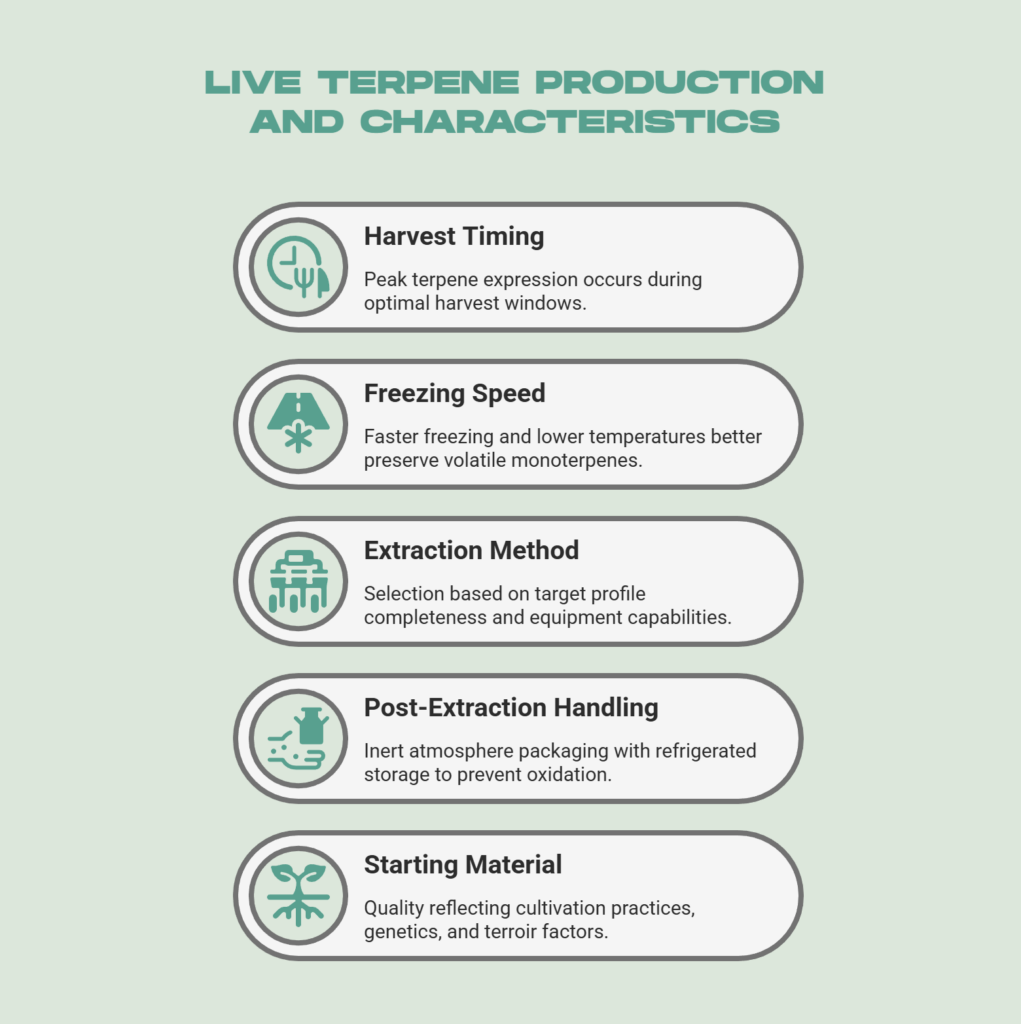
These quality differences don’t happen by accident. Production variables significantly impacting live terpene quality include:
- Harvest timing relative to trichome maturity, with peak terpene expression occurring during optimal harvest windows
- Freezing speed and target temperature, where faster freezing and lower temperatures better preserve volatile monoterpenes
- Extraction method selection based on target profile completeness and equipment capabilities
- Post-extraction handling requires inert atmosphere packaging with refrigerated storage to prevent oxidation
- Starting material quality reflecting cultivation practices, genetics, and terroir factors
The best processors track these variables batch-to-batch because consistency matters at scale.
Terpene Belt Farms’ Fresh Never Frozen® process preserves up to 98% of volatile terpenes through optimized extraction parameters and immediate cold chain intervention, exceeding industry averages of 60-85% recovery. This preservation enables formulators to achieve authentic strain experiences, whether reintroducing terpenes into distillates or developing strain-specific beverage profiles.
What Live Resin Is and How It’s Produced
While live terpenes give you isolated aromatic compounds for formulation flexibility, live resin keeps everything together.
Live resin is a full-spectrum cannabis extract combining preserved terpenes with concentrated cannabinoids, produced from fresh-frozen cannabis through hydrocarbon extraction.
By extracting directly from frozen biomass, processors capture the complete molecular profile present at harvest, including volatile terpenes, acidic cannabinoids like THCA, and aromatic compounds that degrade during traditional drying.
The numbers tell the story. Live resin contains 4-12% total terpenes compared to 1-2% in conventional concentrates, while maintaining 60-90% THC potency. This elevated terpene content creates the characteristic sticky, sauce-like consistency and distinct formulation challenges compared to conventional concentrates.
So, how does production work when keeping cannabinoids and terpenes together? The answer lies in specialized hydrocarbon extraction at extreme cold temperatures.
Hydrocarbon Extraction Fundamentals
Live resin production uses light hydrocarbon solvents to dissolve trichome contents from frozen cannabis packed into extraction columns.
The process maintains -20°F to -50°F throughout extraction cycles, serving dual purposes: preserving heat-sensitive terpenes while improving separation between desirable compounds and contaminants like chlorophyll.
Fresh-frozen material creates unique extraction dynamics. Ice crystals within plant tissues physically exclude water-soluble contaminants, resulting in cleaner crude oil. Research shows propane’s lower boiling point enables colder extraction temperatures, potentially preserving additional volatile terpenes.
After solvent saturation, the extraction mixture undergoes separation through temperature and pressure manipulation. Collection vessels receive the terpene-rich cannabinoid solution while spent material remains in the column. The crude oil enters vacuum purging at controlled temperatures below 100°F to prevent terpene loss while ensuring complete solvent removal over 24-48 hours.
Live Resin Production Characteristics
Walk into any dispensary, and you’ll see live resin labeled as “sauce,” “sugar,” “badder,” or “diamonds”. These describe actual physical differences.
Common forms include sauce (high-terpene liquid with suspended THCA crystals), sugar (granular texture), badder (creamy consistency), and diamonds (large THCA crystals separated from terpene-rich sauce). These variations emerge from controlled crystallization where processors manipulate temperature, agitation, and time.
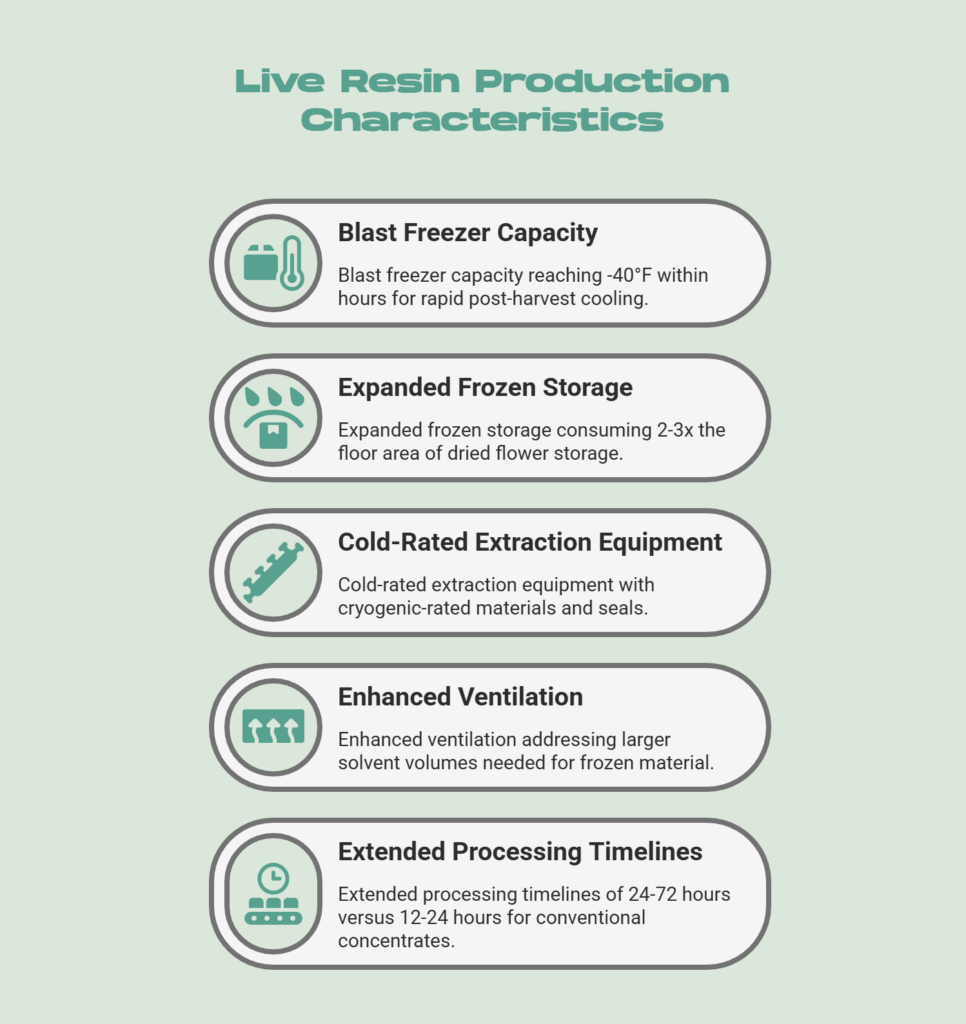
But these end products require significant infrastructure investments:
- Blast freezer capacity reaching -40°F within hours for rapid post-harvest cooling
- Expanded frozen storage consuming 2-3x the floor area of dried flower storage
- Cold-rated extraction equipment with cryogenic-rated materials and seals
- Enhanced ventilation addressing larger solvent volumes needed for frozen material
- Extended processing timelines of 24-72 hours versus 12-24 hours for conventional concentrates
Critical Differences Between Live Terpenes and Live Resin
Now that you know how each product gets made, let’s address what actually matters for procurement: what you’re buying and how you’ll use it.
Composition: Pure Terpenes Vs Full-Spectrum Extract
Here’s the single most important distinction for purchase orders: cannabinoid content. Live terpenes contain exclusively aromatic compounds with near-zero THC (typically below 0.3%), enabling use in THC-restricted markets and formulations requiring precise cannabinoid-to-terpene ratios. Quality COAs list individual terpene percentages totaling 85-95% of composition.
Live resin goes the opposite direction. It keeps the whole plant package together. THC concentrations range from 60-90%, with 4-12% terpene content. THCA often represents the dominant cannabinoid form, requiring decarboxylation during consumption to convert into psychoactive THC. Minor cannabinoids like CBD, CBG, and CBN appear in concentrations reflecting source cultivar chemistry.
This creates a quality control advantage for premium brands. Live resin’s complete strain chemistry enables authentication through gas chromatography analysis, distinguishing whole-plant extracts from reconstituted formulations.
However, this authenticity means processors cannot independently adjust cannabinoid potency and terpene percentages, limiting optimization possibilities.
Application Requirements and Formulation Use
Compositional differences translate directly into manufacturing applications. Live terpenes function as formulation ingredients requiring reintroduction into cannabinoid bases, while live resin serves as a standalone concentrate.
Here’s where each extract type fits in production:
Live Terpene Applications:
- Vape Cartridge Formulation: Manufacturers add 5-10% live terpenes to distillate, enabling extensive strain menus while sourcing cost-effective distillate in bulk
- Cannabis Beverages: Water-soluble terpene formulations provide strain-specific profiles without fat-soluble cannabinoid matrices incompatible with aqueous solutions
- Topical Products: High terpene concentrations deliver skin permeation enhancement and aromatherapeutic properties independent of psychoactive effects
Live Resin Applications:
- Concentrate Dabbing: Direct consumption through rigs and dab pens where full-spectrum profiles deliver superior flavor and perceived enhanced effects
- Specialized Vape Cartridges: High terpene content requires hardware with larger intake ports, enhanced wick systems, and heat-resistant materials
- Premium Pre-Rolls: Infusion into flower or pre-formed joints creates enhanced products exceeding standard flower potency and flavor
Formulation Applications for Each Extract Type
Knowing the differences matters less than knowing when to use which product in manufacturing. The choice fundamentally shapes production workflows, quality control protocols, and pricing architectures. What looks like a simple ingredient decision cascades through every aspect of product development.
When to Specify Live Terpenes
If your formulation needs independent control over cannabinoid and terpene content, live terpenes solve problems that live resin creates.
Vape manufacturers building tiered product lines source bulk distillate, then create differentiation through strain-specific terpene additions varying from 5% (economy) to 8% (premium) without altering base cannabinoid formulations. This simplifies inventory management and enables rapid product line expansion.
The beverage sector represents another clear use case. Beverage developers require terpenes separated from fat-soluble cannabinoid matrices that create formulation incompatibilities in aqueous solutions. Separated components enable micro-dosing products containing 2.5mg THC with proportional terpene content maintaining strain character at low dosages.
Topicals present yet another scenario where pure terpenes outperform full-spectrum extracts. Topical formulations targeting local effects benefit from high terpene concentrations providing anti-inflammatory properties independent of THC content, satisfying specific market requirements or regulatory constraints.
Live Resin in Finished Products
When authenticity and full-spectrum effects matter more than formulation flexibility, live resin delivers what separated components can’t replicate.
Concentrate consumers specifically request live resin based on superior flavor and perceived enhanced effects. The category commands 15-30% price premiums over comparable-potency conventional concentrates.
Pre-roll manufacturers infuse live resin into flower or pre-formed joints, creating enhanced products exceeding standard flower. The viscous consistency enables even distribution when properly warmed, allowing brands to turn commodity-grade trim into premium products.
Vape applications require careful hardware consideration. Live resin cartridges need larger intake ports, enhanced wick systems, and heat-resistant materials. Some processors adjust viscosity through controlled cannabinoid additions, sacrificing absolute authenticity for hardware compatibility.
Production Infrastructure Considerations
Before committing to either product category, calculate real infrastructure costs beyond purchase price. Both require significant investments extending beyond standard concentrate manufacturing:
- Cold storage capacity scaled to production volumes, with live resin requiring 3x cubic footage per kilogram versus dried flower
- Temperature-rated extraction systems maintaining -20°F to -50°F with cryogenic-rated materials
- Enhanced solvent recovery systems processing 1.5-2x hydrocarbon volumes versus dried cannabis
- Controlled atmosphere purging equipment preventing terpene loss during solvent removal
- Blast freezing capacity reaching -40°F within 4-6 hours post-harvest
- Cold chain logistics coordinating harvest timing, transportation, and processing schedules
Live terpene production requires separation equipment beyond full-spectrum extraction. Steam distillation apparatus, fractional distillation columns, or centrifugation systems enable terpene-cannabinoid separation, adding complexity and capital costs while creating compositional purity justifying premium pricing.
Quality Control and Testing Protocols
Infrastructure means nothing without quality verification catching problems before production. Procurement specifications should mandate third-party testing addressing composition verification, safety parameters, and batch consistency.
Here are the important testing requirements for each product type:
- Total terpene percentages through gas chromatography with individual terpene profile breakdown
- Residual solvent levels confirming complete purge cycles (typically <500 ppm regulatory threshold)
- Microbiological safety screening, detecting mold, yeast, or bacterial contamination
- Heavy metals analysis and pesticide screening addressing source material contamination risks
Apart from the generic list, live terpene requires the following testing:
- Cannabinoid content verification below specified thresholds for THC-free or hemp compliance claims
- Stability testing tracking terpene profile changes over time under specified storage conditions
- Oxidation resistance testing informs shelf life determinations and packaging requirements
For live resin testing, you should look into:
- Cannabinoid potency verification confirming expected THC percentages (60-90% range)
- Minor cannabinoid documentation (CBD, CBG, CBN, THCV) supporting full-spectrum claims
- Terpene content as a percentage of total mass, indicating extraction efficiency (premium products exceed 6%)
- Visual inspection and organoleptic evaluation for color brightness, aroma intensity, and consistency
For technical guidance on integrating live terpenes into your formulation workflow, review our vape formulation guide covering dosage rates, mixing protocols, and stability considerations.
Closing Thoughts — Terpene Belt Farms As Your Live Terpene Supplier
Terpene Belt Farms specializes in premium cannabis-derived terpenes extracted through our proprietary Fresh Never Frozen® process, preserving up to 98% of volatile aromatic compounds from California-grown genetics.
Our vertically integrated approach, controlling cultivation through extraction, ensures consistent terpene profiles batch after batch, eliminating the supply chain variability that creates formulation challenges for R&D teams requiring predictable inputs.
Each harvest undergoes immediate flash-freezing within hours of cutting, maintaining the complete molecular complexity present in living plants rather than degraded profiles resulting from conventional drying methods.
Our strain-specific terpene catalog features profiles ranging from fruit-forward to gas-dominant, enabling formulators to build diverse product lines from authentic cannabis expressions. Technical support teams assist with dosage optimization, viscosity management, and stability testing protocols specific to your application requirements.
Whether you’re developing vape cartridges requiring 6% terpene content, formulating cannabis beverages demanding water-soluble terpene solutions, or enhancing flower through vapor-phase infusion, our application specialists provide protocol guidance based on extensive testing across product categories.
Ready to see what California-grown cannabis terpenes add to your formulations? Request samples from Terpene Belt Farms to assess preservation quality and aromatic complexity compared to your current terpene source.
Frequently Asked Questions About Live Terpenes and Live Resin
Can Live Terpenes Replace Live Resin in Dabbing Applications?
No, live terpenes lack the cannabinoid content required for psychoactive effects central to dabbing experiences. Terpenes must be combined with distillate or other cannabinoid sources to create consumable concentrates, at which point the product becomes a formulated blend rather than authentic live resin.
Why Does Live Resin Cost More Than Conventional Concentrates Despite Similar THC Percentages?
Live resin commands premium pricing due to specialized infrastructure requirements, including blast freezers, expanded cold storage, cryogenic-rated extraction equipment, and extended processing timelines. Fresh-frozen source material also carries higher input costs than dried trim or lower-grade flower commonly used in conventional concentrate production. Terpene preservation, creating superior flavor experiences, justifies premium positioning to consumers prioritizing sensory quality over potency alone.
How Long Do Live Terpenes Remain Stable After Extraction?
Properly stored live terpenes under refrigeration (2-8°C) in inert atmosphere packaging maintain profile integrity for 6-12 months. Oxidation from air exposure represents the primary degradation pathway, followed by heat-induced volatilization and photodegradation from light exposure. Processors should specify nitrogen-flushed packaging and refrigerated storage for maximum preservation.
Can Processors Extract Live Terpenes from Live Resin After Production?
While technically possible through fractional distillation or other separation methods, this approach proves economically inefficient. The high value of finished live resin makes it impractical to deconstruct for terpene isolation—similar to buying a completed vehicle solely to harvest the tires. Extract terpenes during initial processing rather than recovering them from finished concentrates.
Do Live Terpenes and Live Resin Require Different Testing Protocols?
Yes, live terpenes require cannabinoid screening verifying THC content remains below specified thresholds (typically 0.3% for hemp compliance), while live resin testing focuses on potency verification confirming expected cannabinoid percentages. Both product types require terpene profiling, residual solvent testing, microbial screening, and heavy metals analysis, but acceptable ranges and focus areas differ based on compositional expectations and intended applications.
What’s the Optimal Dosage Range for Live Terpenes in Vape Formulations?
Industry formulation standards typically recommend 5-10% total terpene content for vape applications, though optimal rates vary based on specific terpene profiles, hardware compatibility, and desired intensity. Myrcene-dominant profiles may perform optimally at 6-7%, while limonene-forward blends tolerate higher concentrations approaching 8-10%. Excessive terpene addition above 12% risks hardware flooding, harsh throat hit, and potential irritation from volatile compound concentration.
How Does Terroir Affect Live Terpene Quality Compared to Live Resin?
Both extract types reflect cultivation conditions, genetics, and environmental factors influencing baseline terpene production. California’s Mediterranean climate, volcanic soil derivatives, and optimal solar angles create ideal growing conditions, stimulating defensive terpene production. Indoor cultivation offers environmental control but may produce lower baseline terpene content than sun-grown cannabis experiencing natural stressors, triggering terpene synthesis. Source material selection affects final extract quality regardless of processing methodology.
Sources Used for This Article
- Humboldt Seed Company: “Expert Tips for Terpene Preservation During Curing” – humboldtseedcompany.com/expert-tips-for-terpene-preservation-during-curing/
- Luna Technologies: “Live Resin: From Flash Frozen Buds to Terpene-Rich Resin” – lunatechequipment.com/blogs/blog/live-resin-from-flash-frozen-buds-to-terpene-rich-resin
- USA Lab: “Hydrocarbon Solvents in Cannabis Extraction” – usalab.com/blog/hydrocarbon-solvents-in-cannabis-extraction/
- NuggMD: “Cured Resin vs Live Resin: Everything You Need to Know” – nuggmd.com/blog/cured-resin-vs-live-resin