Quick Answer: Successful cannabis vape formulation is less about ‘mixing terps into distillate’ and more about controlling viscosity, temperature, dosing precision, and cartridge performance variables. Terpene incorporation must match oil type, roughly 10% for liquid diamonds, 7.5% for standard distillate, and 5% for low-viscosity oils, to ensure proper wicking without leaks or harshness. Oils should be formulated at 55–65°C, while terpenes are added at room temperature to prevent volatilization. Reliable results require precise lab tools, thorough homogenization, and 24–48 hour priming before testing, with strict documentation to scale from R&D to production.
Download the Terpene Belt Farms documentation on vape formulations and learn how our R&D can help improve your product line.
Key Takeaways
- Successful cannabis vape formulation depends on controlling oil viscosity, terpene incorporation rates, and temperature to ensure proper cartridge wicking, flavor delivery, and vapor consistency.
- Terpene percentages must be matched to cannabinoid oil type: about 10% for high-viscosity liquid diamonds, 7.5% for standard distillate, and 5% for low-viscosity oils.
- Precise equipment, including 0.01 g resolution balances, controlled heating baths, and proper mixing tools, is essential for reproducible R&D results and scalable production.
- Temperature management is critical, with cannabinoid oils typically formulated at 55–65 °C and terpenes added at room temperature to prevent volatilization and degradation.
- Adequate cartridge priming, at least 24–48 hours upright, is required to avoid false performance failures caused by incomplete wick saturation.
- Consistent documentation of weights, temperatures, mixing times, and performance metrics enables faster iteration and smoother transition from R&D to manufacturing.
- To improve vape formulation consistency with authentic, cannabis-derived terpene inputs and technical support, work directly with Terpene Belt Farms to strengthen your product line.
Product developers are under a lot of pressure to deliver consistent vape experiences as consumer expectations move beyond basic THC percentages.
Vape products now represent over 30% of total cannabis sales in Canadian markets, with consumers increasingly demanding reliable flavor profiles and predictable effects. This shift has placed formulation precision at the center of competitive product development.
The technical challenges go far beyond simple mixing. Cannabis vape oils must achieve specific viscosity ranges to function properly with cartridge hardware, maintain terpene stability throughout shelf life, and deliver consistent vapor production from first draw to last.
Minor formulation errors, incorrect incorporation rates, improper temperature control, or rushed priming can result in clogged cartridges, burnt taste, or complete product failure. If this is your first vape formulation that you want to pull off correctly, this guide (and our PDF) can help with specifics that we have spent years learning and perfecting.

Essential Equipment and Materials for Vape Testing
Professional vape formulation demands specific tools that enable precision measurement and controlled processes. Having the right equipment eliminates guesswork and creates reproducible protocols that translate smoothly from R&D to production. Each component serves a critical function in maintaining formulation accuracy and product quality.
Essential equipment for vape manufacturing includes:
- 0.01g resolution analytical balance for accurate cannabinoid and terpene weighing
- Glass syringes for controlled liquid transfer
- Water bath or bead bath for even, controlled heating (55-65°C working range)
- Thermometer or temperature probe for temperature verification
- Hot plate with adjustable temperature settings
- 50mL glass beakers for formulation batching
- Thin stainless steel spatulas for mixing and scraping
- Glass stirring rods for homogenization
- Personal protective equipment, including gloves, safety glasses, and lab coats
- Chemical-resistant work surfaces
- Proper ventilation systems
Laboratory Setup Requirements
A dedicated formulation space minimizes cross-contamination and enables consistent environmental conditions. The workspace should maintain a stable ambient temperature to prevent unintended viscosity changes in cannabinoid oils during handling. Adequate ventilation addresses terpene volatility, though excessive air movement can lead to evaporative losses during open mixing.
Organization of materials and clear labeling systems prevent costly mix-ups between different cannabinoid batches or terpene profiles. Many formulation errors stem from simple identification errors rather than technical problems. Implementing systematic material tracking before beginning development work saves significant troubleshooting time later.
Quality documentation processes should be established before formulation begins. Recording exact weights, temperatures, mixing times, and observations creates reproducible protocols and accelerates problem-solving when issues arise. Teams that skip documentation during R&D phases often struggle to scale successful formulations to production.
Cannabinoid Oil Quality Considerations
Not all THC distillate performs identically in vape formulations, making input material selection a critical first decision. Cannabinoid oil quality directly impacts both the required terpene incorporation rate and final product performance. Understanding these differences prevents formulation problems before they begin.
Input material testing should confirm cannabinoid potency and identify residual compounds that affect viscosity. Oils containing significant non-THC constituents behave differently from high-purity materials, requiring adjusted formulation approaches. Many R&D teams waste time developing formulations only to learn that their cannabinoid inputs vary too widely for consistent results.
Standard Vs. High Viscosity Distillate
Cannabinoid viscosity helps R&D teams select appropriate terpene incorporation rates and predict formulation behavior. Each viscosity type presents distinct characteristics that affect both processing and final product performance.
Standard Viscosity Distillate (90%+ purity):
- Exceeds 90% THC purity for consistent formulation baseline
- Requires approximately 7.5% terpene incorporation for optimal wicking
- Contains fewer unknown compounds that might affect flavor
- Allows reliable protocols that translate smoothly from testing to production
- Provides predictable batch-to-batch performance
Low Viscosity Distillate (<90% purity):
- Contains additional compounds that reduce overall thickness
- Requires approximately 5% terpene incorporation
- Variable composition creates formulation challenges
- Demands more extensive testing for batch-to-batch consistency
- May introduce off-flavors from residual compounds
Liquid Diamonds (THC Isolate) Specifications
High viscosity oils, often marketed as liquid diamonds, are melted THC isolate approaching 99% purity.
This extremely thick material requires higher terpene incorporation rates to achieve proper cartridge wicking. High viscosity oils typically need 10% terpene content for optimal performance.
The exceptional purity of quality THC isolate creates cleaner flavor profiles, allowing terpene characteristics to shine without interference from residual compounds. However, lower-grade isolate materials may contain off-flavors or impurities that compromise the final product. Verifying isolate quality through testing before formulation prevents disappointing results from premium terpene investments.
Determining Optimal Terpene Incorporation Rates
Terpene concentration represents the most critical variable in vape formulation, directly affecting viscosity, flavor intensity, and cartridge performance. Too little terpene leaves oils too thick to wick properly, causing dry hits and a burnt taste. Excessive terpene creates overly thin formulations that leak, flood cartridges, or deliver harsh vapor experiences.
Viscosity-Based Formulation Approach
High viscosity cannabinoid oils demand approximately 10% terpene content to achieve proper flow characteristics for standard cartridge hardware. Standard viscosity distillate performs optimally with 7.5% terpene incorporation, while low viscosity materials need only 5% added terpenes.
These percentages represent starting points for testing rather than absolute requirements, as specific hardware and terpene profiles may require minor adjustments.
Batch Size Considerations for Testing
Formulation batch size must balance material efficiency with practical handling requirements. Batches smaller than 2 grams introduce excessive measurement error given the precision limitations of most laboratory balances.
Even with 0.01g resolution, weighing errors represent larger percentage deviations in tiny batches, compromising formulation accuracy and reproducibility.
Larger test batches, 4 to 10 grams, provide sufficient material for multiple cartridge fills plus retain samples for future reference. This approach enables proper evaluation while creating documented standards for comparing subsequent formulations.
Looking for detailed formulation tables showing exact cannabinoid and terpene weights for different viscosity categories and batch sizes? Download our R&D Vape Formulation guide and skip the trial and error.
Critical Steps in Vape Oil Formulation
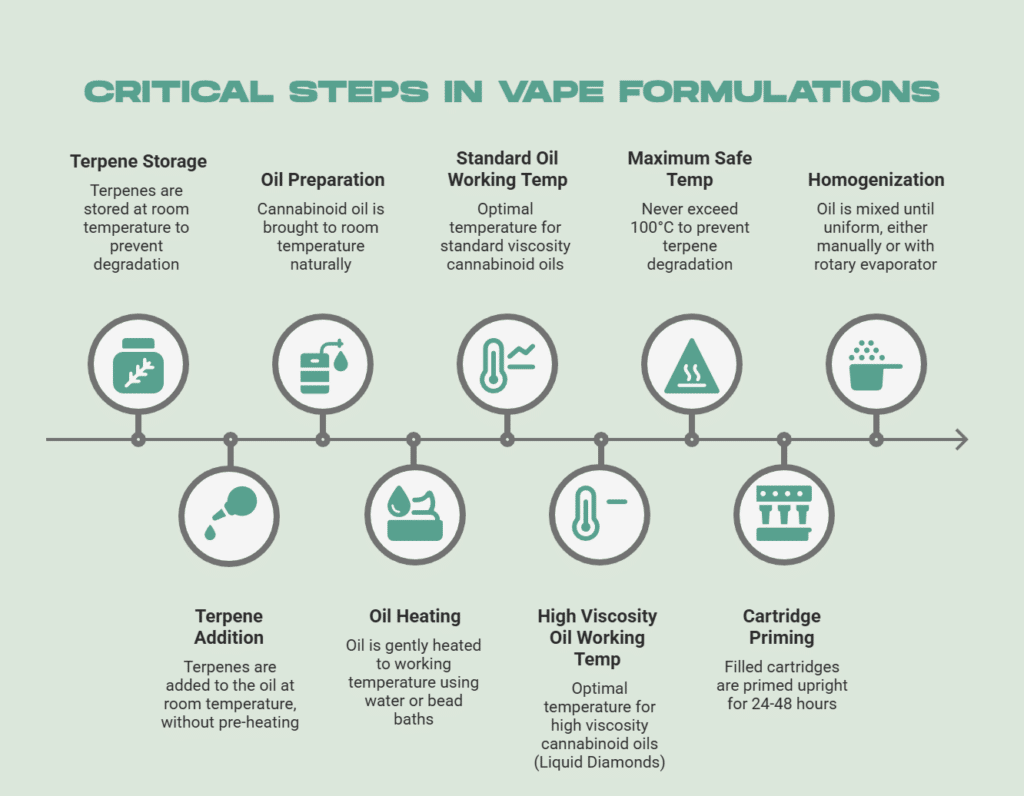
Successful formulation follows a systematic process that controls variables and enables consistent results. Each step builds on previous ones, with errors at any stage compromising final product quality. Here are the critical steps you need to be aware of:
Temperature Control and Oil Preparation
Cannabinoid oil preparation begins with bringing materials to room temperature naturally, never using direct heat sources to rush the process. Thermal shock can create quality issues, while controlled warming preserves material integrity. Once at ambient temperature, oils should be gently heated to working temperature using water or bead baths that provide even, controlled heat distribution.
Optimal temperature for vape formulation are:
- Standard Viscosity Cannabinoid Oils: 55-65°C working temperature
- High Viscosity Cannabinoid Oils (Liquid Diamonds): 65-75°C for proper flow
- Maximum Safe Temperature: Never exceed 100°C under any circumstances
- Terpene Storage and Handling: Room temperature (20-25°C)
- Terpene Addition: Room temperature. Do not pre-heat terpenes
According to research published in Environmental Science & Technology, terpene degradation byproducts increase significantly at elevated temperatures. Maintaining temperatures in the optimal range preserves both cannabinoid and terpene quality throughout the formulation process.
Achieving Proper Homogenization
Homogenization quality directly impacts product consistency and consumer experience.
Incomplete mixing creates stratification where terpene concentrations vary throughout the batch, leading to unpredictable flavor and performance. Thorough mixing ensures every cartridge filled from a batch delivers identical characteristics.
Manual mixing with stainless steel spatulas works for small R&D batches but requires patience and technique. The mixing process should continue until no visual separation remains and the formulation appears completely uniform.
For teams processing larger batches or seeking enhanced consistency, rotary evaporators provide superior homogenization through controlled agitation.
Cartridge Priming and Testing Protocols
Filled cartridges require adequate priming time before evaluation to guarantee accurate performance assessment. The minimum priming period is 24 hours standing upright, though 48 hours provides more reliable results. Insufficient priming causes wick saturation problems that create false negative results unrelated to formulation quality.
Rushing the priming process represents one of the most common formulation testing errors. Teams eager to evaluate new formulations often test prematurely, experiencing poor performance that leads them to abandon viable formulations.
Patient priming eliminates this variable, ensuring performance issues reflect actual formulation problems rather than incomplete preparation.
Evaluating Formulation Performance
Evaluation separates successful formulations from those requiring further development. Without structured assessment criteria, teams struggle to compare formulations objectively or identify specific improvement areas. A consistent evaluation framework enables data-driven decisions rather than subjective preferences. If this is your first time evaluation the performance of your product, here are some things you need to look at:
Key Metrics for Vape Cart Assessment
Performance evaluation should assess multiple dimensions beyond simple taste testing. Vapor production, draw resistance, consistency throughout the cartridge, and hardware compatibility all contribute to overall product quality.
The non-negotiable performance metrics include:
- Flavor Profile Accuracy: Does the formulation deliver intended terpene characteristics?
- Flavor Intensity: Appropriate strength without harshness or overwhelming vapor
- Vapor Production Consistency: Steady output from first to last draw
- Vapor Density: Satisfying cloud production, indicating proper viscosity
- Draw Resistance: Effortless airflow that feels natural, not too tight or too loose
- Wicking Performance: No dry hits, burnt taste, or flooding throughout cartridge life
- Hardware Compatibility: Proper function with the intended battery and cartridge combination
- Consistency Over Time: Stable performance as cartridge empties
Looking for more accurate specifications? Download our R&D vape formulation guide to learn more today.
Hardware Compatibility Testing
Battery performance significantly impacts formulation evaluation accuracy. Inconsistent or underperforming batteries introduce variables that confound the assessment of formulation quality.
Many R&D teams waste time “fixing” formulations that actually perform well when paired with properly functioning batteries. Using reliable, consistent batteries during testing eliminates this variable.
Different cartridge designs perform optimally with different viscosity ranges, making formulation success highly dependent on hardware selection. Teams should either formulate specifically for their chosen hardware or test formulations across multiple cartridge types to identify best matches.
Documentation and Iteration Best Practices
Documentation turns individual tests into institutional knowledge that accelerates future development. Each iteration of a formulation is a learning experience and should be treated as such.
Recording exact weights, temperatures, timing, cannabinoid sources, terpene profiles, and performance observations creates reproducible protocols. When successful formulations need replication or scaling, detailed documentation eliminates guesswork and reduces development time.
Scoring rubrics standardize evaluations across different team members and testing sessions. Consistent criteria enable valid comparisons between formulations tested weeks apart or by different evaluators. Many teams develop custom rubrics addressing their specific product goals, though structured frameworks outperform informal note-taking regardless of specific format.

Building Your Vape Product Line with Terpene Belt Farms
Successful vape formulation combines precise methodology with quality inputs and systematic testing protocols. The process outlined here provides R&D teams with essential best practices for developing consistent, high-performing products that meet market demands.
However, formulation excellence requires more than just proper techniques. It demands premium cannabis-derived terpenes that deliver authentic strain profiles and batch-to-batch reliability.
Terpene Belt Farms specializes in 100% cannabis-derived terpenes extracted from California-grown Cannabis Sativa L, providing the authentic profiles that discerning formulators require.
Unlike botanical alternatives that capture only 8-12 major compounds, our native cannabis terpenes preserve the complete molecular complexity of strain-specific profiles with 150+ distinct compounds. This authenticity translates directly to superior vape experiences that consumers recognize and value.
Every batch undergoes rigorous testing with complete documentation, providing the certificates of analysis and consistency data that production teams need for scalable manufacturing.
Our vertical integration from cultivation through extraction ensures supply chain reliability and quality control that eliminates the variability plaguing many terpene suppliers. When formulation success depends on reproducible inputs, Terpene Belt Farms delivers the consistency that transforms R&D protocols into production realities.
Ready to make your next vape formulation your best one yet? Request samples to experience the difference authentic strain profiles make for your product line.
Frequently Asked Questions About Cannabis Vape Formulation
What Is the Ideal Terpene Percentage for THC Distillate Vapes?
The optimal terpene incorporation rate depends on cannabinoid oil viscosity: 10% for high viscosity liquid diamonds, 7.5% for standard viscosity distillate (90%+ purity), and 5% for low viscosity materials. These percentages ensure proper cartridge wicking while delivering appropriate flavor intensity.
How Long Should Vape Cartridges Prime Before Testing?
Minimum priming time is 24 hours standing upright, though 48 hours provides more reliable performance assessment. According to vaporization research, inadequate priming causes false negative results from incomplete wick saturation rather than formulation problems.
What Temperature Should I Use When Mixing Terpenes with Distillate?
Maintain cannabinoid oil between 55-65°C during formulation, never exceeding 100°C. Terpenes should be at room temperature when added—avoid directly heating terpenes as their volatility causes evaporative losses. Use water or bead baths for controlled, even heating.
Can I Use the Same Formulation for Different Cartridge Brands?
Different cartridge designs perform optimally with specific viscosity ranges, requiring formulation adjustments when changing hardware. Test formulations with your specific cartridge model, as wick materials, airflow designs, and chamber volumes affect performance. What works in one cartridge may clog or leak in another.
Why Does My Vape Oil Separate After Mixing?
Separation typically indicates insufficient mixing temperature or inadequate homogenization time. Ensure cannabinoid oil reaches proper working temperature (55-65°C) before adding terpenes, then mix thoroughly until completely uniform. Proper terpene integration techniques prevent stratification and ensure consistent performance.
What’s the Difference Between Cannabis-Derived and Botanical Terpenes for Vapes?
Cannabis-derived terpenes contain the full complexity of authentic strain profiles with 150+ compounds, while botanical alternatives typically include only 8-12 major terpenes. Cannabis-derived terpenes deliver more accurate strain characteristics and entourage effects, though both require similar incorporation rates based on cannabinoid viscosity.
How Do I Know If My Distillate Is Standard or High Viscosity?
Potency testing is the clearest indicator. Standard viscosity distillate exceeds 90% THC, while high viscosity (liquid diamonds) approaches 99% purity from THC isolate. Visually, high viscosity oils flow extremely slowly at room temperature and may appear almost solid, requiring more warming for handling than standard distillate.
Sources Used for This Article
- Headset: “A look at Cannabis Vapor Pen sales trends” – headset.io/industry-reports/a-look-at-cannabis-vapor-pen-sales-trends
- OSHA: “Personal Protective Equipment” – osha.gov/personal-protective-equipment
- ACS Publications: “Emissions from Heated Terpenoids Present in Vaporizable Cannabis Concentrates” – pubs.acs.org/doi/10.1021/acs.est.1c00351