
Quick Answer: Terpene degradation causes 30-50% product loss within six months when stored improperly. Heat, oxygen, UV light, and humidity fluctuations systematically destroy volatile monoterpenes that define cannabis product quality.
Commercial manufacturers require integrated preservation protocols, including refrigerated storage (35-45°F), amber borosilicate containers, nitrogen-flushed headspace, and continuous environmental monitoring, to maintain 80-95% terpene retention throughout distribution cycles. Proper protocols prevent reformulation costs, customer complaints, and regulatory compliance failures while extending product shelf life from months to years.
Key Takeaways
- Terpene loss occurs through volatility, heat exposure, light degradation, oxidation, and humidity imbalance, making storage stability a systems-level challenge for cannabis operations.
- Monoterpenes degrade far faster than sesquiterpenes, requiring colder storage and tighter environmental controls to maintain product consistency over time.
- Temperature stability between 60 and 70°F significantly improves terpene retention, while refrigeration is necessary for live resin and other high-terpene formulations.
- Amber glass or stainless-steel containers reduce oxygen and UV exposure, helping prevent oxidation and photochemical breakdown during storage and distribution.
- Facilities extend shelf life by minimizing headspace, using nitrogen flushing, maintaining 55 to 62 percent relative humidity, and running routine terpene verification through GC-MS testing.
- Partner with Terpene Belt Farms for our wholesale services and see how our Fresh Never Frozen cannabis-derived terpenes support consistent profiles across your commercial formulations.
Your lab just approved a perfect batch. Terpene analysis shows exactly the profile you formulated. Three months later, customer complaints roll in about “off” flavors and weak effects. Retail partners report the same SKU tastes completely different than initial samples. Your quality control didn’t fail. Your terpenes simply evaporated.
This scenario plays out daily across cannabis manufacturing facilities. Formulators spend weeks dialing in precise ratios, only to watch volatile monoterpenes disappear during distribution.
The difference comes down to preservation protocols. Temperature fluctuations, oxygen exposure, improper containers, and UV light systematically destroy the compounds that define product quality. Yet most facilities treat terpene storage as an afterthought and apply the general “cool, dark place” guidance to products containing some of the most volatile compounds in commercial cannabis.
This technical guide addresses terpene preservation from a production perspective, covering the environmental controls, container selection, handling procedures, and quality verification methods that separate consistent commercial operations from operations constantly firefighting quality problems.
Why Terpenes Degrade Over Time
Terpene degradation isn’t random product failure; it’s basic chemistry.
Five environmental factors systematically destroy these volatile compounds during storage, transportation, and retail display. Manufacturing facilities need to compensate for these degradation mechanisms and make targeted interventions that extend product shelf life by months while maintaining consistent quality.
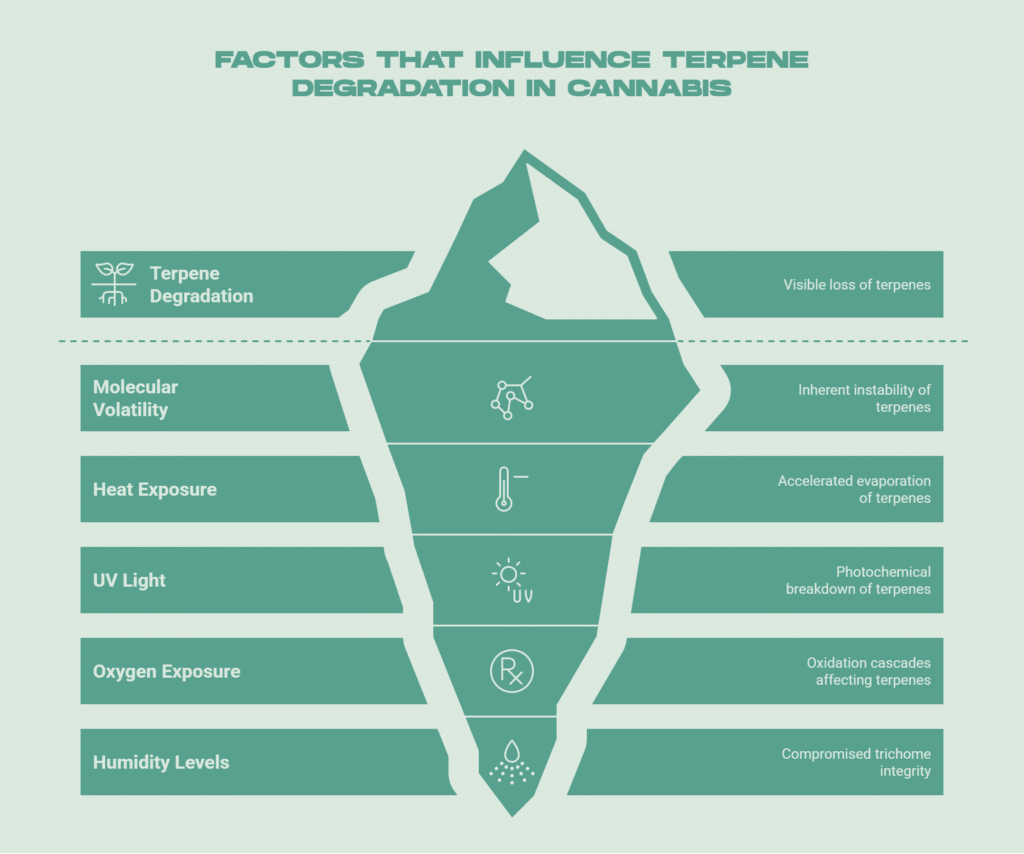
1. Molecular Volatility Creates Inherent Instability
Cannabis terpenes consist of two primary molecular classes with drastically different preservation needs.
According to peer-reviewed research on terpene thermal stability, monoterpenes exhibit high volatility with boiling points ranging from 155-185°C, while sesquiterpenes demonstrate greater stability at 200-275°C.
| Terpene Class | Structure | Boiling Range | Stability Duration |
| Monoterpenes (C10H16) | α-Pinene, β-Myrcene, Limonene | 155-185°C | 6-12 months (refrigerated) |
| Sesquiterpenes (C15H24) | β-Caryophyllene, Humulene, Bisabolol | 200-275°C | 18-24 months (cool/dark) |
This volatility difference creates formulation challenges for product developers. A concentrate profile dominated by myrcene and pinene requires cold storage immediately post-extraction. Sesquiterpene-heavy profiles like OG variants show greater shelf stability but may still degrade through oxidation if oxygen exposure occurs during manufacturing.
Commercial operations benefit from terpene analysis at multiple production stages. Gas chromatography analytical methods provide quantitative data on individual terpene retention rates, identifying which compounds volatilize fastest under specific storage conditions.
2. Heat Accelerates Evaporation Exponentially
Temperature represents the most critical variable controlling terpene degradation rates. Scientific studies on terpene thermal degradation confirm that each 10°F increase above optimal storage conditions approximately doubles terpene loss rates through accelerated evaporation.
Products stored at 75-85°F experience 30-50% terpene loss within 6 months, while identical products maintained at 60-70°F retain 70-80% of original profiles over the same period. Refrigerated storage at 35-45°F extends documented retention rates beyond 90% after 12 months, which is particularly critical for live resin and fresh-frozen extracts containing high monoterpene concentrations.
Temperature fluctuations cause more damage than static elevated temperatures. Products stored in facilities with 10-15°F daily temperature swings experience accelerated degradation compared to stable slightly-elevated storage.
Research on alpha-pinene degradation under different storage conditions shows freeze-thaw cycles introduce condensation that promotes oxidation, while brittle trichome structures fracture during handling at sub-zero temperatures.
3. UV Light Triggers Photochemical Breakdown
Ultraviolet radiation causes direct photochemical degradation of terpene molecular structures. The same alpha-pinene degradation study we mentioned above talks about how product exposure to direct sunlight loses measurable terpene content within hours, with UV wavelengths between 280-400nm causing maximum damage.
Laboratory testing demonstrates rapid terpene oxidation even under standard facility lighting. Samples stored under LED lights showed 15-20% terpene loss over 90 days, while dark-stored controls retained 95%+ of original profiles.
This degradation continues throughout distribution and retail display, particularly for products in clear or poorly-shielded containers.
4. Oxygen Exposure Initiates Oxidation Cascades
Oxidation represents the primary non-temperature degradation mechanism affecting stored terpenes. Atmospheric oxygen reacts with terpene double bonds, creating hydroperoxides and epoxides with altered aromatic profiles. Research on vapor phase terpene antioxidant effects shows that even brief oxygen exposure initiates oxidation chains that continue throughout storage.
Production workflows that repeatedly expose bulk materials to atmospheric oxygen during formulation accelerate cumulative degradation. Each container opening introduces fresh oxygen that reacts with remaining terpenes. Partially-filled containers with large headspace volumes experience faster oxidation than fully-filled containers with minimal air exposure.
5. Improper Humidity Levels Compromise Trichome Integrity
Relative humidity outside optimal ranges damages terpene-containing structures. The same vapor phase terpene research above shows humidity above 65% RH promotes mold growth that destroys terpene profiles, while conditions below 50% RH make trichomes brittle and prone to mechanical damage during handling.
Flower products are particularly difficult when it comes to balancing moisture content with terpene preservation.
Over-dried material shatters trichomes during packaging operations, releasing volatile compounds immediately. Excessive moisture creates environments where microbial activity degrades both terpenes and cannabinoids before visible contamination appears.
How to Preserve Terpenes in Commercial Cannabis Production
Effective terpene preservation requires integrated protocols addressing temperature, oxygen, light, humidity, and container selection simultaneously. Facilities that implement these six strategies create environments where products maintain 80-95% terpene retention throughout typical distribution cycles.
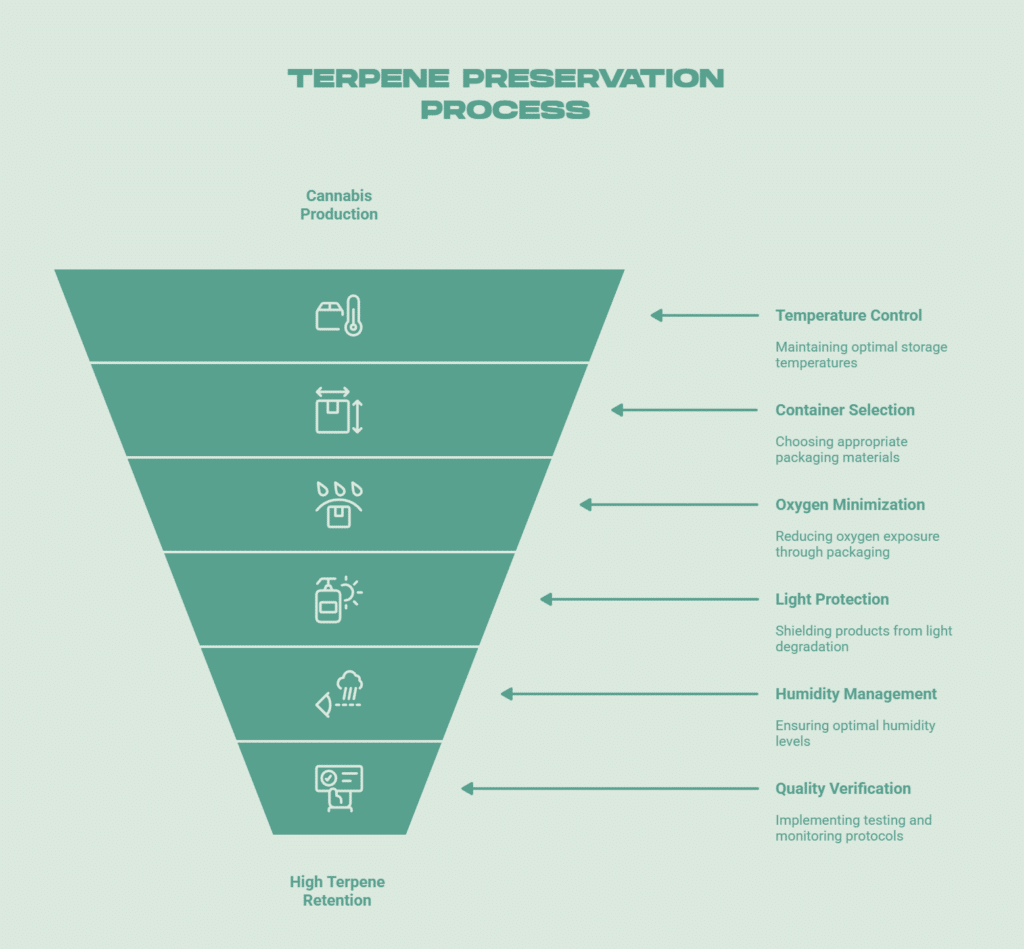
Implement Strict Temperature Controls
Maintaining storage between 60-70°F (15-21°C) dramatically extends terpene shelf life across most product categories. Different formulations require adjusted protocols based on terpene composition and concentration:
- Refrigeration (35-45°F): Optimal for live resin, fresh-frozen extracts, and high-HTFSE products containing volatile monoterpenes. Maintains retention rates exceeding 90% after 12 months.
- Cool Storage (60-70°F): Standard for most concentrate and vape cartridge production. Supports 70-80% terpene retention over 12 months without requiring refrigeration infrastructure.
- Climate-Controlled Distribution: Products must maintain temperature stability through entire supply chains. Temperature logging devices document cold-chain compliance during transportation and storage transitions.
Monitoring temperature at the product level, not just room level, provides accurate preservation data. Environmental sensors placed near inventory provide early warning when HVAC systems fail or when localized hot spots develop near loading docks or exterior walls.
Select Appropriate Container Materials
Container selection directly impacts terpene preservation through chemical compatibility, oxygen barrier properties, and light protection characteristics. Studies on terpene extraction and preservation confirm that material selection represents a critical preservation variable.
| Material | Terpene Compatibility | Oxidation Protection | UV Protection | Commercial Application |
| Borosilicate Glass (Amber) | Excellent – Zero interaction | High (when sealed) | Excellent | All concentrate types, bulk storage <5 gal |
| 316L Stainless Steel | Good – Minimal reactivity | Excellent | Excellent | Bulk storage >5 gal, non-acidic products |
| HDPE/PP Plastic | Poor – Leaching/absorption | Moderate | Poor | Not recommended for long-term storage |
| Silicone | Poor – Absorbs terpenes | Low | Moderate | Avoid for concentrates (20-40% loss) |
Amber borosilicate glass provides ideal storage for most applications, providing complete chemical inertness while filtering damaging UV wavelengths. Medical-grade 316L stainless steel serves bulk storage requirements exceeding 5 gallons, particularly for non-acidic formulations. Plastic containers leach plasticizers that contaminate terpene profiles, while silicone dab containers can absorb 20-40% of terpene content during extended storage.
Minimize Oxygen Exposure Through Packaging Strategies
Reducing the atmospheric oxygen contact extends shelf life dramatically. Multiple approaches provide oxidation protection based on production scale and equipment availability:
- Nitrogen Flushing: Purging container headspace with inert gas reduces oxygen below 1%, extending shelf life from 6-8 months to 18+ months for refrigerated products. This method requires nitrogen generators or a cylinder supply but provides maximum protection.
- Vacuum Sealing: Removes atmospheric oxygen without requiring specialty gases, though condensation may develop with residual moisture. Cost-effective for flower products and pre-packaged concentrates.
- Headspace Management: Fully-filled containers with minimal air volume maintain better stability than half-empty containers. Portioning bulk materials into smaller daily-use containers prevents exposing entire inventory batches to repeated oxygen exposure.
Production workflows that minimize container opening frequency reduce cumulative oxygen exposure, which is particularly important during terpene additions in concentrate formulation where multiple access cycles occur.
Protect Products From Light Degradation
Light exclusion provides simple but effective preservation improvements. Amber glass containers filter UV wavelengths while allowing visible light transmission for product inspection. Dark storage rooms provide complete light exclusion for bulk inventory not requiring regular access.
Immediate packaging of filled vape cartridges in opaque secondary packaging extends shelf life from 6 months to 12+ months by eliminating retail display lighting exposure. Facilities using standard LED lighting should implement dark storage for products during cure periods and intermediate storage before packaging operations.
Maintain Optimal Humidity Ranges
Relative humidity between 55-62% provides optimal conditions for preserving both terpenes and cannabinoids. This range prevents mold growth while avoiding excessive drying that makes trichomes brittle. Two-way humidity control packs maintain stable moisture levels without introducing external water that might promote microbial growth.
For flower products, NEU Bag infusion packs maintain moisture balance while introducing authenticated cannabis-derived terpenes. This dual-function approach prevents moisture loss while restoring aromatic profiles in aged inventory through controlled diffusion rather than liquid application.
Establish Quality Verification Protocols
Gas chromatography with mass spectrometry (GC-MS) provides gold-standard terpene quantification. Testing products at production and 30-day intervals generates retention data demonstrating preservation protocol effectiveness. Published methods for cannabinoid and terpene extraction analysis validate these analytical approaches for commercial operations.
Accelerated aging studies, storing products at elevated temperatures, provide stability data faster than real-time studies. Products stored at 40°C (104°F) for 30 days approximate degradation occurring during 6 months at 20°C (68°F), supporting shelf-life determinations without requiring 18+ month real-time studies.
Environmental monitoring systems tracking temperature and humidity across facility zones provide continuous data documentation. Batch-level documentation connecting products with storage conditions creates traceability chains required by most state regulatory frameworks, while staff training ensures handling procedures consistently support preservation protocols.
Terpene Reintroduction for Aged Products
Cannabis products that have lost terpene content through extended storage often require terpene reintroduction to restore commercial viability.
Rather than accepting inventory losses, manufacturers can implement targeted restoration strategies that return aged products to market-ready condition. The specific reintroduction method depends on product format, target terpene concentration, and production infrastructure available.
Terpene Reintroduction for Flower Products
Traditional spray application, often called “spray and pray”, creates multiple problems for flower reintroduction. Uneven distribution across flower batches causes inconsistent consumer experiences, with some buds heavily saturated while others receive minimal terpene additions.
Liquid application adds moisture that may trigger mold growth or cause products to fail microbial testing. The physical act of spraying also damages trichome structures, reducing visual appeal and potentially releasing cannabinoids.
NEU Bag infusion technology provides controlled diffusion-based introduction, migrating cannabis-derived terpenes from saturated mesh bags into flower over 48-72 hours. This gradual vapor-phase process is superior to terp sprays and distributes terpenes uniformly throughout product batches without adding moisture or requiring liquid handling equipment. The sealed environment prevents terpene loss to ambient air while allowing natural migration into flower structures.
NEU Bag application works particularly well for aged inventory that has lost volatile monoterpenes during extended storage.
Products stored beyond optimal timeframes can be restored to aromatic profiles comparable to fresh material. The technology also supports moisture management, maintaining 55-62% RH while introducing terpenes, addressing two preservation challenges simultaneously.
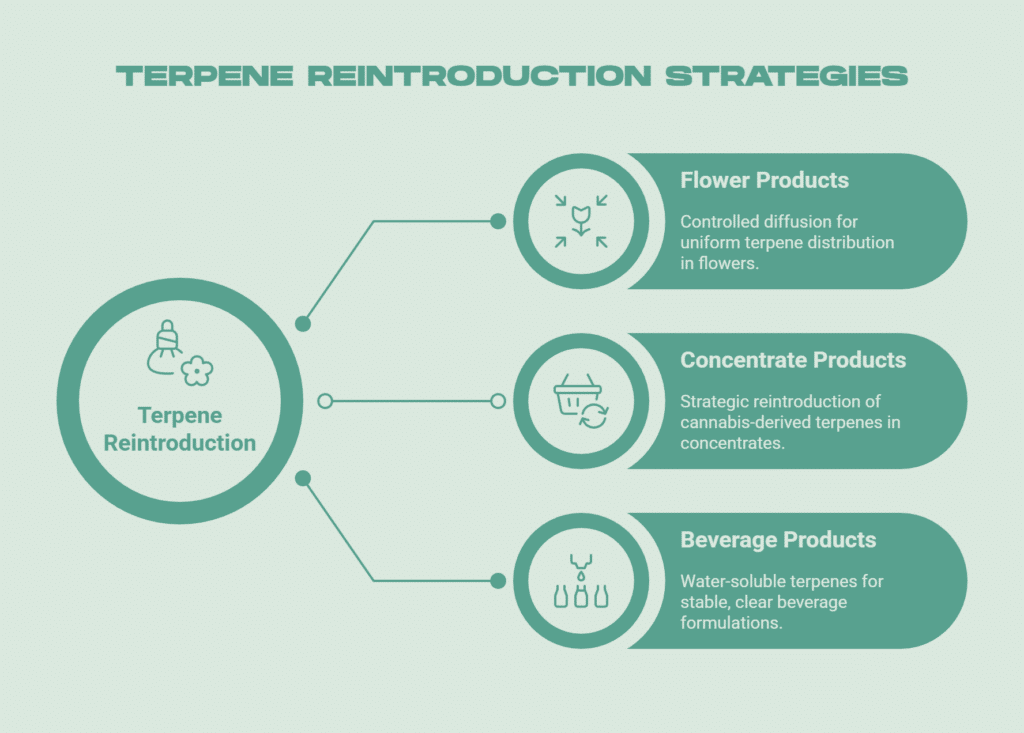
Terpene Reintroduction for Concentrates
Distillate products stripped during refinement lose the aromatic complexity and targeted effects that differentiate premium products from commodity offerings. Live resin formulations that have degraded during storage require profile restoration to match original specifications and maintain brand consistency.
Rather than accepting these losses or reformulating from scratch, manufacturers can restore commercial viability through strategic terpene reintroduction using authenticated cannabis-derived profiles.
Our cannabis-derived terpene collection provides formulators with strain-accurate profiles spanning dessert, fruit, gas, pine, and citrus categories, each preserved through Fresh Never Frozen extraction that captures complete terpene spectrums, including the minor compounds that create authentic cannabis experiences.
These profiles integrate directly into concentrate matrices at addition rates of 3-8% by weight, with specific percentages adjusted based on hardware compatibility and viscosity targets for your cartridge or pod systems.
Water-Soluble Terpene Formulations for Beverages
Beverage manufacturers trying to incorporate standard oil-based terpenes into aqueous products face immediate separation, cloudiness, and inconsistent dosing that makes products unsellable. The hydrophobic nature of traditional terpenes creates formulation nightmares requiring specialized emulsification equipment, extensive R&D timelines, and ongoing stability testing that delays product launches by months.
Most smaller operations lack the resources to solve these dispersion challenges in-house, forcing them to either abandon terpene-infused beverage concepts or accept substandard product quality.
Our emulsified terpene formulations eliminate these development barriers by arriving as water-compatible preparations ready for direct integration into your beverage production lines.
These nano-emulsified cannabis-derived terpenes maintain stability across pH ranges of 3.5-7.0, covering everything from acidic seltzers to neutral wellness drinks, while providing consistent terpene delivery without the cloudiness or separation that signals quality problems to distributors and consumers.
The formulations resist separation under refrigeration and throughout extended shelf storage, solving stability challenges that would otherwise require months of reformulation work.
Closing Thoughts — How Terpene Belt Farms Can Help Formulators
Terpene preservation challenges span cultivation, extraction, storage, formulation, and distribution. Manufacturers addressing only one variable while neglecting others still experience degradation, customer complaints, and reformulation costs. Successful operations treat preservation as a systems-level challenge rather than a storage afterthought.
Terpene Belt Farms addresses these challenges through Fresh Never Frozen extraction that captures complete terpene spectrums from California-grown Cannabis Sativa L. We package products in amber borosilicate glass with nitrogen-flushed headspace, ensuring terpenes arrive at your facility with the integrity needed for successful formulation.
Whether restoring aged concentrates, developing vape lines, infusing flower, or launching beverages, our cannabis-derived profiles support your manufacturing requirements with complete technical documentation and COA verification.
Ready to solve terpene preservation at the source? Shop our sample kits to evaluate how Fresh Never Frozen terpenes perform in your formulation protocols.
Frequently Asked Questions About Terpene Preservation
How Long Do Cannabis Terpenes Remain Stable in Storage?
Cannabis terpenes maintain 90%+ retention for 18-24 months at 60-70°F in airtight containers with 55-62% RH. Monoterpenes like myrcene degrade faster than sesquiterpenes like caryophyllene. Refrigerated storage at 35-45°F extends stability to 24-36 months.
What Causes Faster Terpene Degradation—Heat, Light, or Oxygen?
Heat represents the primary degradation driver, with each 10°F increase doubling terpene loss rates. Light causes photochemical degradation, especially UV wavelengths 280-400nm. Oxygen initiates oxidation cascades. Temperature control provides the largest preservation impact.
Can Lost Terpenes Be Restored to Products?
No, degraded terpenes cannot be reversed. However, products can be restored through controlled terpene reintroduction using authenticated profiles matching original strain characteristics. This creates products functionally equivalent to fresh material.
Do Different Terpene Profiles Need Different Storage Protocols?
Yes—monoterpene-heavy profiles (pinene, myrcene, limonene) require stricter temperature control than sesquiterpene-rich profiles. Live resin products containing 15-20% terpenes need refrigeration while reformulated distillate at 3-5% maintains stability at cool storage.
What Container Materials Work Best for Bulk Terpene Storage?
Borosilicate glass provides ideal storage offering complete chemical inertness. For bulk storage exceeding 5 gallons, medical-grade 316L stainless steel provides acceptable alternative for non-acidic products. Plastic containers leach plasticizers over time.
How Do Humidity Packs Affect Terpene Preservation?
Two-way humidity packs maintaining 55-62% RH provide preservation benefits by preventing moisture extremes. Salt-based formulations remain isolated inside membranes and don’t interact with terpenes. Benefit comes from maintaining optimal moisture preventing trichome brittleness or mold risk.
What Temperature Monitoring Satisfies Regulatory Requirements?
Most cannabis frameworks require continuous monitoring at 15-minute intervals, generating automated alerts when readings fall outside 60-75°F. Monthly calibration verification and quarterly third-party certificates provide compliance documentation. Specific requirements vary by state jurisdiction.
Sources Used for This Article
- American Chemical Society: “Thermal Degradation of Terpenes: Camphene, Δ3-Carene, Limonene, and α-Terpinene” – pubs.acs.org/doi/10.1021/es9810641
- Journal of Chromatography A: “Terpene degradation and extraction from basil and oregano leaves using subcritical water” – pubmed.ncbi.nlm.nih.gov/17126345/
- Environmental Science & Technology: “Degradation of alpha-pinene on Tenax during sample storage: effects of daylight radiation and temperature” – pubmed.ncbi.nlm.nih.gov/11452597/
- Cannabis and Cannabinoid Research: “Vapor Phase Terpenes Mitigate Oxidative Degradation of Cannabis sativa Inflorescence Cannabinoid Content in an Accelerated Stability Study” – pubmed.ncbi.nlm.nih.gov/35384716/