
Quick Answer: Hash terpenes are cannabis-derived aromatic fractions used to preserve or restore the distinctive flavor, texture, and cultivar identity lost during hash and rosin production. Unlike botanical or reconstructed blends, hash-specific terpenes are heavier and better aligned with solventless concentrates, allowing them to integrate without causing sharpness, separation, or instability.
They are typically reintroduced at low ratios, often under 1–3% by weight, after extraction to rebuild aroma, improve handling characteristics, and maintain consistency at scale. Proper sourcing, conservative dosing, gentle mixing, and controlled storage are critical to using hash terpenes successfully.
Key Takeaways
- Hash terpenes are cannabis-derived aromatic fractions used to restore aroma, texture, and cultivar identity lost during solventless hash and rosin production.
- These terpene inputs are typically heavier and less volatile than generic blends, allowing smoother integration without sharpness, separation, or instability.
- Terpene loss occurs during washing, drying, pressing, and storage, making post-extraction reintroduction a practical necessity for consistent hash quality.
- Effective hash terpene use requires conservative dosing, usually below 1–3% by weight, gentle mixing, and allowing time for full integration.
- Improper handling, excess heat, oxygen exposure, or over-application can accelerate grease-out and aroma degradation, undermining product stability.
- Partner with Terpene Belt Farms to source Fresh Never Frozen cannabis-derived hash terpene profiles backed by testing, consistency, and formulation support for solventless concentrates. Shop our sample kits for your R&D today.
Hash terpenes sit at the intersection of expectation and execution. Everyone wants the loud, greasy aromatics of high-quality hash, but very few teams actually manage to preserve or deploy them without something breaking downstream. Batches come off the line muted. Finished products lose their nose after packaging. What smelled perfect in R&D collapses once it hits real production volumes, heat, oxygen, or time.
For processors and formulators, the problem isn’t access, it’s control. Hash terpenes behave differently than steam-distilled botanicals or reintroduced CDT blends. Their volatility, solubility, and degradation pathways can quietly undermine carts, edibles, or infused flower if they’re handled like a generic terpene input.
This article breaks down what hash terpenes actually are at a functional level, why they fail in common production scenarios, and how to use them without sacrificing aroma, stability, or yield. If you’re trying to deliver true hash-forward flavor at scale, the details matter.
What Are Hash Terpenes and Why Do They Matter
Terpenes extracted from cannabis serve dual roles: aromatic compounds and formulation tools. When discussing “hash terpenes,” technical teams reference either the native terpenes in traditional hash (especially the unique compound hashishene found in aged preparations), or cannabis-derived oils formulated for reintroduction into modern concentrates to compensate for processing losses.
Hash is fairly popular in European countries like Germany and the Netherlands, and adding terpenes to hash for these markets has a wide range of benefits that are listed below
Benefits of Terpenes in Hash
Terpenes are the compounds that determine whether hash smells flat, sharp, greasy, floral, or unmistakably true to the plant it came from, and their role becomes especially critical once cannabis is concentrated.
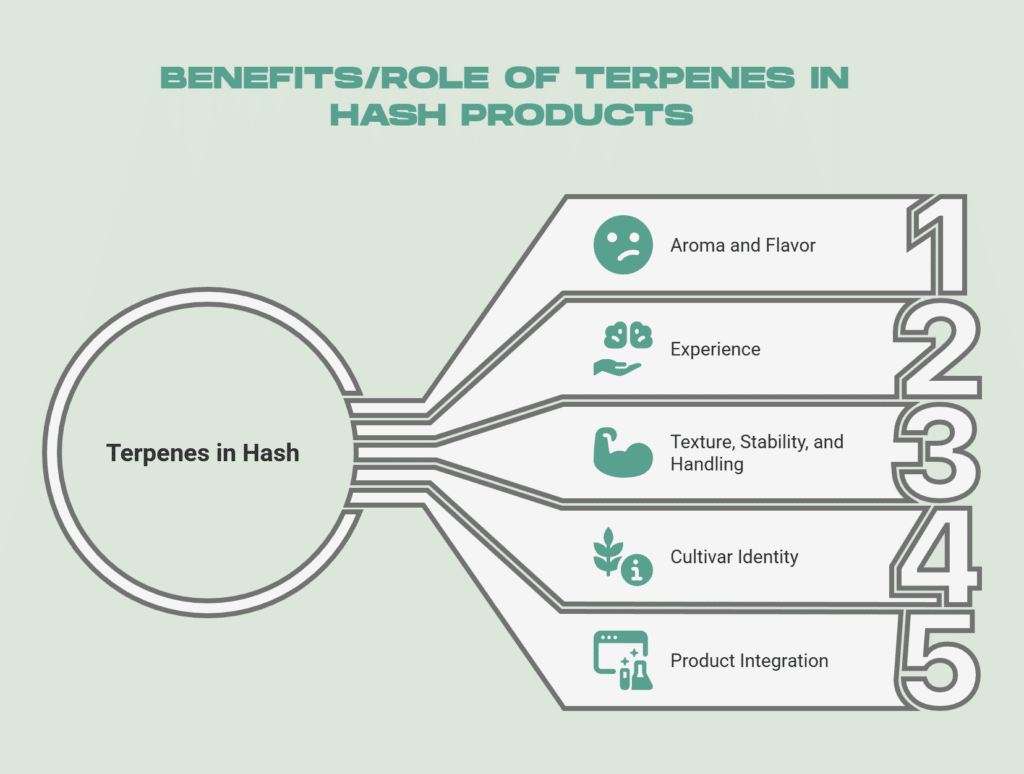
Hash Aroma and Flavor
At the most basic level, terpenes are volatile aromatic compounds produced in cannabis trichomes alongside cannabinoids. In hash, where plant material is removed and resin is concentrated, terpenes become the primary drivers of sensory experience. They define the intensity and clarity of aroma when a jar is opened, influence flavor fidelity from cold cure to combustion or vaporization, and create meaningful differentiation between cultivars that may otherwise share similar cannabinoid content.
Without sufficient terpene presence, hash can retain potency while losing the character that makes it recognizable, desirable, and repeatable for consumers.
The Experience
Beyond aroma, terpenes influence how hash is perceived during use. They modulate smoothness, perceived potency, and the balance between cerebral and physical effects, even when THC levels remain unchanged.
This is why two hash products with similar cannabinoid profiles can feel markedly different in practice. Terpene composition affects onset, intensity, and the way effects unfold, making them a critical variable in how consumers evaluate quality and consistency.
Texture, Stability, and Handling Benefits
Terpenes also play a structural role in hash and hash-derived products. Their interaction with cannabinoids affects viscosity, grease-out behavior, and how concentrates respond to temperature changes during storage and handling.
A balanced terpene fraction can help maintain desirable textures, reduce premature separation, and improve melt behavior during dabbing. From a production standpoint, this translates into better shelf stability and fewer issues as products move from curing to packaging to retail.
Cultivar Identity
Hash strips cannabis down to its most valuable components, but that concentration process can blur strain-specific traits if aromatics are lost. Terpenes are what carry cultivar identity through extraction, allowing products to retain recognizable genetic signatures rather than collapsing into generic potency.
They help maintain consistency across batches and protect brand trust tied to specific cultivars, especially in markets where consumers expect repeatable sensory outcomes.
Why Terpenes Matter as Hash Scales Into Products
As hash is further processed into rosin, vapes, edibles, or infused flower, terpene presence becomes increasingly important. Terpenes influence how well concentrates integrate into downstream formulations, how they perform under heat, and how closely finished products reflect their source material.
For manufacturers, terpene management is not an afterthought; it is a foundational quality control variable that directly impacts product performance, consistency, and commercial success.
Types of Terpenes Added to Hash
Not all terpenes behave the same once they’re introduced to hash. The source, composition, and processing method used to produce a terpene input directly affects aroma accuracy, stability, and how the final product performs during storage and use.
For manufacturers, choosing the right terpene type is less about marketing labels and more about functional compatibility with solventless concentrates.
Cannabis-Derived Terpenes
Cannabis-derived terpenes are extracted directly from cannabis biomass and retain the same compound ratios found in the source plant. Because they originate from cannabis, these terpenes integrate naturally with hash and hash rosin, often delivering the closest match to native cultivar expression.
Their molecular balance tends to support smoother incorporation, more authentic aroma, and better alignment with consumer expectations for solventless products. However, quality varies widely depending on extraction method, starting material, and post-processing, making supplier selection critical.
Botanical Terpenes
Botanical terpenes are isolated from non-cannabis plants such as citrus, pine, or herbs. While they offer consistency and cost advantages, their profiles rarely mirror cannabis resin accurately.
In hash applications, botanical blends can feel sharper or thinner, and may introduce notes that read as artificial when paired with solventless concentrates. They are more commonly used in downstream products where authenticity is less critical, rather than in premium hash or rosin.
Reconstructed Terpene Blends
Reconstructed blends combine individual terpene isolates to mimic a target aroma profile. These blends allow for precise control over composition but often lack the minor compounds that give hash its depth and complexity. In solventless products, reconstructed blends may deliver aroma upfront but fall short in texture, longevity, or melt behavior compared to more complete terpene fractions.
Each terpene type carries tradeoffs in accuracy, stability, and cost. In hash, where subtle differences are immediately noticeable, those tradeoffs become amplified, making terpene selection a foundational formulation decision rather than a finishing touch.
Terpene Loss During Hash and Rosin Production
Hash terpenes exist because even the cleanest solventless processes don’t fully preserve a plant’s original aromatic profile. By the time hash or rosin reaches post-processing, terpene loss has already occurred across multiple stages, each compounding the next. Here’s where your products are losing terpenes
Ice Water Hash Extraction
Ice water extraction preserves more native terpenes than solvent-based methods, but it is not lossless. Mechanical agitation ruptures trichome heads, allowing volatile compounds to dissolve into wash water where they cannot be recovered.
Drying worsens the situation here and introduces additional degradation, with air exposure and room-temperature handling accelerating oxidation and evaporation. Freeze drying significantly reduces this loss, but cost and throughput constraints mean most commercial operations accept some level of terpene degradation at this stage.
Rosin Pressing
Rosin pressing introduces thermal stress that volatilizes terpenes by design. Short, low-temperature presses help preserve delicate compounds like linalool and pinene but reduce yield, while longer or hotter presses improve returns at the expense of aroma.
Every operation chooses a balance based on margins and positioning, but that choice has direct consequences for final terpene expression.
Post-Extraction Storage: Silent Degradation
Even after extraction, improper storage continues to erode terpene content. Room-temperature storage, excess headspace, and oxygen exposure cause rosin to “grease out” as lighter aromatics separate and evaporate. Cold storage and tight packaging slow this process, but they don’t reverse losses that have already occurred.
Why Genetics Matter
Not all cultivars degrade equally. Genetics dominated by heavier sesquiterpenes remain stable longer, while high-monoterpene profiles shift texture and aroma rapidly without aggressive temperature control. This explains why some SKUs stay consistent while others fall apart under identical SOPs.
Taken together, these losses explain why many manufacturers turn to hash terpene reintroduction. Rather than accepting diminished aroma as inevitable, reintroduction allows processors to restore complexity and consistency closer to the plant’s original expression, after production realities have done their damage.
Post-Extraction Degradation
Improper storage accelerates terpene loss after extraction. Hash rosin stored at room temperature in containers with excessive headspace will “grease out” as terpenes separate and evaporate. Commercial operations implement cold storage (refrigeration short-term, freezing long-term) and minimal headspace packaging to mitigate losses.

Reintroducing Terpenes to Hash After Degradation
Once terpene loss has occurred during washing, pressing, and storage, the question shifts from preservation to restoration. Reintroducing terpenes into hash is not about masking defects or inflating aroma, it is about rebuilding what solventless processing inevitably strips away, while maintaining stability and authenticity.
Why Reintroduction Becomes Necessary
Even well-run solventless operations rarely retain the full native terpene fraction of the starting material. Volatile compounds are lost to water, air, and heat long before a finished hash or rosin is packaged. The result is often a product that tests strong but smells muted, separates unpredictably, or fails to carry cultivar identity through to the consumer.
Reintroduction allows manufacturers to correct those deficits after production realities have taken their toll, rather than redesigning entire extraction workflows.
Hash-Specific Terpenes as the Most Effective Solution
The most reliable way to restore aroma without destabilizing hash is through hash-specific, cannabis-derived terpene inputs. Terpene Belt Farms produces Fresh Never Frozen terpene oils and solventless-compatible fractions designed specifically for hash and hash rosin applications.
These terpene profiles are heavier, less volatile, and better aligned with the compounds that naturally survive solventless extraction. As a result, they integrate smoothly, preserve texture, and rebuild aroma without introducing sharpness or excessive volatility.
Unlike generic CDT or botanical blends, these inputs are engineered to complement hash, not fight it. This reduces grease-out, improves shelf stability, and delivers aroma that reads as native rather than reassembled.
Fresh Never Frozen Terpene Product Recommendations
When selecting terpene inputs for hash reintroduction, specificity matters. Broad profiles tend to overpower solventless concentrates, while more focused fractions integrate cleanly and preserve texture. The following Terpene Belt Farms products are well-suited for hash and hash rosin applications where control and authenticity are priorities.
When restoring aromatic complexity in hash, starting with a profile that aligns with your target sensory outcome is key. For a bright, fruit-forward character that doesn’t overpower solventless concentrates, consider 2023 Fruit #132. This hemp-derived terpene oil is rich in α-pinene, myrcene, limonene, and β-ocimene, producing citrus, floral, and sweet layers similar to Cherry Bomb and Cherry Pie, making it a strong fit for dessert-leaning hash formulations while preserving aromatic depth.
If you want to shift toward crisp, resinous energy that complements citrus and pine-leaning hash profiles, 2023 Pine #122 is a great next step. Also hemp derived, this profile is dominated by terpinolene with supporting myrcene, β-caryophyllene, and limonene, translating into fresh apple and lemon zest balanced with grounding pine undertones.
Its brightness helps revitalize muted concentrates while fitting well with solventless texture stability needs.
For a richer dessert-style profile that still holds up structurally, 2024 Dessert #116 rounds out the lineup. Extracted using Fresh Never Frozen methods, this oil features high levels of limonene and β-ocimene paired with β-caryophyllene and α-pinene to deliver lemon-pound-cake-inspired aromatics with sweet, citrusy body.
Because it’s engineered for nuanced complexity rather than one-dimensional sweetness, it integrates smoothly into concentrates, helping hash retain sensory richness without destabilizing texture or accelerating volatility.
Alternative Approaches to Terpene Reintroduction
Some manufacturers attempt to compensate for terpene loss by blending cultivars, adjusting cure conditions, or relying on higher yields to offset sensory shortcomings. Others turn to botanical terpenes or reconstructed blends for cost or availability reasons.
While these approaches may increase aroma intensity, they often introduce mismatched notes, accelerate separation, or compromise melt behavior. In hash, these shortcomings are immediately noticeable and difficult to hide.
Formulation Recommendations for Terpene-Infused Hash
Successfully reintroducing terpenes into hash is less about the act of addition and more about how the material is handled before, during, and after infusion. Small deviations in temperature, ratio, or post-processing can undo the benefits of even the best terpene inputs.
Start With Fully Stabilized Hash
Terpenes should only be introduced once hash or hash rosin has reached a stable state. Infusing too early, while the moisture content or internal structure is still shifting, increases the risk of separation and uneven distribution.
Hash should be properly dried or cured, and rosin should be allowed to nucleate or settle before terpene introduction. This ensures the terpene fraction integrates into a predictable matrix rather than migrating unpredictably as the product evolves.
Control Ratios Conservatively
More terpene is not better in hash applications. Solventless concentrates are already terpene-rich relative to distillate, so reintroduction should focus on restoration, not amplification.
Most manufacturers find success at significantly lower inclusion rates than vape formulations, often starting below one percent by weight and adjusting incrementally. Overloading terpenes increases volatility, accelerates grease-out, and can thin texture beyond acceptable handling limits.
Use Gentle, Uniform Mixing
Mechanical force should be minimized during terpene incorporation. Excess agitation introduces heat and oxygen, both of which accelerate terpene degradation.
Slow, controlled folding or low-shear mixing allows terpenes to distribute evenly without disrupting texture. Uniformity is critical, uneven terpene pockets can lead to inconsistent aroma, melt behavior, and consumer experience.
Allow Time for Integration
After infusion, terpene-infused hash benefits from a short resting period under controlled conditions. This allows the terpene fraction to equilibrate within the concentrate rather than sitting on the surface. Rushing directly to packaging increases the likelihood of separation or aroma loss during early storage.
Storage After Terpene Infusion
Post-infusion storage is where many otherwise solid formulations quietly fail. Once terpenes have been reintroduced, the hash matrix becomes more volatile and more sensitive to environmental variables.
Temperature swings, oxygen exposure, and excess headspace can all undo careful formulation work by accelerating evaporation, oxidation, and separation.
Terpene-infused hash should be stabilized immediately after integration. Key storage techniques here include:
- Maintain consistent cold storage, avoiding repeated temperature cycling that encourages terpene movement and grease-out
- Minimize headspace in jars or containers to reduce oxygen availability and terpene evaporation
- Use airtight, low-permeability packaging materials that slow terpene migration and oxidation
- Avoid clear containers when possible, as light exposure can contribute to terpene degradation
- Allow the product to return to working temperature gradually before handling, rather than rapid warming that can force separation

Closing Thoughts — Partnering with Terpene Belt Farms for Terpene Sourcing
For manufacturers serious about reclaiming authentic cannabis aromatics in hash and concentrates, sourcing matters as much as formulation technique. Terpene Belt Farms is one of the few vertically integrated producers capturing Fresh Never Frozen® cannabis essential oil directly from peak-ripe plants grown on our own California farm, without curing, drying, or freezing. This proprietary process preserves a fuller aromatic spectrum and minor terpene components that generic CDT or botanical blends simply can’t match.
We combine scalable supply chain reliability with vintage-driven profiles that reflect California terroir, and we engage directly with R&D and manufacturing partners to ensure product consistency and compliance. Whether you’re rebuilding hash terpenes or crafting premium concentrates, working with a supplier who treats purity, stability, and cultivar fidelity as non-negotiables sets your formulations up for success.
Want to work with the best in cannabis-derived terpenes? Partner with Terpene Belt Farms for our wholesale services to learn more today.
Frequently Asked Questions About Hash Terpenes
What’s the Difference Between Hash Terpenes and Regular Cannabis Terpenes?
“Hash terpenes” typically describes cannabis-derived terpene oils formulated specifically for reintroduction into hash and concentrate products to restore aromatic compounds lost during processing. These are the same cannabis terpenes found in flower, but the term emphasizes their application in hash enhancement rather than their source.
Some producers also use “hash terpenes” to reference the unique compound hashishene that forms in aged traditional hash through beta-myrcene oxidation.
Can You Add Terpenes to Hash Rosin Without Affecting Potency?
Yes, properly executed terpene additions at appropriate ratios (1-3% by weight) do not significantly alter cannabinoid concentration or potency. The slight dilution effect from added terpenes is minimal—adding 2% terpenes to 1 gram of 75% THC rosin reduces THC concentration to approximately 73.5%, an imperceptible difference for consumers. The enhanced aromatic profile and improved entourage effect typically provide superior overall experience despite nominal potency reduction.
How Much Do Cannabis-derived Terpenes Cost Compared to Botanical Alternatives?
Cannabis-derived terpenes typically wholesale between $30-80 per gram depending on extraction method and profile rarity, while botanical terpene blends generally range $15-40 per gram. The cost differential reflects agricultural investment, specialized extraction infrastructure, and limited supply inherent to cannabis cultivation. For premium concentrate operations, the quality advantages of cannabis-derived profiles justify higher input costs through improved product differentiation and consumer willingness to pay premium pricing.
What Terpene Ratio Should I Use for Hash Enhancement?
Optimal ratios vary by concentrate format and starting terpene content. Hash rosin typically requires 1-2.5% terpene addition, traditional pressed hash responds well to 0.5-2%, and bubble hash performs best with 1-3% depending on native terpene retention. Start with conservative ratios (1% for rosin, 0.5% for traditional hash) on small test batches, evaluate results after appropriate cure periods, then adjust upward if stronger aromatic intensity proves desirable for your target market positioning.
Do Terpenes Affect Hash Rosin Consistency and Texture?
Yes, terpene additions directly influence concentrate consistency. Higher terpene percentages create more viscous, “wet” textures while lower concentrations maintain firmer, more stable products. This relationship allows strategic texture optimization—producers targeting vape applications may intentionally use higher terpene ratios (2-3%) to achieve appropriate viscosity, while dab-focused products benefit from conservative additions (1-1.5%) that preserve stable handling characteristics.
How Long Do Added Terpenes Last in Hash Products?
Properly stored hash concentrates with added terpenes maintain quality for 6-12 months under optimal conditions (refrigeration or freezing, minimal headspace, light protection). Terpene degradation accelerates with exposure to heat, light, and oxygen—products stored at room temperature in partially filled containers may experience noticeable aromatic decline within 2-3 months. Cold storage in airtight glass containers significantly extends shelf life while preserving both cannabinoid and terpene quality.
Can You Mix Different Terpene Profiles in One Hash Batch?
Yes, blending multiple terpene profiles enables custom aromatic creation beyond single-profile limitations. Combine complementary profiles (e.g., 60% Gas with 40% Fruit) to develop unique sensory characteristics that differentiate products in competitive markets. Test blends systematically on small batches before scaling—document exact ratios and evaluate results across 48-72 hour cure periods. Most operations find that 2-3 profile blends deliver optimal complexity without creating muddled or confused aromatic profiles.
Sources Used for This Article
- The Cannigma: “What is hashishene? Examining the unique chemistry of hashish” – cannigma.com/plant/terpenes/what-is-hashishene-examining-unique-chemistry-hashish/
- Healthline: “Cannabis Terpenes: What They Are and How They Work” – healthline.com/health/cannabis-terpenes