
Quick Answer: Linalool is a monoterpene alcohol (C₁₀H₁₈O) found in cannabis, lavender, coriander, and over 200 other plant species. It carries a distinctly floral, lavender-forward aroma and is most recognized for its calming, anxiolytic, and sedative properties.
In formulation, linalool rarely appears as the dominant terpene in cannabis profiles, but it plays a critical supporting role: softening harsh notes in distillate, contributing mouthfeel in concentrates, and anchoring the relaxation arc in sleep and wellness products. Recommended working concentrations range from 1–3% in vapes, 3–10% in concentrates, and 0.5–1.5% in edibles, depending on target format and effect profile.
Key Takeaways
- Linalool is a monoterpene alcohol (C₁₀H₁₈O) found in cannabis and over 200 plants, including lavender and basil, contributing a floral aroma and calming pharmacological profile.
- In cannabis, linalool usually appears as a supporting terpene at roughly 0.05–1.5% of flower composition, rather than a dominant compound like myrcene or limonene.
- Its primary mechanisms include GABA-A receptor modulation, producing anxiolytic and sedative effects similar to benzodiazepine pathways without strong motor impairment.
- Research shows inhaled linalool reaches peak plasma levels around 72.7 ng/ml after 40–45 minutes, indicating inhalation provides higher bioavailability than dermal application.
- Recommended formulation ranges include 1–3% in vape terpene blends, 3–10% in concentrates, and 0.5–1.5% in edibles, depending on delivery format and target effect profile.
- Linalool pairs effectively with myrcene for sleep sedation, β-caryophyllene for anti-inflammatory wellness products, and limonene for clear-headed daytime calm.
- Shop R&D samples from Terpene Belt Farms to evaluate Fresh Never Frozen cannabis-derived terpene profiles with full COA documentation for formulation-grade consistency.
What Is the Linalool Terpene?
Linalool shows up in a lot of products, from perfumes to household cleaners to cannabis cartridges. Most people encounter it daily without realizing it. But the version that matters to formulators is a much more precise subject than “the lavender terpene,” and treating it as such changes how you deploy it.
Chemical Profile and Botanical Origins
Linalool is a monoterpene alcohol with the molecular formula C₁₀H₁₈O. That hydroxyl group is what chemically distinguishes it from monoterpene hydrocarbons like limonene or pinene. The alcohol functional group increases polarity, improves miscibility in both oil and water matrices compared to pure hydrocarbons, and influences how the molecule interacts with receptor systems in the body.
It exists in two enantiomeric forms. (R)-(–)-linalool, which dominates in lavender and is the more studied form, and (S)-(+)-linalool, which appears in coriander, basil, and some cannabis cultivars. This matters in authenticity discussions, as botanical-sourced linalool and cannabis-derived linalool may have different enantiomeric ratios that influence both odor character and pharmacological behavior.
Linalool is found in over 200 plant species, including lavender, rosewood, coriander, birch, basil, mint, and cinnamon. It has been used in traditional Chinese, Ayurvedic, Egyptian, and Roman medicine for centuries, specifically for anxiety, insomnia, and infections.
Modern research is now beginning to validate many of those applications with preclinical data.
How Much Linalool Is Actually in Cannabis?
Linalool is not a dominant terpene in most cannabis cultivars. Lab data compiled across commercial cannabis consistently shows that terpenes like myrcene, limonene, caryophyllene, and terpinolene occupy the top positions. Linalool typically appears in the 0.05–1.5% range in finished flower, and meaningful formulation-relevant concentrations (above 0.5%) are found in a narrower subset of genetics.
Cannabis Strain Profiles With Notable Linalool Expression
Linalool-forward genetics tend toward indica or indica-leaning hybrid expression. The strains listed below are among the most referenced in literature and consumer data for linalool contribution:
- Granddaddy Purple: High myrcene and caryophyllene with linalool as a meaningful tertiary; full-body sedation with floral sweetness
- Do-Si-Dos: Floral and sweet, linalool contributes to the smooth, calm finish that defines this strain’s closing character
- Lavender (Soma Seeds): One of the rare cultivars where linalool approaches primary terpene status; the floral aroma is distinct and unmistakable
- Amnesia Haze: Terpinolene-dominant with linalool adding floral complexity; notable because linalool softens what would otherwise be an almost purely stimulating profile
- LA Confidential: Piney and sedative, linalool reinforces the relaxation arc alongside myrcene
- Wedding Cake: Caryophyllene and humulene dominant; linalool adds anxiolytic depth and smooths the bouquet at lower concentrations
Linalool Effects and Mechanisms of Action
A lot of content on linalool stops at “it’s calming.” That’s accurate but incomplete. What’s actually happening at the neurochemical level gives formulators a defensible framework for positioning products and explaining effect claims to retail partners and R&D teams.
GABA-A Receptor Modulation and Anxiolytic Activity
The most mechanistically documented property of linalool is its interaction with the GABAergic system. Research suggests linalool allosterically modulates GABA-A receptors of the α1β2γ2 subtype, the same sedative receptor subtype targeted by benzodiazepine drugs. This allosteric potentiation increases inhibitory GABAergic tone, which produces calming and anxiolytic effects without directly binding the primary agonist site.
Another research suggests that simply smelling linalool is enough to trigger its calming effects. The signal travels through the olfactory pathway before meaningful systemic absorption even occurs. In practical terms, this means the anxiolytic response begins at the point of inhalation, not after the compound enters the bloodstream.
Sedative, Analgesic, and Anti-Inflammatory Properties
Animal studies consistently show that linalool produces sedation without meaningful motor impairment, a property relevant to any brand positioning a product as sleep-supporting without “next-day fog” language. That distinction between sedation and motor impairment is something formulators building evening-use or sleep-category products can lean into.
On the analgesic side, a 2025 review in MDPI Pharmaceuticals covering cannabis terpenes in chronic pain noted that linalool reduced pain responses in mice via peripheral opioidergic and cholinergic pathways.
These effects were observed without motor function disruption, which supports its use in comfort-focused formulations. Research also suggests anti-inflammatory activity, including evidence that linalool inhibits smoke-related lung inflammation.
Bioavailability data is also more developed for linalool than for most cannabis terpenes. A 2021 review published in Frontiers in Psychiatry reported that inhaled (R)-(–)-linalool reached peak plasma levels of approximately 72.7 ng/ml at 40–45 minutes post-exposure in healthy human subjects, compared to 12.6 ng/ml via dermal application.
This gap is significant for formulators evaluating delivery routes, and reinforces why inhalation remains the most efficient format for terpene-driven effect formulations.
Mood Support and Neuroprotective Research
Beyond sedation and pain, a 2023 PMC review positions linalool as a candidate antidepressant compound, identifying activity at monoaminergic pathways, serotonin reuptake inhibition, NMDA receptor blockade, and BDNF (brain-derived neurotrophic factor) modulation.
Inhalation studies in stressed animal models showed that linalool restored depleted noradrenaline and dopamine levels. While human clinical trials are still limited, the preclinical picture is notably multi-pathway and coherent.
| Area / Effect | Key Mechanism | Evidence / Findings | Practical Implication |
| Anxiolytic (Calming) Activity | Allosteric modulation of GABA-A receptors (α1β2γ2 subtype) | Enhances inhibitory GABAergic signaling similar to benzodiazepine sedative pathways | Supports positioning in calming, stress-relief, or relaxation formulations |
| Olfactory-Triggered Effects | Activation through olfactory signaling pathways before systemic absorption | Simply smelling linalool can initiate anxiolytic response | Explains why inhalation and aroma-based products produce rapid calming effects |
| Sedative Properties | CNS depressant activity via GABAergic modulation | Animal studies show sedation without significant motor impairment | Enables sleep-support positioning without “next-day fog” concerns |
| Analgesic Effects | Peripheral opioidergic and cholinergic pathway activity | Reduced pain responses in mice (MDPI Pharmaceuticals review) | Relevant for comfort-focused or pain-support formulations |
| Anti-Inflammatory Activity | Inhibition of inflammatory signaling pathways | Evidence of reduced smoke-related lung inflammation | Supports wellness or respiratory-support positioning |
| Bioavailability & Delivery | Pharmacokinetics vary by administration route | Inhalation peak plasma ~72.7 ng/ml at 40–45 min vs 12.6 ng/ml dermal (Frontiers in Psychiatry, 2021) | Indicates inhalation as the most efficient delivery format |
| Mood & Neuroprotective Research | Activity at monoaminergic pathways, serotonin reuptake inhibition, NMDA blockade, BDNF modulation | Animal studies show restoration of noradrenaline and dopamine under stress | Suggests potential antidepressant and neuroprotective applications |
Linalool Dosage and Concentration Guidelines by Product Format
Linalool is more dose-sensitive than many formulators account for. The right amount depends heavily on delivery method, cannabinoid context, and the target of the effect. Getting this wrong affects hardware performance in vapes, structural integrity in concentrates, and bioavailability in edibles.
Vape Formulations
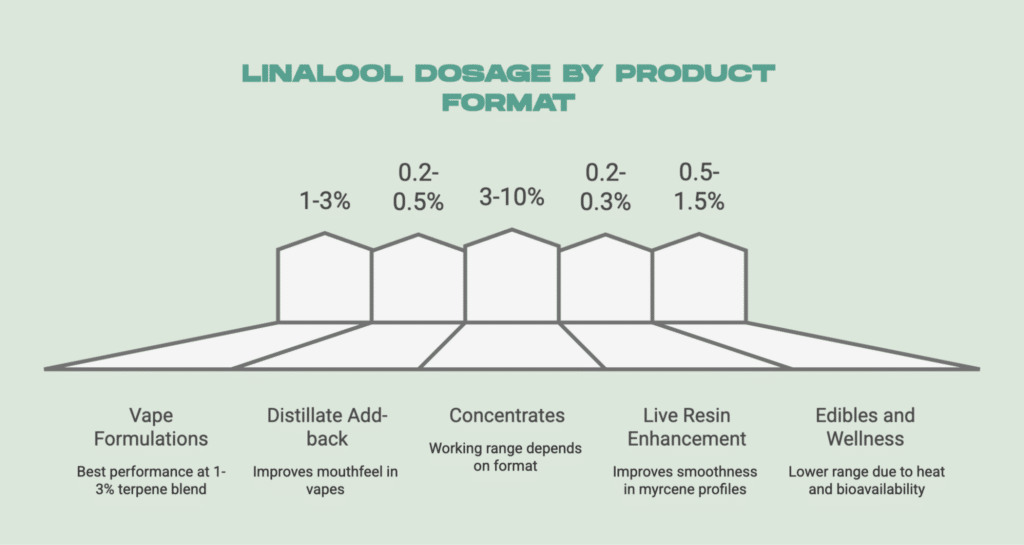
In vape applications, linalool typically performs best at 1–3% of the total terpene blend. Because linalool has higher viscosity relative to limonene and pinene, formulations weighted toward linalool require viscosity management.
At concentrations above 3%, wicking may be compromised in cotton-wick hardware, and total oil viscosity can affect fill line and flow consistency.
In distillate add-back applications, linalool at 0.2–0.5% meaningfully improves mouthfeel and reduces harshness without pushing the profile into detectable lavender territory. This is one of its most practical uses in vape production. For technical benchmarks on viscosity, mixing ratios, and hardware compatibility, check out our R&D Vape Formulation Best Practices Guide.
Concentrates and Distillate
For concentrates, the working range is 3–10% depending on format. Shatter should stay at the lower end of that range because higher terpene concentrations act as plasticizers, converting shatter into pull-and-snap consistency. Wax and budder tolerate slightly higher concentrations (3–5%) due to their lipid content. Full details on format-specific integration are covered in our R&D Concentrates Formulation Best Practices Guide.
For live resin enhancement, adding 0.2–0.3% linalool to a myrcene-dominant native profile can improve the perceived smoothness without masking the original expression.
Edibles and Wellness Products
The working range for edibles is 0.5–1.5%, driven down by two factors: extended heat exposure during baking or cooking accelerates linalool degradation, and digestive absorption produces lower bioavailability than inhalation. Keeping integration temperatures low, targeting 100–120°F for any mixing that involves heat, preserves more of the linalool content through processing.
Linalool Terpene Pairing Guide for Formulators
Linalool’s real formulation value is not as a standalone. It’s in how it shapes the behavioral character of other dominant terpenes. Think of it as a modifier that adds a calming, floral layer to profiles that would otherwise feel incomplete or directionally vague. Here are some combinations that are proven to work consistently.
Linalool + Myrcene
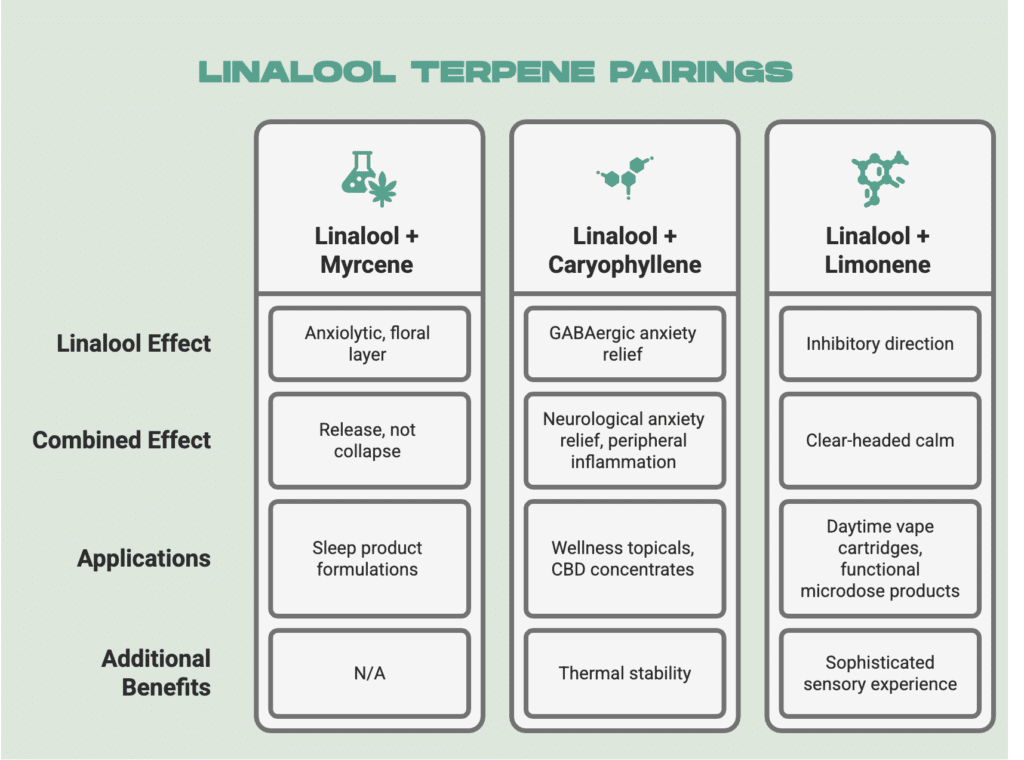
Myrcene brings heavy physical sedation and earthy body weight. Linalool adds the anxiolytic and floral layer above it, softening the blunt sedation into something that reads more as release than collapse.
In sleep product formulations targeting vapes, a myrcene concentration of 30–50% of total terpene content with linalool at 15–25% creates a well-documented evening profile.
Linalool + Caryophyllene
Beta-caryophyllene is the only terpene known to directly activate CB2 receptors in the endocannabinoid system, giving it an anti-inflammatory pathway that is mechanistically distinct from linalool’s GABAergic one.
Together, these two compounds cover both neurological anxiety relief and peripheral inflammatory signaling, which makes this pairing useful for wellness topicals, CBD concentrates, and any product targeting stress-related somatic symptoms.
The caryophyllene also adds thermal stability to the formulation, helping anchor the blend under heat exposure that would otherwise degrade the more volatile linalool.
Linalool + Limonene: Daytime Calm Without Sedation
Limonene’s serotonergic and dopaminergic activity produces an uplifting effect that partially offsets linalool’s inhibitory direction. The result is what product developers often call “clear-headed calm”, anxiety reduction without the sedative slide.
This pairing works well in daytime vape cartridges, functional microdose products, and CBD-forward beverage formulations where the consumer expectation is stress relief rather than sleep support.
The contrast between a limonene-dominant uplifting profile and the linalool-softened landing creates a more sophisticated sensory experience than either terpene achieves alone.
Quick reference pairing guide:
- Linalool + Myrcene: Full-body sedation, sleep, evening use
- Linalool + Caryophyllene: Anxiety management, anti-inflammatory, CB2 support
- Linalool + Limonene: Daytime calm, mood balance, clear-headed relaxation
- Linalool + Pinene: Sedation with alertness counterweight, prevents cognitive fog
- Linalool + Terpinolene: Complex floral-fruity; distillate uplift blends, premium vape positioning
Formulation Challenges with Linalool
Linalool is one of the more technically demanding terpenes to work with at scale. These are the failure points that matter before you move from bench to batch.
Volatility and Storage
As a monoterpene alcohol, linalool oxidizes relatively quickly under improper storage conditions. Oxidation produces hydroperoxide compounds that are not only less aromatic than the parent molecule, but they can also cause skin sensitization in topical applications and alter flavor character in edibles and vapes. This is a safety and quality concern, not just a shelf life one.
The solution here is proper storage. Store linalool-containing oils in amber glass, nitrogen-sealed containers at cool temperatures away from light. Shelf life under ideal conditions runs approximately 6–12 months, which is shorter than most cannabinoid inputs.
Viscosity Management in Vapes
Linalool increases blend viscosity more than lighter monoterpenes like limonene and alpha-pinene. At concentrations above 3% in a vape formulation, this can impair wicking in cotton systems and reduce draw consistency across the cartridge’s lifespan.
The practical solution is to balance linalool with lower-viscosity monoterpenes and test the flow rate at the temperature before committing to scale. Ceramic coil hardware is considerably more forgiving at higher linalool concentrations than cotton-wick systems. Choosing terpene profiles for different product formats covers this viscosity-hardware relationship in more detail.
Heat Degradation During Processing
Linalool and limonene are the first two compounds to degrade in a profile exposed to excessive heat. This applies to distillate mixing, edible production, and infused pre-roll manufacturing alike.
Keeping distillate integration temperatures at 45–50°C and live resin add-back below 35°C preserves a meaningful portion of linalool content. Any process step that exceeds 60°C should be considered a linalool loss event, and formulations should be designed to account for that attrition rather than assuming the final product COA will match the input.
Why Terpene Belt Farms for Linalool-Containing Profiles
Whether linalool is the centerpiece of your formulation or a supporting compound, the quality of every terpene in your blend is determined by how it was grown, extracted, and handled before it reached your lab. Supply chain gaps, improper storage, and botanical substitution are the three most common ways terpene inputs underperform at the bench, and all three are sourcing problems rather than formulation ones.
At Terpene Belt Farms, every terpene oil in the catalog is extracted from cannabis grown in Byron, California’s San Joaquin Valley, using Fresh Never Frozen methodology. The source material never freezes post-harvest, which preserves volatile monoterpenes like linalool that are among the first compounds to degrade under thermal or oxidative stress during conventional handling.
Each batch is tested by ISO/IEC 17025-accredited third-party labs and documented with full COAs, SDS sheets, and product specification sheets. When you’re building a product where terpene performance is part of the effect claim, you need inputs you can defend to retail partners and compliance reviewers. That documentation chain is standard here, not an add-on.
Request your R&D samples today at Terpene Belt Farms and see what Fresh Never Frozen terpene profiles bring to your formulation work.
Frequently Asked Questions About the Linalool Terpene
Is Linalool the Same Thing as Lavender?
Linalool is the primary terpene responsible for lavender’s characteristic scent, but the two are not the same. Lavender essential oil contains linalool alongside dozens of other compounds, including linalyl acetate, camphor, and eucalyptol. Cannabis-derived linalool carries a different enantiomeric ratio and compound context than lavender-extracted linalool, which affects both aromatic character and pharmacological behavior.
Does Linalool Get You High or Alter Consciousness?
Linalool does not produce intoxication. It does not bind CB1 receptors with appreciable affinity and therefore does not produce the psychoactive effect associated with THC. It is physiologically active, its effects on GABA-A receptors and glutamate pathways are real, but its influence is calming and sedative rather than intoxicating.
What Percentage of Linalool Should I Add to Distillate?
For mouthfeel improvement and background relaxation layering, 0.2–0.5% is sufficient and will not introduce detectable lavender character. For evening-use or sleep-focused products where linalool is part of a deliberate effect stack alongside myrcene, working up to 3–5% is appropriate. Exceeding 10% in any finished product is not recommended both from a safety standpoint.
Can Linalool Cause Adverse Effects or Skin Irritation?
Linalool itself is generally well-tolerated and carries FDA GRAS status. However, oxidized linalool, formed when the compound is improperly stored and exposed to light, heat, or air, can produce hydroperoxide derivatives that are skin sensitizers.
Why Does Linalool Rarely Appear as the Dominant Terpene in Cannabis?
Cannabis biosynthetic pathways favor sesquiterpenes like myrcene and monoterpene hydrocarbons like limonene and pinene as dominant outputs. Linalool’s alcohol functional group requires additional enzymatic steps in the terpene synthesis pathway, making high-linalool expression genetically uncommon.
How Does Linalool Compare to Myrcene for Sleep and Relaxation Formulations?
Myrcene is the more potent sedative compound with a lower boiling point and stronger physical body effect. Linalool contributes anxiolytic and mood-regulatory depth that myrcene alone does not provide. In sleep formulations, the two work best together rather than as substitutes. Myrcene handles the physical sedation load while linalool addresses the anxiety and mental quieting side of the sleep equation.
Sources Used for This Article
- PMC: “Cannabidiol (CBD) and its analogs: a review of their effects on inflammation” – pmc.ncbi.nlm.nih.gov/articles/PMC5478857/
- Frontiers: “Cannabidiol as an Intervention for Fear and Anxiety in Humans: A Systematic Review of Controlled Clinical Studies” – frontiersin.org/journals/behavioral-neuroscience/articles/10.3389/fnbeh.2018.00241/full
- MDPI: “The Potential of Cannabidiol (CBD) in the Treatment of Neurodegenerative Diseases” – mdpi.com/1424-8247/18/8/1100
- PMC: “Cannabidiol (CBD) as a Promising Anti-Cancer Drug” – pmc.ncbi.nlm.nih.gov/articles/PMC8426550/
- PMC: “The Anxiolytic Effects of Cannabidiol (CBD)” – pmc.ncbi.nlm.nih.gov/articles/PMC9886818/