Quick Answer: No, terpenes are not lipids. While both compound classes share hydrophobic properties and dissolve in similar solvents, terpenes are isoprenoid hydrocarbons built from isoprene units (C5H8), whereas lipids contain fatty acid chains with ester bonds linking them to glycerol backbones. This distinction matters for extraction efficiency, product stability, and formulation design in cannabis and beverage applications.
Key Takeaways
- Terpenes are not lipids; they are isoprenoid hydrocarbons built from isoprene units, while lipids are fatty-acid–based molecules with ester bonds and glycerol backbones.
- Terpenes and lipids are often confused because both are hydrophobic and dissolve in similar solvents, despite having fundamentally different chemical structures.
- This distinction affects extraction, since crude cannabis extracts can contain both terpenes and unwanted plant lipids that must be separated through winterization or distillation.
- In formulation, terpenes integrate cleanly into cannabinoid oils, while lipid contamination can cause instability, harshness, or regulatory failures in inhalable products.
- Terpenes and lipids are detected using different analytical methods, meaning lipid tests do not measure terpene content and vice versa.
- Shop our sample kits today for your R&D and source lipid-free, formulation-ready cannabis-derived terpenes from Terpene Belt Farms.
A batch of premium vape cartridges fails vitamin E acetate testing despite using only cannabis distillate and terpenes. A beverage formulator watches their “water-soluble terpenes” separate within hours. A concentrate producer receives customer complaints about a harsh throat hit from what should be a smooth, terpene-enhanced product.
The common thread? Each assumed terpenes and lipids belong to the same chemical family simply because both dissolve in carrier oils. This misconception costs manufacturers thousands in rejected batches, reformulation delays, and damaged brand reputation.
Both compound classes resist water and dissolve in similar solvents, creating a convincing illusion of chemical kinship. Yet these molecules are constructed through entirely different biosynthetic pathways, respond to distinct degradation mechanisms, and require separate analytical protocols. The confusion shows up everywhere. From extraction labs where processors struggle to separate desirable terpenes from unwanted plant lipids, to safety testing labs flagging vape products for lipid contamination. Terpenes are not lipids, and here’s everything you need to know about the why.
Terpene Chemical Structure vs Lipid Classification
The molecular architecture of terpenes and lipids determines how these compounds behave during extraction, processing, and storage. These structural foundations directly inform formulation decisions, from integration methods and carrier selection to stability protocols that maintain product consistency batch after batch.

What Defines a Lipid Molecule
Lipids are characterized by fatty acid chains, which are long hydrocarbon sequences terminated by carboxylic acid groups (COOH). These fatty acids connect to a three-carbon glycerol backbone through ester bonds, creating the triglycerides that comprise most biological fats and oils. The ester linkage (R-COO-R’) represents the defining structural feature that separates lipids from other hydrophobic compounds.
Beyond triglycerides, the lipid family includes phospholipids (which form cell membranes), steroids (like cholesterol), and waxes. What unites these diverse molecules is the presence of fatty acid-derived structures and, in many cases, ester bonds that can be hydrolyzed.
These amphipathic molecules contain both hydrophobic regions (hydrocarbon tails) and hydrophilic regions (polar head groups), allowing them to form complex structures like lipid bilayers.
Terpene Molecular Architecture
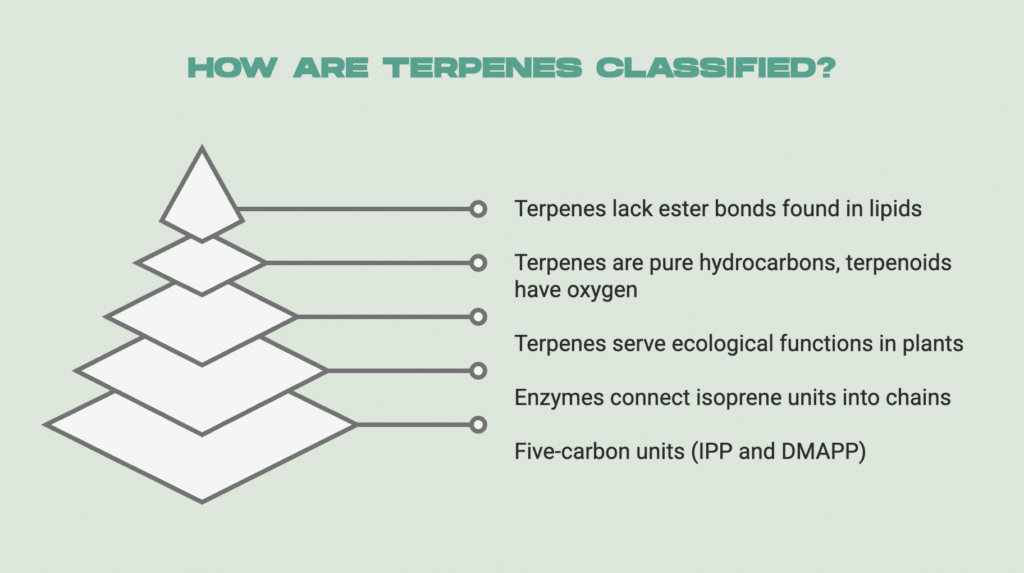
Terpenes belong to the isoprenoid family, constructed from five-carbon isoprene units (C5H8) linked in head-to-tail configurations. Unlike lipids, terpenes are purely hydrocarbon molecules that contain only carbon and hydrogen atoms, with no heteroatoms like oxygen in their basic structure. This composition places them in a distinct chemical category from fatty acid-based lipids.
The classification system for terpenes depends on how many isoprene units combine: monoterpenes contain two units (C10H16), sesquiterpenes have three units (C15H24), and diterpenes consist of four units (C20H32). Cannabis produces monoterpenes like myrcene, limonene, and pinene, alongside sesquiterpenes such as caryophyllene and humulene. These molecules can form linear chains or cyclic structures, but they never contain the ester bonds characteristic of lipids.
When terpenes gain oxygen-containing functional groups (hydroxyl, carbonyl, or aldehyde groups), they become terpenoids. Even these oxidized versions maintain their isoprenoid structure and lack the glycerol-fatty acid ester architecture that defines true lipids. For cannabis product developers, this means terpenes and terpenoids require different handling considerations than plant lipids during extraction and processing.
Key Structural Differences:
- Lipids: Contain ester bonds and fatty acid chains attached to glycerol backbones
- Terpenes: Built from isoprene units (C5H8) without ester linkages or glycerol structures
- Lipids: Often amphipathic with both hydrophilic (polar head) and hydrophobic (fatty tail) regions
- Terpenes: Purely hydrophobic hydrocarbons throughout their structure
Why Terpenes and Lipids Share Similar Properties
Despite fundamental structural differences, terpenes and lipids exhibit remarkably similar solubility behaviors and extraction compatibility. This overlap creates practical challenges for product developers who need to separate these compound classes or prevent cross-contamination during manufacturing.
Hydrophobic Nature in Formulation
Both terpenes and lipids are hydrophobic, meaning they repel water and dissolve readily in nonpolar solvents. This shared characteristic stems from their extensive hydrocarbon content, where long chains of carbon and hydrogen atoms interact favorably with oils but not with aqueous solutions.
In practical terms, both compound classes will dissolve in carrier oils like MCT, hemp seed oil, or ethanol-based extraction solvents.
This solubility similarity explains why cannabis distillate formulations can incorporate terpenes directly without additional solubilizers. The terpene molecules mix at the molecular level with cannabinoid-rich oils because both substances share compatible chemical properties. However, this same compatibility means unwanted plant lipids can co-extract alongside terpenes during crude extraction, requiring additional processing steps to achieve purity.
Extraction Method Compatibility
Hydrocarbon extraction captures both terpenes and lipids efficiently because these solvents dissolve all hydrophobic plant compounds. CO2 extraction similarly retrieves both classes, though parameters like temperature and pressure can be tuned to favor certain molecular weights. Ethanol extraction, while more polar, still dissolves significant quantities of both terpenes and plant lipids.
This overlap necessitates post-extraction refinement. Winterization, chilling the extract to precipitate lipids, allows processors to remove waxy plant fats while retaining volatile terpenes. For processors focused on capturing authentic cannabis terpene profiles, this poses a technical challenge of maximizing terpene recovery while eliminating lipid contamination that can affect product quality.
Terpenes and lipids share similar traits, like:
- Both dissolve readily in hydrocarbon solvents (butane, propane, hexane) and carrier oils
- Compatible with the same extraction methods, including ethanol, CO2, and hydrocarbon extraction
- Require similar storage conditions like cool temperatures, protection from light, sealed containers to prevent oxidation
- Need emulsification or solubilization for integration into water-based product formats like beverages
Chemical Classification: Where Terpenes Actually Belong
Proper organic chemistry classification places terpenes in a category fundamentally separate from lipids. This distinction affects regulatory documentation, safety testing requirements, and formulation strategy for commercial cannabis products.
Terpenes as Isoprenoids
Plants produce terpenes through specialized metabolic pathways, the mevalonate (MVA) and methylerythritol phosphate (MEP) pathways, that build five-carbon molecular units called isopentenyl pyrophosphate (IPP) and dimethylallyl pyrophosphate (DMAPP). Think of these as Lego blocks that snap together in different combinations. Terpene synthase enzymes then connect these blocks into longer chains, creating the diverse terpene molecules found in cannabis.
Cannabis plants produce terpenes as secondary metabolites, compounds that serve ecological functions like attracting pollinators or deterring herbivores rather than supporting primary growth processes.
The specific terpene profile of each cannabis cultivar results from which terpene synthase genes are expressed and how environmental conditions influence biosynthesis. This biological origin through specialized enzymatic pathways distinguishes terpenes from lipids, which form through fatty acid synthesis, which is a completely different metabolic system.
Functional Group Analysis
Basic terpenes are simple molecules made entirely of carbon and hydrogen atoms bonded together, regardless of the other elements involved. This pure hydrocarbon structure is what chemists mean when they classify something as a true terpene.
Some terpenes pick up oxygen atoms during natural processes, transforming into terpenoids (like linalool or caryophyllene oxide found in cannabis). Even with these oxygen additions, they keep their core isoprene-based structure and never develop the ester bonds that define lipids.
There are a few practical reasons why this matters. When labs test products for lipids using standard methods, those tests won’t pick up terpenes or terpenoids. They’re looking for completely different molecular structures. A product could have high terpene content but zero lipids, or vice versa, because the analytical equipment targets specific chemical bonds that only exist in one category or the other.
Formulation Implications for Cannabis Products
Chemical classification directly translates to manufacturing decisions. Product developers who understand terpene-lipid differences avoid formulation pitfalls that compromise product quality, consumer safety, and regulatory compliance.

Solubility in Vape Formulation
Cannabis distillate naturally contains residual terpenes from the extraction process, but many manufacturers add supplemental terpenes to restore lost aromatics or create specific sensory profiles. The compatibility between terpenes and cannabinoid-rich oils allows direct blending without additional emulsifiers. Terpene concentration typically ranges from 5-15% in finished vape formulations, with higher percentages affecting viscosity and throat sensation.
The critical safety here is to avoid lipid contamination in inhalable products. The vaping crisis of 2019 linked vitamin E acetate, a lipid compound used as a cutting agent, to severe lung injuries, including lipoid pneumonia.
When inhaled, this oily substance coats lung tissue and interferes with normal respiratory function. The outbreak emphasized why vape products must remain free of lipid-based additives, even though terpenes and lipids share similar solubility properties in cannabis oil.
Responsible manufacturers now implement rigorous testing protocols to verify the absence of vitamin E acetate and other lipid contaminants. This requires understanding that terpenes, despite dissolving in the same carrier medium, are chemically distinct and do not pose the same inhalation risks as true lipids.
Terpenes are integrations via:
- Direct blending with cannabis distillate or isolate for vape and concentrate applications
- Carrier oil dilution (MCT, hemp seed oil) for topical and edible formulations
- Emulsification using surfactants for beverage and water-based product integration
- Microencapsulation in cyclodextrins or liposomes for extended-release or targeted delivery
Extraction Process Design
Extraction methodologies must account for the fact that crude cannabis extracts contain both desirable terpenes and undesirable plant lipids. The winterization process addresses this by dissolving crude extract in ethanol and chilling to -20°C or below, causing lipids, waxes, and chlorophyll to precipitate while keeping terpenes and cannabinoids in solution.
However, aggressive winterization can lead to terpene loss, especially of highly volatile monoterpenes, which may evaporate during solvent removal. Processors seeking to preserve authentic strain profiles often employ gentler techniques or capture and reintroduce terpenes after refinement. This balance between lipid removal and terpene preservation represents a core technical challenge in cannabis extraction.
Terpene Recovery Vs Lipid Removal
Fractional distillation separates compounds based on boiling point differences. Terpenes typically volatilize between 150-200°C, while heavier plant lipids and cannabinoids require higher temperatures. Short-path distillation can isolate a terpene-rich fraction early in the process, before lipids and cannabinoids distill over. This recovered terpene fraction can then be reintroduced to refined cannabinoid distillate.
Alternatively, processors may employ steam distillation or hydrodistillation specifically to capture terpenes from fresh or dried cannabis material before solvent extraction. These water-based methods prevent lipid co-extraction entirely, yielding pure cannabis-derived terpene fractions free from fatty contamination. The trade-off involves additional processing steps and equipment, but results in superior terpene purity for premium applications.
Closing Thoughts: How Terpene Belt Farms Can Offer a Lipid-Free Terpene Supply
The difference between terpenes and lipids goes beyond academic knowledge. It’s operational intelligence that prevents formulation failures, safety issues, and regulatory complications.
At Terpene Belt Farms, we produce premium cannabis-derived terpenes through methods specifically designed to maximize terpene recovery while eliminating lipid contamination. Our Fresh Never Frozen extraction process preserves delicate volatile compounds without introducing the plant lipids that compromise vape safety and product quality.
Every batch undergoes thorough GC-MS analysis to verify complete terpene profiles alongside safety testing that confirms the absence of vitamin E acetate and other lipid contaminants. When you partner with Terpene Belt Farms, you gain access to terpene products formulated with genuine chemical understanding, not marketing assumptions.
Partner with Terpene Belt Farms for wholesale today and eliminate the risk of lipids contaminating your batches permanently.
Frequently Asked Questions About Terpenes and Lipids
Are Terpenes Considered Fats?
No, terpenes are not fats. While both are hydrophobic, terpenes are isoprenoid hydrocarbons composed solely of carbon and hydrogen without the fatty acid chains and ester bonds that define fats (lipids). This structural difference affects extraction methods, analytical testing, and safety considerations for inhalable products.
Why Do Terpenes Dissolve in Oils If They’re Not Lipids?
Terpenes dissolve in oils due to shared hydrophobic properties, not chemical similarity. Both contain extensive hydrocarbon regions that interact favorably with nonpolar solvents. This “like dissolves like” principle explains solubility without requiring identical chemical structures. The compatibility allows direct terpene-cannabinoid blending without emulsifiers.
Can Terpenes and Lipids Be Separated During Extraction?
Yes, through winterization and distillation. Winterization chills ethanol-dissolved extracts to precipitate lipids while keeping terpenes in solution. Fractional distillation separates based on boiling points, with terpenes volatilizing at lower temperatures than plant lipids. These methods enable high-purity terpene isolation from crude extracts.
Do Terpenes Affect the Lipid Profile of Cannabis Products?
No, terpenes don’t alter lipid content because they’re chemically distinct compound classes. However, terpene addition can affect perceived viscosity and texture in formulations containing lipid carriers. Proper formulation ratios make sure terpenes improve aromatics without compromising product consistency or sensory experience.
What’s the Difference Between Terpenoids and Terpenes?
Terpenes are pure hydrocarbons (C and H only), while terpenoids contain additional functional groups with oxygen, nitrogen, or sulfur. Linalool (alcohol), menthol (alcohol), and camphor (ketone) are terpenoids. Both retain isoprenoid structure and remain distinct from lipids. The terms are often used interchangeably in cannabis contexts.
Why Is Vitamin E Acetate Dangerous in Vapes but Terpenes Are Safe?
Vitamin E acetate is a lipid that remains in lung tissue after inhalation, causing lipoid pneumonia and respiratory damage. Terpenes, being non-lipid volatile hydrocarbons, don’t accumulate the same way and have an extensive safe use history in aromatherapy and flavor applications. Chemical structure determines inhalation safety profiles.
How Do I Verify My Products Contain Only Terpenes and No Lipid Contaminants?
Implement detailed testing protocols, including GC-MS for terpene profiling and HPLC for vitamin E acetate screening. Work with accredited laboratories that test both compound classes. Request COAs (Certificates of Analysis) from terpene suppliers documenting purity and absence of lipid adulterants before purchasing raw materials.
Sources Used for This Article
- Britannica: “Lipids in Biochemistry” – britannica.com/science/lipid
- Biology LibreTexts: “3.3: Lipid Molecules – Introduction” – bio.libretexts.org/Bookshelves/Introductory_and_General_Biology/General_Biology_(Boundless)/03:_Biological_Macromolecules/3.03:Lipid_Molecules-_Introduction
- PubMed: “Analysis of Terpenes in Cannabis sativa L. Using GC/MS: Method Development, Validation, and Application” – pubmed.ncbi.nlm.nih.gov/30646402/
- PubMed: “Terpenes and isoprenoids: a wealth of compounds for global use” – pubmed.ncbi.nlm.nih.gov/30467631/
- PMC: “Vitamin E Acetate as a Plausible Cause of Acute Vaping-related Illness” – pmc.ncbi.nlm.nih.gov/articles/PMC6952050/