Quick Answer: Organic (natural) terpenes are extracted directly from plant material using physical separation methods, while synthetic terpenes are manufactured in a laboratory through chemical reactions, often starting from petroleum-derived precursors. For cannabis and hemp product formulation, the difference is not just philosophical. It affects sensory depth, batch behavior, regulatory standing, and how well the terpenes interact with cannabinoids in your finished product.
Key Takeaways
- Organic terpenes are plant-derived, while synthetic terpenes are laboratory-made through chemical reactions using petroleum-derived or plant-based precursors.
- Cannabis-derived terpenes preserve minor compounds, sesquiterpenes, and trace aromatics that synthetic and botanical blends cannot fully replicate.
- Standard gas chromatography-mass spectrometry testing identifies terpene structure and percentages, but cannot confirm whether compounds are natural or synthetic.
- Synthetic terpenes offer purity and consistency, but may create flatter sensory profiles, higher dosing risk, and added scrutiny in cannabis formulations.
- Cannabis-derived terpenes are better suited for vapes, concentrates, pre-rolls, and flower infusions because they support authenticity, complexity, and formulation stability.
- Terpene Belt Farms grows Cannabis sativa L. in Byron, California, using Fresh Never Frozen extraction and full traceability from plant to bottle.
- Shop samples for your R&D process to compare Terpene Belt Farms’ cannabis-derived profile depth against your current terpene inputs before formulating.
What “Organic” and “Synthetic” Mean in the Terpene Industry
The word “organic” means two completely different things depending on the context. In chemistry, it simply refers to carbon-based compounds. In agriculture and consumer packaging, it refers to USDA-certified cultivation practices.
Terpenes are always organic in the chemical sense because they are hydrocarbon compounds built from isoprene units. When suppliers call their terpenes “organic,” they almost always mean plant-derived, not certified by a regulatory body. That difference is important when you are trying to compare products across suppliers who may be using the term differently.
In terms of the sourcing spectrum, a terpene can be a part of three main categories.
The Three Source Categories for Terpenes
Knowing exactly what category a product belongs to changes how you evaluate its price, its performance claims, and its fit for your formulation. Here is how the three break down:
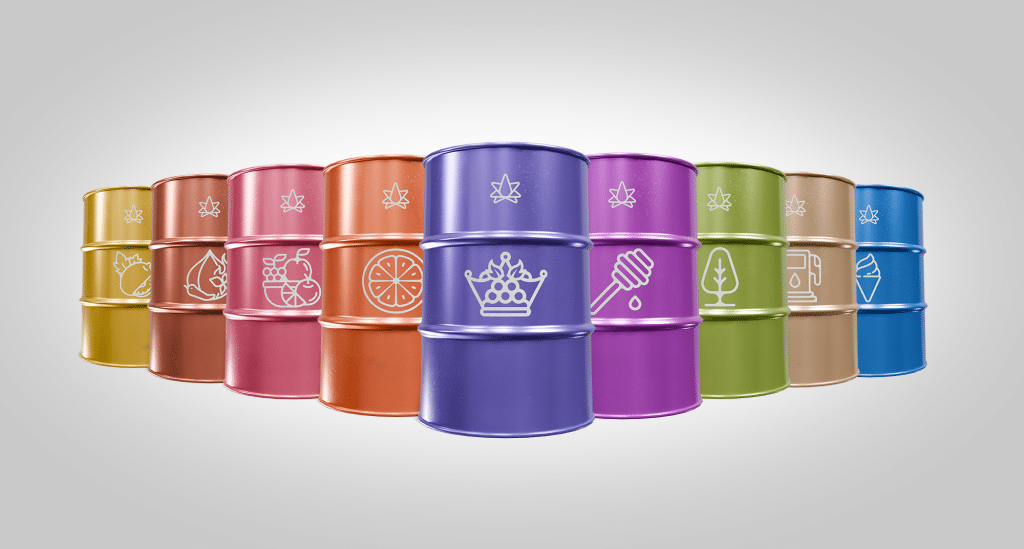
- Cannabis-Derived Terpenes (CDTs): Extracted directly from Cannabis sativa L. plant material. They contain the full spectrum of compounds the plant produces, including minor terpenes, sesquiterpenes, and trace-level aromatic compounds that make up less than 1% of the total profile individually but contribute meaningfully to the overall character.
- Botanical/Natural Terpenes (BDTs): Extracted from non-cannabis plant sources that naturally contain the same individual terpene compounds. Limonene from lemon peel, myrcene from hops, and linalool from lavender are common examples. These are then blended to approximate cannabis strain profiles. They are natural, but they are not cannabis-derived.
- Synthetic Terpenes: Produced in a laboratory through catalytic chemical synthesis, typically starting from petroleum-derived or plant-based precursor molecules. The final compound may be structurally identical to a naturally occurring terpene, but the production pathway is entirely artificial. No plant material is involved.
Why the “Organic” Label Gets Complicated Here
Both CDTs and BDTs qualify as natural or organic in the plant-derived sense. Synthetic terpenes do not.
But because GC-MS testing identifies terpenes by molecular structure rather than origin, a synthetic limonene and a cannabis-derived limonene will return identical results on a standard COA. This is the core of the authentication problem the industry has been grappling with for years, and it is why a significant percentage of products marketed as cannabis-derived have been found to contain partial or complete botanical or synthetic substitutions.
The only method that can reliably distinguish origin is isotopic fingerprinting, which analyzes carbon, hydrogen, and oxygen isotope ratios that differ based on whether a compound was biosynthesized in a plant or manufactured in a lab.
How Synthetic Terpenes Are Made
Most terpene buyers know that synthetic terpenes come from a lab, but the specifics of how they are produced are rarely explained. That process is worth knowing because it determines both what you are getting and what you are not getting in the final formulation.
Petroleum-Derived Precursors and Catalytic Synthesis
The synthetic production process starts with a precursor chemical. That precursor is typically either petroleum-derived or sourced from an isolated plant compound, and it undergoes a series of catalytic reactions to form a specific terpene molecule.
Alpha-pinene, for example, can be synthesized from turpentine. Limonene can be produced from petrochemical feedstocks. The chemistry involved is precise and well-established, which is why manufacturers can produce individual terpene molecules at purities exceeding 99%.
That level of purity is simply not achievable with plant-derived terpenes, which always contain multiple related compounds by nature of how biosynthesis works.
The starting materials matter because they introduce variables that do not exist in plant extraction. Residual catalysts, solvents used in the reaction, and processing byproducts all need to be managed. In a well-run synthetic facility, those contaminants are screened out. In a less rigorous one, they may not be.
Products intended for inhalation or ingestion carry more risk from these residuals than products used in non-consumable applications, which is one reason poorly sourced synthetic terpenes have drawn safety concerns in vape formulation specifically.
Purity Vs. Complexity
Here is where the formulation implications become concrete. A synthetic terpene product built from isolated individual molecules can control exactly how much of each compound is present. That sounds like a precision advantage, and in some contexts it is.
The problem is that cannabis character does not come from a handful of dominant terpenes at high percentages. It comes from the full constellation of compounds working together, including dozens of trace-level molecules that no synthetic blend captures.
GC-MS analysis of cannabis-derived terpene profiles typically shows 20 to 35 identifiable compounds. Botanical alternatives from non-cannabis sources generally show 5 to 10.
Synthetic blends assembled from isolated molecules show whatever was deliberately added, often just the three to five most common terpenes in a given strain’s profile. What gets left out of a synthetic blend are the minor sesquiterpenes, the isomer variants, and the sub-1% aromatic compounds that experienced cannabis consumers recognize as the difference between a product that smells like a real plant and one that smells like a candle meant to approximate it.
That sensory gap is measurable by trained evaluation panels and is consistently noted in comparative product testing across the industry.

Natural Vs. Synthetic Terpenes: Side-By-Side Formulation Differences
Choosing between terpene sources is not just a sourcing philosophy decision. It has direct downstream consequences for how your product performs in manufacturing, how it behaves at the consumer level, and how it holds up under regulatory scrutiny. Each of the differences below matters differently depending on your application, so it is worth examining them individually rather than treating this as a simple binary choice.
Sensory Profile Depth
Natural terpenes, particularly cannabis-derived, produce richer sensory profiles because of molecular complexity. Synthetic blends tend to read as louder and more one-dimensional. The dominant terpenes are present at high concentrations, which creates an intense initial impression, but the aromatic arc is shorter and flatter.
There is no mid-note development because the minor compounds that create that complexity are absent. Botanical blends fall in between. They are more complex than synthetics because they start with real plant material, but they still lack the cannabis-specific trace compounds that give CDTs their distinctive character.
Batch Consistency and Concentration Behavior
- Synthetic Terpenes: Highly consistent batch to batch. Ratios are controlled at the manufacturing level. They also tend to be more concentrated than natural equivalents, which means dosing errors are more consequential. Over-addition creates a sharp, artificial flavor profile that is difficult to correct in a finished product.
- Botanical Terpenes: Moderate consistency. Individual plant-sourced compounds can be standardized, but the blending process introduces variability, especially when sourcing from multiple suppliers.
- Cannabis-Derived Terpenes: Vary by extraction methodology and source material. Cold-chain extraction and Fresh Never Frozen processing significantly improves batch-to-batch reproducibility by eliminating thermal degradation variables during handling.
Stability in Heat-Exposed Applications (Vape, Pre-Roll, Concentrates)
Stability at temperature is one of the most practically important variables in terpene selection, particularly for vape and pre-roll applications, where the terpene profile is exposed to significant heat before reaching the consumer.
Cannabis-derived terpenes show better stability in vape applications across the 350–450°F operating range, maintaining sensory consistency through the thermal exposure that occurs during inhalation. Botanical alternatives at equivalent concentrations often show flavor shifts and increased harshness at the higher end of that range. Synthetic terpenes at elevated concentrations can produce a particularly sharp or chemical character at high temperatures because the absence of buffering minor compounds leaves the dominant molecules more exposed to thermal degradation byproducts.
Regulatory Risk and State-Level Scrutiny
This is the category where the risk calculus has changed most significantly in recent years. Multiple states have moved to restrict or ban synthetic terpenes in cannabis products, and regulatory pressure at the federal level has increased as well.
Several cannabis markets that previously allowed liberal ingredient sourcing have added testing requirements or explicit prohibitions on synthetically derived compounds in inhalable products.
For formulators building multi-state product lines, synthetic terpene use introduces compliance risk that simply does not exist with plant-derived alternatives. The compliance burden of verifying synthetic-free sourcing is far lower than managing reformulation after a state bans an ingredient already integrated into your product architecture.

Where Synthetic Terpenes Still Get Used And Where They Fall Short
Synthetic terpenes are not universally useless. There are specific non-cannabis applications where their consistency and price point make them a reasonable choice. The problems start when they are applied to cannabis product formulation, where their limitations compound in ways that matter to the end consumer.
Applications Where Synthetic Terpenes Can Work
In applications where the terpene’s only function is to contribute a specific aroma or flavor note and where the interaction between terpene compounds is not meaningful, synthetic terpenes can perform adequately.
These include household cleaning products, non-consumable fragrances, industrial solvents, and some conventional cosmetics that use terpenes at low concentrations for scent. In these contexts, the purity and consistency advantages of synthetic production are genuinely useful, and the absence of molecular complexity is not a practical problem because nobody is looking for an entourage effect in a floor cleaner.
Water-soluble beverage formulations using isolated terpene compounds at very low doses represent another use case where synthetic sourcing is sometimes employed, primarily because the emulsification requirements make total compound count less important than individual compound behavior. Even here, though, natural alternatives are increasingly preferred by brands making clean-label claims.
Why Synthetic Terpenes Do Not Belong in Cannabis Formulations
In cannabis products, vapes, concentrates, pre-rolls, flower infusions, or any inhalable format, synthetic terpenes create problems that plant-derived alternatives do not.
Entourage Effect
The first issue is the entourage effect.
Research published in Scientific Reports in 2021 found that cannabis terpenes, including alpha-humulene, linalool, geraniol, and beta-pinene, produced cannabimimetic behaviors and activated CB1 receptors in ways that selectively enhanced cannabinoid activity.
A landmark 2011 review in the British Journal of Pharmacology by Dr. Ethan Russo had previously documented how terpenes present in their natural cannabis-derived ratios produced measurably different therapeutic outcomes than isolated or artificial combinations.
Synthetic blends, by definition, cannot replicate the full compound ratios that drive this activity because they are assembled from a limited set of isolated molecules rather than extracted from the plant.
Safety Concerns
The second issue is inhalation safety. When terpenes are combusted or vaporized, their chemical breakdown products enter the lungs directly. The residual processing chemicals that can be present in poorly manufactured synthetic terpenes, combined with the concentrated nature of synthetic blends, create a risk profile that does not exist with properly extracted plant-derived alternatives.
While a well-made synthetic terpene from a rigorous manufacturer may be free of processing residuals, there is no standardized testing protocol in the cannabis industry that reliably verifies this, which means buyers are dependent on supplier claims without an independent verification infrastructure.
Market Trends
The third issue is market positioning. Consumers who purchase cannabis products with labeled terpene profiles expect those profiles to reflect the plant. Formulators using synthetic terpenes in products marketed as cannabis-derived or strain-specific are making a product authenticity claim that the ingredient cannot support.
As consumer sophistication increases and analytical authentication methods become more accessible, that gap will become harder to sustain. Brands that build product identity around authentic terpene sourcing are better positioned for long-term market trust than those that cut costs on the terpene input and hope buyers do not notice.
Why Terpene Belt Farms Solves the Sourcing Authenticity Problem
One of the core challenges in the terpene supply chain is that most buyers have no way to verify what they are actually getting. A COA shows compound percentages. It does not show whether those compounds came from a cannabis plant or a petroleum reactor. Standard GC-MS testing cannot make that distinction, which means the authenticity of a terpene product depends entirely on the integrity of the supplier and their upstream sourcing practices.
Terpene Belt Farms operates at the source. Cannabis is cultivated at their Byron, California farm using their Fresh Never Frozen methodology, which means terpenes are cold-chain extracted from fresh plant material and never exposed to the heat degradation that compromises profile integrity at most extraction facilities.
Every product in the catalog is cannabis-derived from Cannabis sativa L. grown in-house, with full traceability from plant to bottle. The profiles are vintage-dated, reflecting the actual harvest they came from, and the company’s extraction process preserves the minor compound complexity that synthetic and botanical alternatives cannot replicate.
For R&D teams that need to verify sourcing claims rather than take them on faith, that level of documentation is the starting point for a supplier relationship worth building on.
Request samples for your R&D process and evaluate the difference in profile depth against your current terpene input before committing to a formulation direction.
Frequently Asked Questions About Organic Vs. Synthetic Terpenes
Are Synthetic Terpenes Safe to Inhale?
High-purity synthetic terpenes from rigorous manufacturers may not present acute safety risks in inhalation applications. The concern is with inconsistently manufactured products that retain residual processing chemicals, catalysts, or solvents from the synthesis pathway. There is no standardized cannabis-industry testing protocol that reliably screens for these residuals, so buyers cannot verify safety claims without supplier documentation of the specific testing methodology used.
Can You Tell If Terpenes Are Synthetic by Smell?
Trained sensory evaluation panels can distinguish synthetic terpene blends from cannabis-derived profiles with meaningful accuracy, primarily because synthetic blends read as louder and less complex. The dominant terpenes are present at high concentrations, creating an intense initial impression, but the absence of minor compounds means the aromatic profile does not develop the way a plant-derived profile does. Average consumers may not be able to articulate the difference, but experienced cannabis users consistently rate synthetic-terpene products lower on authenticity and smoothness in blind panel testing.
Does GC-MS Testing Show Whether Terpenes Are Synthetic or Natural?
No. GC-MS identifies compounds by molecular structure and returns their percentages. A limonene molecule derived from a cannabis plant and a limonene molecule synthesized from a petroleum precursor are structurally identical. Standard testing cannot tell them apart.
Why Do Some Cannabis Products Use Synthetic Terpenes?
Cost and consistency are the primary drivers. Synthetic terpenes can be produced at a fraction of the cost of cannabis-derived extraction, and their batch-to-batch uniformity is extremely high because the manufacturing process is controlled at the chemical level. For brands that prioritize margin over product authenticity, or for product formats where terpene origin is less visible to the end consumer, the cost reduction is attractive. The trade-off is sensory quality, entourage effect support, and increasing regulatory exposure as more states tighten restrictions on synthetic compounds in cannabis products.
Are Botanical Terpenes a Good Alternative to Synthetic?
Botanical terpenes are meaningfully superior to synthetic terpenes for cannabis formulation because they start with real plant material and carry more molecular complexity than isolated synthetic compounds. However, they still fall short of cannabis-derived terpenes because the non-cannabis plant sources lack the specific minor compound spectrum that Cannabis sativa L. produces.
Sources Used for This Article
- PMC: “Cannabis sativa terpenes are cannabimimetic and selectively enhance cannabinoid activity” – pmc.ncbi.nlm.nih.gov/articles/PMC8050080/
- British Journal of Pharmacology: “Taming THC: potential cannabis synergy and phytocannabinoid‐terpenoid entourage effects” – bpspubs.onlinelibrary.wiley.com/doi/full/10.1111/j.1476-5381.2011.01238.x