Choosing a terpene supplier feels straightforward until you start asking the questions that actually matter in formulation: What percentage of each terpene am I getting? Can I access a COA without creating an account? If I need to scale to 10 kilos next quarter, will this product still exist? These are not nitpicky questions. They are the baseline criteria for any ingredient you build a product around.
Most comparison content in this category stops at brand-level summaries: Company A has a big catalog, Company B has good science, and Company C is authentic. That framing is not useful for an R&D lead or procurement manager trying to look for a supplier for a production run.
This article compares Terpene Belt Farms, Abstrax Tech, and Lab Effects across product categories, documentation practices, sourcing transparency, and supply chain considerations. The goal is to give formulators a practical picture of what each supplier actually delivers, not just what they claim.
Key Takeaways
- Terpene supplier comparisons become meaningful only when evaluated through formulation criteria such as terpene percentages, COA accessibility, batch consistency, and long-term supply stability.
- Terpene Belt Farms focuses on hemp-derived cannabis-derived terpenes (CDTs), publishes full compound percentages on product pages, provides public batch-specific COAs, and uses its Fresh Never Frozen extraction process.
- Abstrax Tech offers one of the industry’s largest catalogs with strong analytical research capabilities, including HDTs, botanical recreations, effect-focused products, and application-specific formats.
- Lab Effects provides CDTs, botanical blends, water-soluble formats, powders, and formulation accessories while positioning itself around third-party cGMP-certified manufacturing.
- Terpene Belt Farms differentiates itself through public per-compound percentages, full COA access without account creation, pesticide and heavy metal panels, and an in-stock supply model designed for production continuity.
- Shop R&D samples from Terpene Belt Farms and compare the full COA package alongside the profile itself before building a production formula around any terpene input.
1. Terpene Belt Farms

Terpene Belt Farms is a California-based producer of hemp-derived cannabis terpenes (CDTs), operating exclusively within the Farm Bill interstate commerce framework. The company grows Cannabis Sativa L in Byron, California and extracts fresh plant material immediately after harvest using a proprietary Fresh Never Frozen methodology.
Every product on our catalog ships with a full COA showing per-terpene percentages, validated through ISO/IEC 17025-accredited third-party testing. TBF supplies primarily to R&D teams, vape manufacturers, concentrate producers, and CPG formulators who need batch-consistent, regulatory-ready terpene inputs for scalable production.
Core Product Categories
TBF’s catalog is organized by flavor category rather than strain name, which is a deliberate decision that reduces ambiguity. Strain names vary by cultivar and region. Flavor categories anchor the product to what it actually delivers in formulation.
Fresh Never Frozen CDTs
Fresh Never Frozen cannabis-derived terpenes are TBF’s flagship products and the clearest expression of what sets us apart.
Each oil is extracted from freshly harvested Cannabis Sativa L before the plant material is dried, frozen, or stored, preserving the full complement of volatile monoterpenes and minor compounds that are typically lost during post-harvest processing.
Every single-harvest oil is vintage-dated, meaning you know exactly which growing season your batch came from. The catalog spans seven flavor families: Fruit, Gas, Pine, Sweet, Citrus, Dessert, and Purple.
Every product ships with a COA showing per-compound percentages from an ISO/IEC 17025 accredited lab, so formulators know precisely what they are working with before a single milliliter of terpene goes into a prototype.
Emulsified Formats
Oil-based terpenes and water-based formulations do not mix without help. TBF’s emulsified terpene products are designed for beverage developers, edibles manufacturers, and anyone working in an aqueous product matrix where a standard terpene oil would separate, cloud, or destabilize the finished product.
The emulsified format maintains the aromatic character of the underlying CDT profile while allowing clean, stable dispersion in water-based applications. For formulators entering the cannabis beverage space or building water-soluble supplement formats, this removes a significant technical barrier without requiring proprietary emulsification infrastructure on their end.
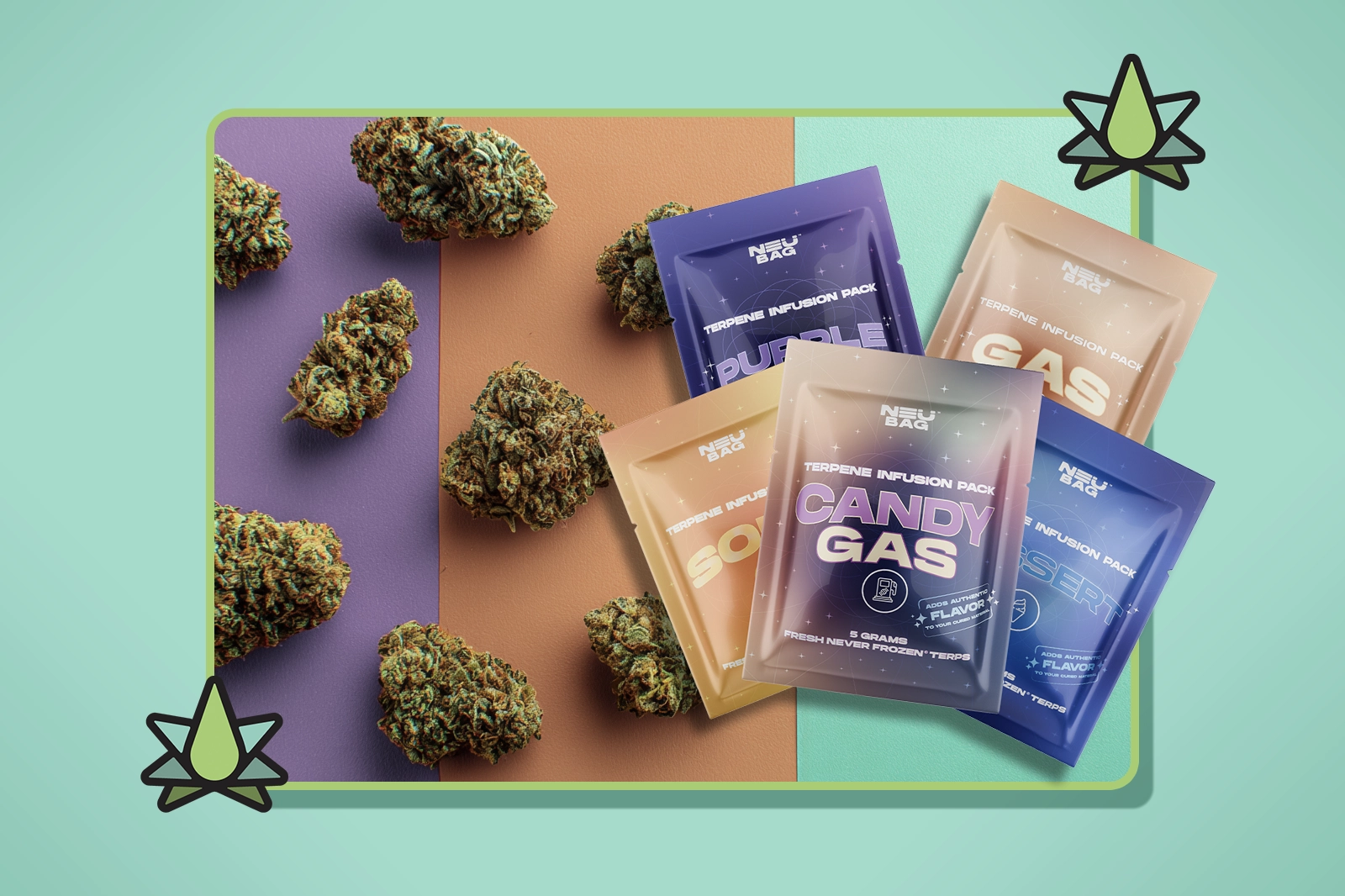
NEU Infusion Bags
The NEU bag solves a problem that liquid terpene application creates: moisture introduction, surface residue, and uneven distribution across flower or pre-roll material. Each bag uses vapor-phase diffusion to transfer terpenes into cured flower over a 48-hour period, treating approximately one pound of material per bag.
Because the terpenes move as vapor rather than liquid, there is no wet application, no hot spots, and no change to the moisture content of the flower. The result is a consistent, evenly distributed terpene layer that integrates with the existing profile of the material rather than sitting on top of it.
For pre-roll producers and flower brands looking to elevate baseline material or standardize profiles across batches, this is a scalable infusion method that does not require additional processing equipment. For more details, check out our R&D guide on pre-roll formulation.
Our Recommended Products
Gas #707 is a multi-vintage CDT built for formulators who need a dependable gas profile year-round. The COA shows Myrcene at 27.42%, Limonene at 11.55%, and Caryophyllene at 10.95%. That Myrcene load carries the earthy, fuel-forward base notes associated with ATF-adjacent genetics, while Caryophyllene and Limonene balance the profile with peppery spice and citrus lift. For vape manufacturers specifically, the heavier sesquiterpene content at these concentrations also helps reduce viscosity in thick distillates.
2024 Fruit #135 is a single-harvest CDT from the 2024 growing season, with a profile built around Limonene at 24.04% and Caryophyllene at 15.13%. The aromatic character runs deep: muscat grape, crushed dark fruit, zinfandel, plum, and ruby red grapefruit on the finish. Formulators working on fruit-forward vape lines, concentrate enhancers, or premium edibles will find this profile delivers layered complexity that simple limonene-dominant blends cannot achieve. It is documented, single-varietal, and available for R&D sampling.
2024 Dessert #116 leads with Limonene at 23.27% and beta-Ocimene at 21.78%, a pairing that produces citrus peel brightness layered over sweet, herbal mid-notes. Caryophyllene at 11.37% grounds the profile with enough pepper and woodiness to prevent it from reading as one-dimensional. Dessert profiles can easily skew synthetic or cloying in finished products. This one avoids both traps through the same authentic extraction process used across the TBF catalog, and the COA confirms exactly what you are working with before you commit to a production run.
2. Abstrax

Abstrax is a California-based terpene company with a strong research background and one of the larger catalogs in the industry. The company operates a Type 7 licensed research and manufacturing lab in Irvine and has invested heavily in analytical science, using GCxGC-MS technology to identify hundreds of compounds per strain.
They serve vape manufacturers, edibles producers, beverages, and CPG brands across a wide range of application categories.
Core Product Categories
- Hemp-Derived Terpenes (Live Series / HDT): USDA Organic certified, 3rd generation hemp-bred Cannabis Sativa L extracted fresh at harvest. Abstrax is transparent that these are not CDTs in the traditional sense, as they come from hemp rather than high-THC cannabis genetics with decades of selective breeding. That said, they represent the closest Abstrax gets to a true plant-derived terpene oil.
- Native Series: Botanically-derived profiles formulated to replicate authentic cannabis aromatic fingerprints, including cannasulfur compounds (CSCs) to capture gassy and skunky top notes. Built from Abstrax’s in-house GCxGC-MS analysis of real cannabis flower, rosin, and sauce, these are botanical recreations engineered to smell and perform like the original material.
- Signature and Premium Strain Profiles: Strain-specific botanical blends covering a wide range of named cultivars. The Signature Series is breeder-approved, while the Premium Strain Profiles are formulated for discretion, meaning lower dank aroma output for applications where cannabis-forward scent is not desirable.
- Cloudburst Series: Maximum-intensity flavor blends optimized for sensory impact rather than strain accuracy. Designed for brands competing on flavor differentiation rather than authenticity.
- Entourage Series and AI Terp Effects: The Entourage Series delivers effect-focused formulations in non-traditional flavor profiles, while AI Terp Effects are flavor-neutral effect boosters developed through machine learning pattern analysis on cannabis product data. Both are designed to add functional character to a formulation without altering its base flavor.
- Terpene-Infused Papers and Gellies: Application-specific formats including terpene-infused rolling papers and cones for the pre-roll market, and Gellies, an edible-specific terpene format developed for gummy and chewable applications.
What Makes Terpene Belt Farms Better Than Abstrax
Abstrax’s research depth is genuine, but there are practical gaps that matter once you move past R&D and into production.
Abstrax lists terpene names on product pages but does not consistently publish per-compound percentages. Without those numbers, a formulator cannot predict how a profile will behave at a specific addition rate in a specific carrier. Sensory evaluation alone is not a substitute for that data. Every TBF product page shows compound-level percentages pulled directly from a third-party COA, so you know exactly what you are working with before sampling begins.
On documentation, the standard Abstrax COA covers visual testing, odor, water activity, and residual solvents. Heavy metals and pesticides are not listed as standard panels. TBF’s COAs include both, tested by an ISO/IEC 17025 accredited laboratory, which matters for formulators operating in regulated markets or building products with explicit purity claims.
Abstrax is also made-to-order, which the company acknowledges openly. For R&D quantities that model works fine. For production runs tied to a manufacturing schedule, lead time variability creates real downstream risk. TBF products are in-stock and batch-consistent, designed to support predictable procurement at scale.
Finally, Abstrax releases new products at a high cadence. The variety is useful for discovery, but SKU continuity becomes a concern when you build a product around a specific profile.
If that SKU is reformulated or discontinued, your formula changes with it. TBF’s vintage-dated single-harvest oils and multi-vintage Standard Terpene Oils are both structured around long-term consistency, giving procurement teams a stable input they can plan around.
3. Lab Effects

Lab Effects has been operating since 2012 and positions itself as the only terpene supplier in the industry to hold a third-party cGMP certification audited against FDA manufacturing standards.
The company offers a catalog that spans cannabis-derived terpenes, botanical blends, hybrid formulations, water-soluble formats, and a range of formulation accessories. They ship to 30+ countries and serve brands across cannabis, beverage, topical, and supplement categories.
Core Product Categories
- Cannabis Derived Terpenes (CDTs): Lab Effects’ True-to-Flower CDT line is extracted directly from cannabis plant material and marketed as the most aromatic and strain-accurate tier of their catalog. All products are cannabinoid-free through a dual-extraction process, and the company claims these are the only CDTs in the industry that fill the room the moment you open the bottle.
- Canna-Botanical Strains (CBS) and Flavor Enhanced Strains: CBS blends combine CDT extract with a corresponding botanical terpene profile to extend availability and reduce cost while preserving strain character. Flavor Enhanced Strains go one step further, pairing a strain profile with a complementary natural flavor to punch up intensity.
- Botanical Derived Strains, Isolated Botanical Terpenes, and Natural Terpene Flavors: The non-cannabis tiers of the catalog. Botanical-derived strains recreate named cultivars entirely from non-cannabis plant sources. Isolated Botanical Terpenes are individual compounds available in pure form for custom blending. Natural Terpene Flavors are flavor-forward profiles not tied to any specific strain. These three categories overlap in function and are aimed at different budget levels and formulation approaches.
- Water-Soluble and Flowable Powder Formats: Lab Effects offers water-soluble terpenes in both liquid and powder form for beverage, edible, and supplement applications where oil-based terpenes are incompatible with the product matrix. The Flowable Powder line goes further, using a non-destructive powderization process to render terpene profiles into static-free powders suitable for capsule filling, tablet pressing, and powder-blend applications without altering the molecular structure of the underlying compounds.
- Beer and Spirits Terpenes: Alcohol-soluble terpene formats designed specifically for beverage and culinary applications. Alongside these, Lab Effects sells a range of formulation accessories, including The CUT diluent, a vape carrier oil, a thickening agent to manage viscosity, and an antioxidant stabilizer.
What Makes TBF Better Than Lab Effects
Lab Effects has put genuine work into product development and their cGMP credential is legitimate. But there are friction points that show up early in the sourcing process.
The most immediate is COA access. Viewing a certificate of analysis on the Lab Effects site requires creating an account. A COA is the minimum transparency a formulator needs to evaluate an ingredient, and gating it behind registration creates unnecessary friction at exactly the moment a supplier should be making qualification easier.
TBF’s COAs are publicly accessible by product, no account required, and organized by batch so you can pull documentation for a specific lot before you ever place an order.
The second issue is percentage data. Lab Effects product pages, similar to Abstrax, describe terpene names without consistently publishing per-compound percentages. A profile listing five dominant terpenes without ratios leaves formulators without the data they need to predict behavior at a given addition rate.
One terpene at 25% and another at 3% perform very differently in a formulation, even if both are described as dominant. TBF publishes exact percentages on every product page, derived directly from the third-party COA, so there is no ambiguity about what you are actually buying. Here’s what the terpene section in a Terpene Belt Farms COA looks like:

The third consideration is catalog complexity. Lab Effects offers a wide range of product types across CDTs, botanicals, hybrids, water-solubles, powders, carriers, thickeners, and accessories. For large CPG operations that need all of those formats, that breadth is useful.
For most cannabis and hemp formulators, it adds decision fatigue. TBF’s catalog is organized by flavor category and format, with a focused product set that makes it straightforward to identify the right profile for a given application without navigating twenty subcategories first.
Terpene Supplier Comparison at a Glance
| Evaluation Criteria | Terpene Belt Farms | Abstrax Tech | Lab Effects |
| Terpene % per compound published | Yes, on every product page | No | No |
| COA accessibility | Public, no login required | Public, no login required | Login required |
| COA scope | Full panel including pesticides, heavy metals, solvents | Visual, odor, water activity, residual solvents | Listed, but heavy metals panel does not specify metals tested |
| Source type | True CDT from Cannabis Sativa L (hemp) | HDT (hemp-bred) + botanical blends | CDT + botanical + hybrid blends |
| Farm Bill compliant / interstate eligible | Yes | Yes | Yes |
| Supply model | In-stock, batch-consistent | Made-to-order | In-stock |
| Extraction method | Fresh Never Frozen, steam distillation | Molecular distillation, botanical sourcing | Dual-extraction CDTs |
How to Actually Evaluate a Terpene Supplier
Before requesting samples or comparing prices, a formulator should run every potential supplier through the same baseline checklist. These criteria filter out suppliers who look credible on the surface but create problems at scale.
Documentation you should be able to access without friction:
- Per-compound terpene percentages published on the product page, not buried in a downloadable document or available only on request
- COAs accessible without a login, organized by batch or lot number
- COA panels that include residual solvents, heavy metals (with specific metals identified, not just “heavy metals tested”), pesticides, and microbial testing
- Third-party testing from an ISO/IEC 17025 accredited laboratory
Supply chain questions worth asking before you commit:
- Is this product made to order or in stock?
- How far in advance do I need to order to support a production run?
- What happens to my formula if this SKU is discontinued?
- Is there a multi-vintage or blended version of this profile designed for long-term consistency?
Sourcing questions that affect your regulatory position:
- Is this a true CDT from Cannabis Sativa L, a hemp-derived HDT, a botanical blend, or a synthetic recreation?
- Is it Farm Bill compliant for interstate commerce?
- Can the supplier provide documentation that supports your state-level labeling and compliance requirements?
Red flags to watch for:
- Terpene names listed without percentages
- COAs that only cover sensory evaluation (odor, color, appearance)
- No batch or lot number linking the COA to a specific production run
- A product page that describes multiple “dominant” terpenes without defining what dominant means in percentage terms
- No third-party accreditation mentioned for testing
Why Terpene Belt Farms Gives Formulators a Cleaner Sourcing Path
Most of the friction in terpene sourcing comes from information that should be standard but is not. Percentages that are not published. COAs that require account creation. Documentation that confirms a product smells correct but does not tell you what is in it at a compound level. These gaps slow down R&D timelines and introduce risk into production decisions.
Terpene Belt Farms was built around a different assumption: that formulators deserve the same documentation rigor for terpene inputs that they expect from every other ingredient in their supply chain. Every product in the TBF catalog ships with a full COA including compound-level percentages, pesticide panels, heavy metals, and residual solvents.
All COAs are publicly accessible without a login. Products are in-stock, not made-to-order. And the Fresh Never Frozen extraction process preserves trace compounds, minor terpenes, and natural ratios that get lost when plant material is dried, stored, or processed using heat before extraction.
If you are building a product that needs to perform batch after batch, the input quality and documentation need to match that standard. Request samples for R&D from Terpene Belt Farms and evaluate the COA documentation alongside the profile itself.
Frequently Asked Questions About Abstrax Vs Lab Effects Vs Terpene Belt Farms
What Is the Difference Between CDT and HDT Terpenes?
Cannabis-derived terpenes (CDT) are extracted from Cannabis Sativa L plants, including both high-THC cannabis and hemp varieties. Hemp-derived terpenes (HDT), as used by companies like Abstrax, come from hemp specifically bred for aroma rather than THC content. CDTs from mature cannabis genetics tend to carry a wider range of minor compounds than hemp-bred HDTs, though both are Farm Bill compliant when sourced from hemp under 0.3% THC.
Why Do Terpene Percentages Matter for Formulation?
Terpene percentages determine how a profile behaves at a given addition rate in a specific carrier or product matrix. Two products with the same listed terpenes but different ratios will produce noticeably different sensory outcomes. Without published percentages, formulators must rely on sensory evaluation alone to make production decisions, which introduces inconsistency and increases the time needed to validate a new supplier.
What Does Made-To-Order Mean for Terpene Lead Times?
Made-to-order means a product is produced after the order is placed rather than from pre-existing inventory. For small R&D orders, this is typically manageable. For production-scale orders tied to manufacturing schedules, it introduces lead time variability that can delay production runs. Formulators scaling from R&D to production should confirm whether their supplier operates on a made-to-order or in-stock model before committing to a specific product.
What Is the Fresh Never Frozen Extraction Method?
Fresh Never Frozen refers to Terpene Belt Farms’ process of extracting terpenes from Cannabis Sativa L immediately after harvest, before the plant material is dried or frozen. This preserves volatile monoterpenes and minor compounds that are lost when plant material is processed after drying or long-term cold storage. The result is a more complete terpene profile with natural ratios intact, which is reflected in the per-compound percentages shown on each product COA.
Are Botanical Terpene Blends Acceptable for Cannabis Product Formulation?
Botanical terpene blends are widely used and legally acceptable in most markets. The practical limitation is completeness. Cannabis plants produce esters, flavonoids, and minor non-terpene aromatic compounds alongside their terpene profile. Botanical blends can recreate the primary terpene ratios of a given strain but cannot replicate the full molecular fingerprint. For brands making authenticity claims or targeting experienced consumers, that gap in complexity is detectable in finished products.