



Quick Answer: Terpene-infused wraps are rolling papers, hemp wraps, or tobacco leaf wraps that have been coated with terpenes during manufacturing to enhance aroma and flavor. Their primary contribution is sensory, particularly during the first few draws, because many terpenes volatilize rapidly when exposed to combustion temperatures. While infused wraps can improve first-light aroma and help reinforce strain-inspired branding, they provide limited control over terpene delivery and consistency compared to direct terpene reintroduction into the flower itself. As a result, they are best viewed as a complementary enhancement rather than a replacement for flower infusion.
Key Takeaways
- Terpene-infused wraps are pre-coated paper, hemp leaf, or tobacco leaf substrates that add aroma and flavor through terpene application during manufacturing.
- Terpene content in infused wraps begins declining immediately after production due to terpene volatility, making storage conditions and shelf-life management critical.
- The wrap’s terpene contribution is concentrated in the first-light experience because monoterpenes volatilize rapidly at combustion temperatures.
- Beta-caryophyllene offers better heat stability than lighter terpenes, helping maintain detectable flavor deeper into the smoking session.
- Direct terpene reintroduction into flower provides greater formulation control, stronger terpene delivery, and more consistent consumer experience than wraps alone.
- Brands sourcing infused wraps should evaluate terpene load specifications, carrier systems, batch consistency documentation, and shelf-life guarantees before committing.
- Partner with Terpene Belt Farms for wholesale Fresh Never Frozen terpene inputs and build pre-roll formulations with documented, batch-consistent terpene profiles.
What Are Terpene-Infused Wraps?
Most of the content on this topic stops at a surface-level definition: terpenes are in the wrap, the wrap smells good, and you get a better smoke. That tells a formulator almost nothing they need to make a sourcing or product development decision.
The mechanics of how terpenes are applied to wraps, how they behave during combustion, and what a brand can and cannot control after the fact are the questions that actually matter for product teams.
How the Infusion Process Works at a Manufacturing Level
Terpene-infused wraps are produced by specialized paper or leaf manufacturers, not by cannabis brands working with bulk terpene inputs at their own facilities. The standard approach involves either spraying or roller-coating a diluted terpene solution onto the substrate during the paper production stage.
The terpenes are blended into a carrier agent, which helps them disperse evenly across the sheet and adhere to the cellulose or leaf fiber structure before the material goes through a controlled drying phase.
Research published in PMC studying terpene-containing infused cone papers found that terpene content begins declining immediately after production due to the inherent volatility of these compounds.
The data showed measurable flavor-containing terpene (FCT) loss over storage periods, meaning the product a consumer opens may already carry less terpene load than what was applied at the factory. This has direct implications for shelf life planning, packaging format selection, and how brands communicate product freshness to end consumers.
The infusion process also physically changes the wrap substrate. Terpene oils penetrate cellulose fibers and alter the material’s moisture balance and mechanical flexibility.
Depending on infusion concentration, the wrap can become 15 to 25 percent more pliable in some formulations, while higher concentrations can stiffen the sheet. This is relevant for brands sourcing infused wraps for automated pre-roll production, where paper properties need to fall within specific tolerances for cone rolling equipment to run without jams or tears.
Wrap Substrates: Paper, Hemp Leaf, and Tobacco Leaf
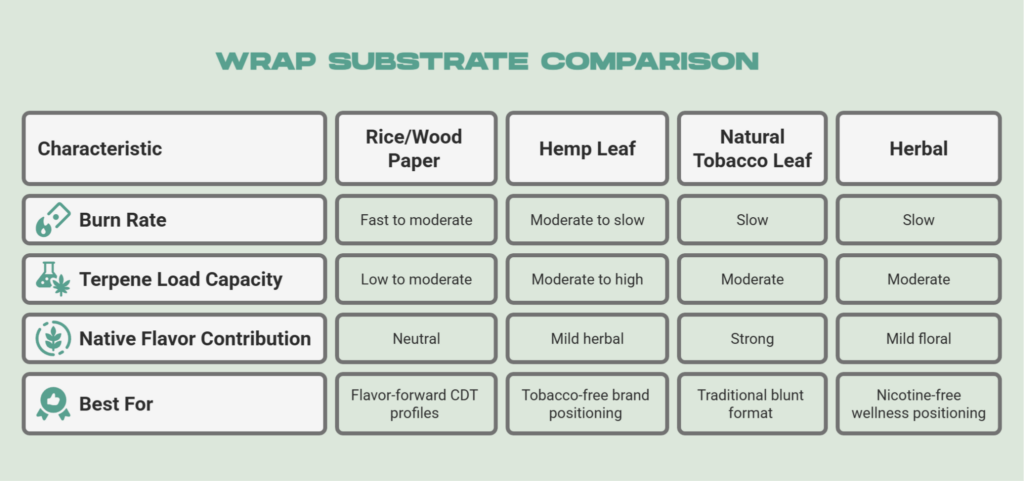
Not all infused wraps are built on the same base material, and the substrate changes how terpenes behave both before and during combustion.
The three primary options in the market are wood-pulp or rice paper, hemp leaf wraps, and natural tobacco leaf wraps.
- Rice or Wood-Pulp Paper: Low porosity limits how much terpene solution the sheet can absorb before saturation, which means manufacturers work with tighter load ceilings. The upside is a neutral baseline with no competing aromatics, so the applied terpene profile comes through cleanly. Burn rate tends to be faster, which accelerates monoterpene volatilization at the combustion zone.
- Hemp Leaf Wraps: More porous than processed paper, which increases terpene absorption capacity but also means terpenes off-gas more readily during storage. The natural fiber structure contributes mild herbal notes that are low enough in intensity to complement rather than compete with most terpene profiles. A popular choice for brands positioning around tobacco-free and nicotine-free claims.
- Natural Tobacco Leaf Wraps: Carry native aromatic compounds from the leaf itself, which means the applied terpene layer is working alongside an existing flavor signature rather than defining it outright. Slower burn rate gives heavier sesquiterpenes more time in the combustion zone, but the tobacco baseline can partially mask subtler monoterpene top notes in the profile.
What Terpene-Infused Wraps Are Not
There are a lot of misconceptions on the internet regarding what terpene-infused wraps are. A terpene-infused wrap is not a terpene delivery system in the same sense that a spray-infused pre-roll or a terpene-dosed concentrate is.
The terpene contribution from the wrap is real, but it is modest relative to what the flower inside the wrap is delivering throughout the session. The wrap is better understood as a sensory enhancement layer, one that frames the first-light impression and contributes to pre-session aroma, rather than a mechanism for sustained terpene delivery.
It is also not a customizable formulation input at the brand level. Brands sourcing infused wraps are selecting from a manufacturer’s existing library of profiles. They are not specifying terpene percentages, adjusting ratios, or requesting CDT substitutions through a typical wrap procurement process.
That level of customization belongs to the flower infusion stage, which is where brand-level terpene control actually lives. For more on how terpene reintroduction into flower works at scale, the cannabis flower enhancement guide covers the technical parameters formulators need to know.
How Terpene-Infused Wraps Actually Deliver Flavor
The marketing behind infused wraps tends to lean heavily on the entourage effect and strain-specific aroma claims without addressing the chemistry that determines whether those claims hold up through a full session.
For formulators and product managers, the practical question is: where in the smoking experience does the terpene contribution from the wrap actually land, and what does that mean for how the product should be positioned?
Monoterpene Volatilization at Combustion
The terpenes most commonly featured in wrap formulations are monoterpenes: limonene, myrcene, pinene, terpinolene, and ocimene. These compounds are lightweight, highly volatile, and have boiling points that sit well below the temperatures generated at the combustion zone of a burning blunt or joint.
Limonene, for example, has a boiling point around 176°C, while combustion at the cherry of a pre-roll can reach 700 to 900°C. At those temperatures, monoterpenes in the wrap material at and near the burn point volatilize almost immediately.
This means the terpene expression you get from an infused wrap is front-loaded. The aroma released when the wrap is first lit, and the flavor experienced in the first few draws, represents the peak of the wrap’s terpene contribution.
As the session progresses and the burn point moves away from the pre-lit section of the wrap, the remaining terpenes in the unburned portion are contributing to pre-session aroma rather than inhalation.
This is not a flaw in wrap design. It is just a chemical reality that should inform how brands position infused wraps in their product line.
Why the First-Light Experience Is the Most Important
Given that the wrap’s terpene delivery is concentrated at ignition, the first-light sensory experience is where infused wraps earn their value proposition. The aroma that hits when someone first lights an infused blunt, and the flavor profile in those initial draws, form the consumer’s first impression of the product.
This is also where terpene source quality becomes immediately apparent to experienced consumers. A well-sourced terpene profile that accurately reflects a strain’s actual aromatic composition will land differently than a synthetic or low-grade botanical approximation.
The terpene-forward first impression that infused wraps are designed to create only works as a brand asset if the profile is credible and consistent across production runs.
Sesquiterpenes and Wrap-Level Retention
Beta-caryophyllene is the notable exception in the volatilization story. As a sesquiterpene with a molecular weight roughly double that of monoterpenes, beta-caryophyllene has a boiling point around 130°C under standard conditions and is significantly more heat-stable than its lighter counterparts.
Research suggests that heavier terpene fractions show better retention in infused paper products over both the production storage window and the combustion event itself.
This has a direct formulation implication. Wrap profiles built with meaningful beta-caryophyllene content will sustain a more detectable terpene presence further into the session than profiles weighted entirely toward monoterpenes. For brands selecting terpene profiles to pair with their infused wrap program, sourcing oils that carry beta-caryophyllene as a meaningful secondary component, rather than a trace compound, gives the consumer a terpene experience that extends past the first draw.
It also contributes to the spicy, peppery depth that characterizes premium strain profiles and that consumers increasingly associate with authentic cannabis expression.
Terpene Wraps Vs Reintroduction: What’s More Effective
For brands looking into infused wraps, direct terpene reintroduction into flower, or both, the answer depends on what problem they are trying to solve. These two approaches serve different formulation goals and operate at different points in the product development process. Treating them as interchangeable or assuming one replaces the other leads to product gaps that show up in the consumer experience.
How Terpene Reintroduction Works in Pre-Roll Production
Terpene reintroduction involves applying terpene inputs directly to the cannabis flower before it is ground, filled into cones, or rolled. The two primary methods at the production level are spray application and core injection.
- Spray application involves blending terpenes with a volatile carrier like ethanol at roughly 1 to 5 percent concentration, then misting the blend over evenly spread flower before drying and grinding.
- Core injection pushes a terpene-and-distillate mixture, typically around 7 percent terpene concentration by mass, through the center of an already-filled cone.
Both methods put the terpenes in direct contact with the flower biomass, which means the terpene compounds are present throughout the material that combusts during the session, not just on the outer wrap layer.
Final moisture targets for spray-infused flower typically fall between 9 and 11.5 percent after drying to protect burn quality and prevent paper staining. Getting this right requires controlled application, moisture monitoring between stages, and QC checks on each batch.
For more details on these workflows and the specific parameters that separate consistent production from variable results, the R&D pre-roll guide is a useful resource.
Where Wraps Win and Where They Fall Short
Infused wraps offer something direct flower reintroduction cannot: a terpene contribution that is entirely separate from the flower input. This matters for brands working with lower-quality or processed flower where the base material is terpene-depleted and the wrap becomes the primary aromatic vehicle for establishing the product’s identity.
The wrap’s terpene layer also functions as a brand identity signal at the point of sale. A well-matched infused wrap that complements the strain name on the packaging creates a sensory story that starts before the consumer even lights the product.
Where wraps consistently fall short is preservation.
Terpenes applied to a wrap substrate during manufacturing are exposed to oxygen from the moment the coating dries. Monoterpenes in particular are highly susceptible to oxidative degradation, which means the profile a wrap carries at production is not the same profile it carries after weeks of sitting in a distribution chain or on a retail shelf. Heat accelerates this further.
A pallet sitting in a warm warehouse or a product left near a point-of-sale display can lose meaningful terpene load before the consumer ever opens the package.
Beyond shelf stability, wraps offer very limited formulation control at the brand level. The load limits imposed by paper porosity and the carrier ratios required for even coating mean the terpene contribution per unit is inherently modest, and increasing concentration does not linearly increase sensory output.
Higher loads can compromise burn quality, cause uneven coating, or create paper handling issues in automated cone-rolling environments. As a first-impression framing tool, infused wraps have a role.
As the primary mechanism for building a terpene identity into a product, they are a fragile foundation. Terpene reintroduction into the flower is where brands actually get control over what the consumer experiences throughout the session, with inputs they can specify, verify, and reorder consistently.

What Formulators and Brand Managers Need to Know Before Sourcing
Sourcing infused wraps is a straightforward procurement decision on the surface, but it carries meaningful quality variables that only become visible once you know what to look for.
The brands that treat wrap sourcing as a formulation decision rather than a packaging decision end up with products that perform more consistently and position more clearly in the market.
Terpene Load Limits and Paper Porosity
Every wrap substrate has a practical ceiling for how much terpene it can hold before the coating becomes uneven, the paper behavior changes, or the burn quality degrades. This ceiling is determined primarily by the substrate’s porosity.
More porous materials like hemp leaf can absorb a higher volume of terpene solution before reaching saturation, but they also release terpenes more readily during storage, which accelerates the natural terpene loss that occurs post-production.
When evaluating a wrap manufacturer’s product, asking for the terpene load specification per unit (typically measured in milligrams of terpene per wrap) gives you a concrete data point for comparing options.
A wrap with a higher load does not automatically perform better if the carrier system is not appropriate or the terpene profile is not matched to the substrate. What you are looking for is a consistent load across units in a production batch and a supplier who can document that consistency with batch-level data.
Carrier Agents and Their Effect on Burn Quality
The carrier used to apply terpenes to the wrap substrate during manufacturing has a direct impact on how the finished product burns. Carriers need to help the terpene solution disperse evenly, adhere to the fiber structure, and then either fully evaporate during the drying stage or be inert enough at combustion temperatures to not introduce off-flavors or harsh draw characteristics.
The key considerations when asking suppliers about their carrier systems are:
- Evaporation Rate: Carriers that do not fully evaporate during the drying stage can affect moisture content and create uneven burn behavior.
- Combustion Byproducts: Some carrier compounds produce detectable flavors or increased harshness when burned. Ask whether the carrier is food-grade and whether combustion byproduct data is available.
- Compatibility with Terpene Types: Certain monoterpenes interact differently with carrier chemistry than sesquiterpenes. A carrier system optimized for one terpene class may not perform as well with another.
Batch Consistency and What to Demand from Your Supplier
The most common failure point in terpene infused wrap programs at scale is batch-to-batch inconsistency in the terpene profile applied to the wrap. A first order that smells correct and performs well does not guarantee the third or fifth order will match. This is particularly true when suppliers are sourcing their terpene inputs from multiple agricultural seasons or blending botanical isolates without formal COA documentation on the inputs.
What a well-structured sourcing relationship looks like in practice:
- COA for the terpene inputs used in your specific wrap formulation, showing individual compound percentages by GC-MS
- Batch records documenting the terpene load applied per production run
- Documented storage and packaging requirements that protect terpene integrity between production and delivery
- A minimum shelf life guarantee from production date
Why Terpene Belt Farms Belongs in Your Pre-Roll Sourcing Stack
Pre-roll brands building a terpene program face a consistent sourcing problem: the wrap manufacturer controls what goes on the paper, and the terpene supplier controls what goes into the flower. Getting both to tell the same sensory story requires a terpene supplier who can provide documented, consistent CDT inputs across harvest cycles, with enough profile variety that your team can actually match formulations rather than working around whatever a general-purpose catalog happens to carry.
Terpene Belt Farms grows cannabis in Byron, California under Fresh Never Frozen extraction protocols that preserve the full terpene fingerprint from harvest through bottling. Every oil ships with a GC-MS COA verifying individual compound percentages at the batch level.
The catalog spans fruit, dessert, gas, sweet, citrus, and pine categories across multiple harvest years, which means R&D teams can find profile matches for nearly any strain positioning a brand wants to build. Wholesale pricing is available from 1L, with sample kits designed specifically for formulation evaluation before production commitment.
If your pre-roll or infused wrap program needs a terpene input that holds up to scrutiny, we can help. Partner with Terpene Belt Farms for wholesale and put the Fresh Never Frozen catalog to work in your formulations.
Frequently Asked Questions About Terpene-Infused Wraps
What Terpenes Are Most Commonly Used in Infused Wraps?
Limonene, myrcene, pinene, and beta-caryophyllene are the most frequently used terpenes in infused wrap formulations. Limonene and pinene provide bright, clean aromatic opening notes, while myrcene contributes earthy body. Beta-caryophyllene is particularly valuable in wrap formats because its higher boiling point gives it better combustion stability, allowing it to contribute flavor further into the session than lighter monoterpenes.
Do Terpene-Infused Wraps Actually Change the Effects?
The terpenes in a wrap contribute to the overall terpene load of the smoking experience, which can influence the entourage effect alongside the cannabinoids in the flower. That said, the volume of terpenes in a wrap is modest relative to what terpene-infused flower contributes. Wraps are more reliably evaluated as a sensory enhancement tool than a primary mechanism for targeted effect formulation.
Can Brands Customize the Terpene Profile on an Infused Wrap?
In most cases, no. Terpene infusion happens at the wrap manufacturing stage, and brands are selecting from a supplier’s existing profile library rather than specifying custom ratios or terpene sources. Some manufacturers offer private-label wrap programs at scale, but truly custom terpene specifications at the wrap level are not widely available. Brand-level terpene customization is more accessible through direct flower infusion.
How Should Infused Wraps Be Stored to Retain Terpene Freshness?
Infused wraps should be stored in airtight, resealable packaging away from heat, light, and humidity. Terpene volatility means that any exposure to air accelerates aromatic loss after the package is opened. Glass tube packaging and resealable foil pouches are more effective at preserving the terpene load than standard cardboard. Brands should account for storage conditions in their shelf life calculations and set expectations accordingly in product dating.
What Is the Difference Between a Terpene-Infused Wrap and a Terpene-Infused Pre-Roll?
A terpene-infused wrap is a blank wrap substrate coated with terpenes at the manufacturing stage, which a brand or consumer then fills with flower. A terpene-infused pre-roll is a finished, filled cone where terpenes have been applied directly to the flower inside, the paper, or both. The infused pre-roll typically delivers a more substantial and sustained terpene experience because the terpene input is in direct contact with the flower material throughout the session rather than only present at the outer surface.
Sources Used for This Article
- PubMed Central (PMC): “Data on terpene content in pre-rolled cone paper infused with terpene-containing flavours based on the formation of a partially soluble precipitate” – pmc.ncbi.nlm.nih.gov/articles/PMC11237848/


