
Quick Answer: Maximizing trichome and terpene preservation requires controlling heat, oxygen exposure, light, handling, and humidity from harvest through storage. Terpenes degrade quickly under poor conditions, so best practice is harvesting at peak trichome maturity, drying below 20–25 °C with 50–60% humidity, minimizing mechanical handling, and protecting material from UV and oxidation.
Fresh-frozen processing preserves the most volatile compounds, while long-term stability improves with airtight amber glass containers, nitrogen-flushed headspace, and refrigerated storage, all of which slow terpene loss and maintain the plant’s original chemical profile.
Key Takeaways
- Trichomes are the glandular structures on cannabis flowers that produce and store cannabinoids and terpenes, with capitate-stalked trichomes carrying the highest monoterpene concentrations.
- The biggest threats to terpene preservation are heat, oxidation, UV exposure, mechanical handling damage, and humidity imbalance, which can rapidly degrade volatile compounds.
- Research shows air-dried cannabis can lose ~31% of terpene content within one week and up to 55% within three months compared with freshly harvested material.
- Optimal post-harvest conditions include drying below 20–25 °C, maintaining 50–60% relative humidity, minimizing physical handling, and curing in airtight, light-protected containers.
- Fresh-frozen processing preserves more volatile monoterpenes than traditional drying but requires consistent cold-chain handling and specialized extraction infrastructure.
- Long-term terpene stability improves with amber borosilicate glass storage, nitrogen headspace flushing, refrigerated temperatures, and minimized oxygen exposure.
- Shop samples from Terpene Belt Farms to evaluate Fresh Never Frozen cannabis essential oils that preserve volatile terpene fractions from harvest through extraction.
What Are Trichomes and Why They Carry Your Terpene Yield
If you’re sourcing cannabis flower for processing, working with live material, or formulating with cannabis essential oil, trichomes are the structure everything else depends on. They are the biosynthesis site for terpenes and cannabinoids, and their physical integrity directly determines how much of that chemistry survives into your final product.
Trichomes aren’t a single structure. They come in different types with different chemical properties, and knowing which type does the most work helps explain why certain post-harvest decisions cost you more than others.
The Gland Types That Carry the Most Terpene Load
A 2019 study published in PubMed on cannabis glandular trichomes identified that stalked trichomes contain 12–16 secretory disc cells and carry strongly monoterpene-dominant terpene profiles. In contrast, sessile trichomes have fewer secretory cells and carry less monoterpene-heavy chemistry.
That distinction matters because monoterpenes such as myrcene, limonene, alpha-pinene, and terpinolene are also the most volatile and the most prone to degradation under heat, light, and mechanical stress.
Capitate-stalked trichomes are concentrated on the flower’s sugar leaves and bracts. They’re tall enough to rupture easily when the flower is handled aggressively or pressed against surfaces. Once the trichome head breaks, the aromatic oils inside begin oxidizing immediately with nothing left to protect them.
How Trichome Integrity Affects Downstream Terpene Quality
For processors doing fresh-frozen extraction or live resin work, intact trichome heads are the starting point for everything. A broken trichome isn’t just a mechanical loss of material. It triggers an accelerated oxidation cascade at exactly the point where you need the profile to be stable.
For brands doing distillate add-back or infused product production, trichome integrity on the incoming material affects how much terpene work you have to do downstream.
High-integrity flower that arrives with its trichome structure mostly intact gives you a better platform for formulation. Flower that’s been mishandled through transport or storage leaves you recovering a profile that was already compromised before processing started.
The Biggest Threats to Trichome and Terpene Integrity
There are four primary degradation pathways that you’re always managing simultaneously. They don’t operate in isolation. When two or three are active at once, the rate of loss compounds. A room that’s too warm and too bright with poor airflow will strip a batch faster than any single factor would suggest.

Heat and Oxidation
Heat is the most immediately damaging of the four. Research suggests terpenes are chemically reactive and structurally unstable, making them prone to degradation from environmental conditions, including light, heat, and oxygen.
Some of the most commercially important terpenes, including myrcene and linalool, begin to break down at temperatures near 100°C. In a poorly managed drying room, even ambient heat from grow lights, fans running in enclosed spaces, or unventilated racks can push flower surface temperatures high enough to drive off volatile fractions over a 7–14 day hang.
Oxidation compounds the heat damage because it happens at the same time. The moment oxygen contacts a broken trichome or a surface-exposed essential oil, a chemical reaction begins converting that terpene profile into a degraded state. Research suggests that cannabis flower can lose 30–50% of original terpene content after six months under standard storage conditions without active oxygen management.
Light and UV Exposure
UV radiation causes direct photochemical degradation of terpene molecular structures. When photons are absorbed by terpene molecules, they transfer energy that makes the compounds structurally unstable and accelerates their conversion to degraded byproducts.
What’s often missed is that this process doesn’t require direct sunlight. Standard LED facility lighting has been shown to contribute to measurable terpene loss when products are stored without UV-blocking packaging.
The implication for processors is that every moment a batch spends under open facility lighting without protection is a slow, quiet loss. Extraction equipment, storage areas, and packaging stations all benefit from UV-blocking measures that most facilities treat as optional.
Mechanical Damage During Handling
Trimming, packaging, transport, and sorting all involve physical contact with flower. Every contact point is an opportunity to rupture trichome heads. Hand trimming, while often preferred for quality control, involves repetitive physical manipulation of the bud that can cause significant trichome loss.
Machine trimming is faster but applies more force. The goal isn’t to avoid trimming entirely. It’s to minimize unnecessary contact and to time handling so that the least amount of surface disruption happens to flower that’s still at full terpene density.
Cold temperatures during handling help by making trichomes slightly more rigid and less likely to rupture under light contact. Processing freshly frozen or chilled material before the trichomes have warmed to ambient temperature is one of the most effective ways to reduce mechanical terpene loss.
Moisture and Humidity Imbalance
The humidity window for terpene preservation is narrower than many processors realize. Below 50% relative humidity, trichome structures become brittle. Brittle trichomes shatter during packaging operations, releasing their volatile compounds into the curing environment rather than retaining them in the product.
Above 65%, microbial activity begins, and the biological degradation of terpenes is both harder to detect and harder to reverse than mechanical loss.
Flower that’s been over-dried before infusion is a common problem in pre-roll production because it creates a situation where the infusion material itself is structurally compromised at intake. For more detail on pre-roll-specific handling considerations, check out our R&D guide on pre-rolls.
Post-Harvest Practices That Protect Terpene Profiles
The decisions made in the first 72 hours after harvest determine the ceiling for what’s recoverable in your final product. Most post-harvest terpene loss isn’t gradual. It’s front-loaded into the earliest stages of handling, drying, and curing, which makes the immediate post-harvest window the highest-leverage point in the entire preservation chain.
Harvest Timing and Its Effect on Trichome Peak
Trichome development follows a visual timeline. As the plant matures, trichome heads progress from clear to milky white, and then to amber. The milky-white stage represents peak cannabinoid and terpene accumulation in the stalked glandular trichomes.
Harvesting past peak, when heads have significantly ambered, means your starting material already has reduced monoterpene content because degradation begins in the trichome before the plant is ever cut.
Harvesting slightly early, when most heads are milky with minimal amber, gives you the highest terpene density at intake. This is especially relevant for live input material going into fresh-frozen extraction, where the goal is to capture the most volatile fractions before any post-harvest degradation begins.
Drying and Curing Temperature Controls
This is where the data becomes stark. Research published in PMC found that hot-air drying can reduce terpene levels by 80–90%, particularly at higher temperatures. Infrared or microwave drying can lead to a 75% reduction in total volatile content due to massive monoterpene degradation. The temperature-versus-retention relationship is not linear. Small increases above an ideal drying range can produce disproportionate losses.
Controlled atmosphere drying at lower temperatures, ideally below 20–25°C with managed airflow, preserves significantly more volatile terpene content than conventional hang drying in uncontrolled rooms. Minimizing drying duration while maintaining those temperature conditions gives you the best combination of speed and retention. Curing in sealed glass containers in dark, temperature-stable environments allows moisture to redistribute through the flower without exposing the terpene-rich surface to repeated fresh oxygen.
- Target Drying Temperature: Below 20–25°C
- Target Drying Humidity: 50–60% RH
- Curing Container: Airtight glass or vacuum-sealed, dark conditions
- Fan Contact: Avoid direct fan contact with flower surfaces during early drying stages
Freezing Vs. Fresh Processing Tradeoffs
Fresh-frozen processing, where flower is frozen immediately after harvest rather than dried and cured, preserves the highest concentration of volatile monoterpenes by preventing oxidative degradation before extraction begins. This approach trades shelf stability for terpene density. The chemistry captured in fresh-frozen material more closely reflects the living plant profile than anything achievable through conventional drying.
The limitation is operational. Fresh-frozen processing requires extraction infrastructure that can handle high-moisture, frozen material, and it creates a much shorter processing window.
A study published in the Journal of Cannabis Research measured that air-dried and stored cannabis inflorescence lost 31% of terpene content within one week and up to 55.2% within three months compared to freshly harvested material. For operations running fresh-frozen programs, consistent temperature management through the full chain of custody is non-negotiable.
Storage, Packaging, and the Role of Oxygen Management
Good drying and curing can be undone quickly by poor storage. Many processors apply careful environmental controls during the harvest window and then move finished material into suboptimal packaging that slowly compromises the profile before it reaches the next stage.
Container Materials and Terpene Permeability
Not all container materials protect terpenes equally. Plastic packaging creates static that pulls trichome powder from the surface and can interact chemically with terpene compounds over time. Terpenes are volatile and will permeate through lower-grade polymers, meaning product in a plastic container is passively off-gassing even when sealed. Amber borosilicate glass is the standard for quality terpene storage because it provides UV blocking, chemical inertness, and an airtight seal without the permeability issues of plastic.
For liquid terpene concentrates and cannabis essential oils, the container choice is even more consequential.
Every time a container is opened, fresh oxygen enters and contacts the remaining product. Partially filled containers with large headspace volumes experience faster oxidation than full containers. Decanting into smaller vessels as product is consumed extends shelf life in ways that no storage temperature alone can replicate.
Headspace Purging and Inert Gas Flushing
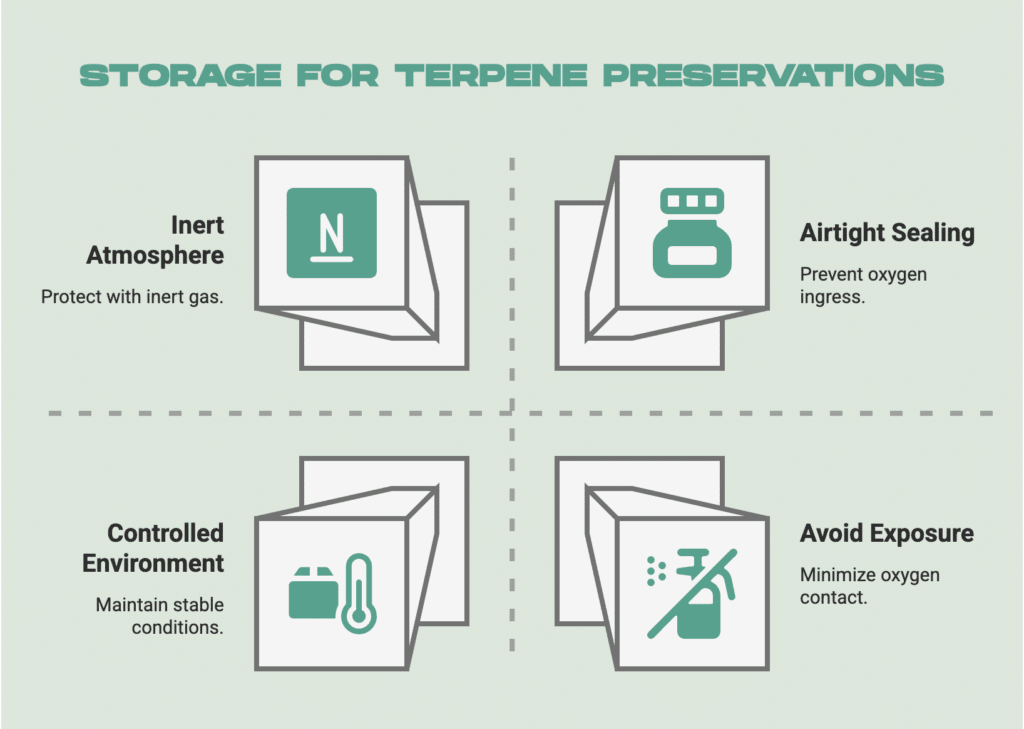
Nitrogen flushing is one of the highest-return preservation investments available to cannabis processors. Displacing the oxygen in a container’s headspace with an inert gas before sealing interrupts the primary oxidation pathway entirely.
A 2022 study published in PubMed showed that external terpenes added to inflorescence packaging in vapor phase reduced the degradation of total THC content by 47.4% over 127 days in an accelerated study, with the antioxidant properties of the terpenes themselves contributing to the protective effect.
For bulk storage of extracted cannabis essential oil, nitrogen-flushed containers maintained at refrigeration temperatures represent the current best practice for retaining an intact terpene profile over longer periods.
This is the standard that well-run extraction operations use because the cost of nitrogen is negligible relative to the value of the terpene mass it protects.
Temperature Targets for Long-Term Storage
Storage temperature isn’t one-size-fits-all across product formats. Each form factor has a different terpene density, a different surface-area-to-volume ratio, and a different oxidation risk profile that affects the right storage approach.
- Dried Flower: 60–70°F for general storage; refrigeration for premium or long-term holds
- Live Resin and Fresh-Frozen Material: frozen throughout; minimize thaw cycles
- Cannabis Essential Oil and Extracted Terpenes: refrigerated (35–50°F), away from light and oxygen
- Infused Products: shelf-stable formulations benefit from cool, dark storage even when not refrigeration-required
Temperature stability matters as much as the target temperature. Cycling between warm and cold introduces condensation, and that moisture disrupts both the trichome structure of flower and the chemical stability of liquid concentrates.
Why Terpene Belt Farms Delivers Terpenes That Arrive Already Preserved
Most of the terpene loss in the supply chain happens before product ever reaches a formulator’s bench. Freezing, thawing, extended cold-chain gaps, and extraction methods that prioritize throughput over profile integrity all deliver a degraded starting point. Downstream preservation efforts can only protect what’s already there.
Terpene Belt Farms built its operation around the premise that preservation is a farm-level responsibility, not a packaging-level fix. The Fresh Never Frozen extraction process works with fresh cannabis, not frozen biomass, capturing the volatile fractions that conventional processing loses in the freeze-thaw cycle.
Nitrogen-flushed containers, refrigerated shipping, and direct-from-extraction handling mean the profile you receive reflects the plant at peak harvest density. Every bottle ships with a full Certificate of Analysis and detailed terpene percentages so your team can verify what you’re formulating with before it enters production.
If your current terpene supplier can’t tell you exactly how the oil was handled between harvest and your door, that’s a gap your end product is paying for.
Request samples for R&D and test Fresh Never Frozen cannabis essential oil against your current input before your next production run.
Frequently Asked Questions About Trichome and Terpene Preservation
What Temperature Should I Dry Cannabis to Preserve Terpenes?
Drying temperatures below 20–25°C preserve the most volatile terpene content. Published research shows that hot-air drying at elevated temperatures can reduce total terpene levels by 80–90%, with most of that loss concentrated in monoterpenes. Controlled atmosphere drying with managed humidity is the most reliable method for retaining the profile captured at harvest.
Do Freeze-Thaw Cycles Damage Terpene Quality?
Yes. Repeated freeze-thaw cycles introduce condensation onto trichome surfaces, which promotes oxidation. Sub-zero handling also makes trichome heads more brittle, increasing mechanical rupture risk during processing. Fresh-frozen extraction is effective, but the entire chain of custody from harvest to extraction needs to maintain consistent frozen temperatures without cycling.
How Long Can Cannabis Terpenes Be Stored Before Significant Degradation?
Under standard storage without oxygen or light management, cannabis flower can lose 31% of terpene content within one week and up to 55% within three months of harvest and air drying. With active oxygen management, UV-blocking containers, and refrigerated temperatures, high-quality cannabis essential oils can retain profile integrity for significantly longer periods, though ongoing GC-MS verification is the only reliable confirmation.
Which Terpenes Degrade the Fastest?
Monoterpenes degrade faster than sesquiterpenes due to their lower molecular weight and higher volatility. Myrcene, linalool, terpinolene, and limonene are particularly heat-sensitive and begin to volatilize and chemically break down at lower temperatures than compounds like caryophyllene or humulene. Formulations that rely heavily on these monoterpenes for their aromatic character require tighter storage and handling controls.
Does Packaging Material Matter for Terpene Retention?
Yes, significantly. Plastic packaging is permeable to volatile terpene molecules, which off-gas through the material over time even in sealed containers. Plastic also generates static that pulls trichome material from flower surfaces. Amber borosilicate glass with airtight seals, combined with nitrogen flushing, is the standard for minimizing both oxidation and permeability losses in terpene-rich products.
What Is the Optimal Humidity Range for Terpene Preservation During Curing?
The target range is 55–62% relative humidity. Below 50% RH, trichomes become brittle and prone to shattering during handling, which releases volatile terpenes into the curing environment rather than retaining them in the product. Above 65% RH, conditions favor microbial activity that degrades both terpenes and cannabinoids before visible contamination becomes apparent.
Does Trimming Affect Terpene Content?
Yes. Both hand and machine trimming involve physical contact with trichome-covered surfaces and cause mechanical rupture of gland heads. Timing trimming as close to the point of sale or processing as possible, rather than at harvest, limits the window between trichome damage and packaging. Cold-room trimming at reduced temperatures also reduces rupture rates because trichomes are more structurally stable at lower temperatures.
Sources Used for This Article
- PubMed: “Cannabis glandular trichomes alter morphology and metabolite content during flower maturation” – pubmed.ncbi.nlm.nih.gov/31469934/
- ACS Publications: “Thermal Degradation of Terpenes: Camphene, $\Delta^3$-Carene, Limonene, and $\alpha$-Terpinene” – pubs.acs.org/doi/10.1021/es9810641#
- PMC: “In Pursuit of Optimal Quality: Cultivar-Specific Drying Approaches for Medicinal Cannabis” – pmc.ncbi.nlm.nih.gov/articles/PMC11013261/
- SpringerLink: “Cannabis sativa L. terpenes/terpenoids: Redesigning the plant for the 21st century” – link.springer.com/article/10.1186/s42238-020-00035-z
- PubMed: “Vapor Phase Terpenes Mitigate Oxidative Degradation of Cannabis sativa Inflorescence Cannabinoid Content in an Accelerated Stability Study” – pubmed.ncbi.nlm.nih.gov/35384716/