Quick Answer: Terpene percentage is calculated by dividing the weight of terpenes by the total weight of the formulation, then multiplying by 100. For example, adding 5g of terpenes to 95g of distillate gives you a 5% terpene load. That said, the formula is only one part of the picture. The right target percentage depends entirely on your format, your base material, and what your COA is actually telling you.
Key Takeaways
- Terpene percentage measures terpene weight relative to the total formulation weight, whether on a Certificate of Analysis (COA) or in a finished product mix.
- The standard formulation equation is: terpene weight = base material weight × target percentage, with higher-precision adjustments possible when calculating against finished batch weight.
- Weight-based dosing is more accurate than volumetric measurement because terpene density varies between monoterpene-heavy and sesquiterpene-heavy blends.
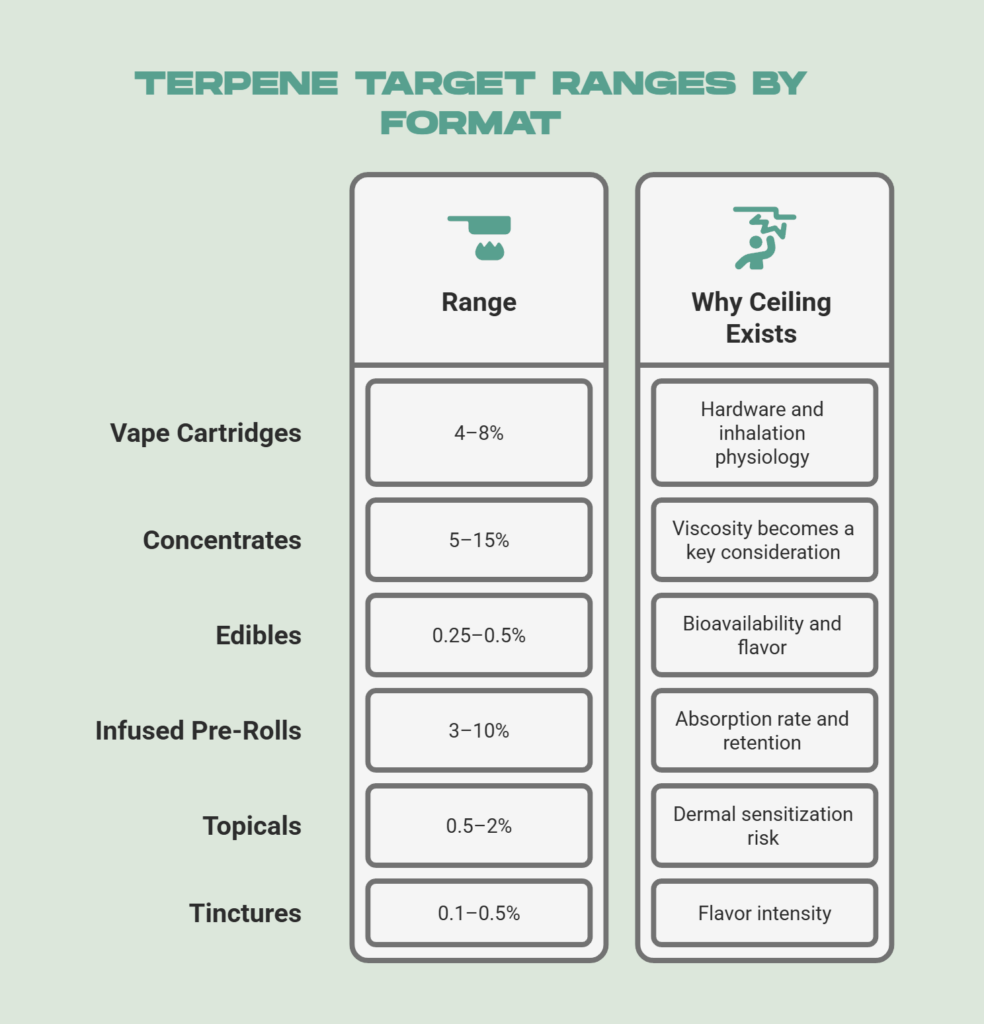
- Typical terpene load ranges vary by format: vape cartridges 4–8%, concentrates 5–15%, edibles 0.25–0.5%, pre-rolls 3–10%, and topicals 0.5–2%.
- Base material changes the math significantly because crude oil, rosin, and broad-spectrum extracts may already contain measurable terpene content before add-back.
- Heat-sensitive formulations like gummies and tinctures should add terpenes after cooking, since monoterpenes volatilize rapidly at standard processing temperatures.
- Shop Terpene Belt Farms sample kits to work with COA-verified cannabis-derived terpenes and build formulations with reproducible terpene percentages across production runs.
What a Terpene Percentage Measures
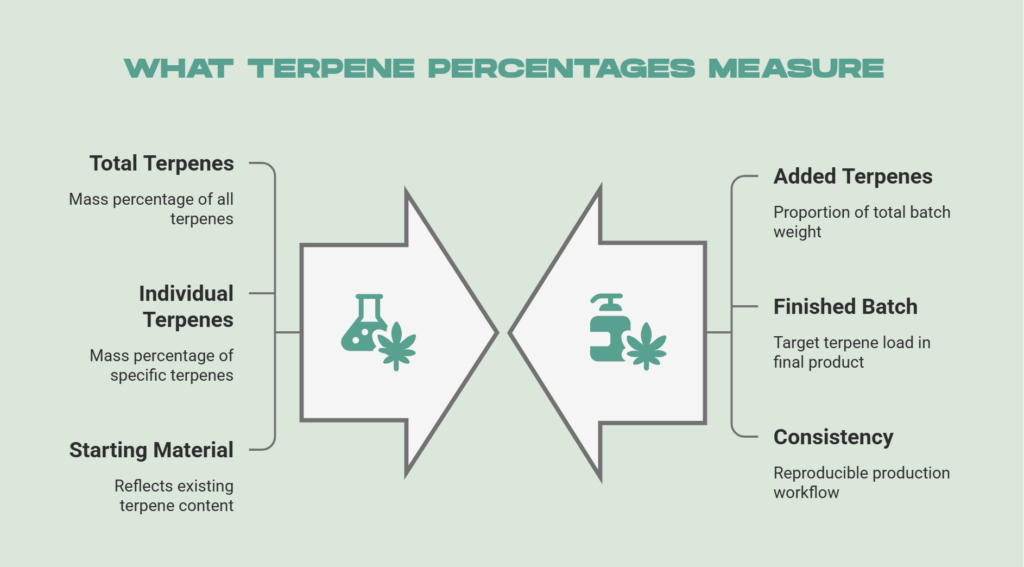
Before you can calculate anything accurately, it helps to be precise about what terpene percentage refers to in each context where you’ll encounter the number. There are two distinct situations where this figure appears, and conflating them leads to real formulation problems.
In a COA
When a lab returns a COA with a terpene readout, every figure listed, whether for myrcene, caryophyllene, or total terpenes, represents the mass of that compound as a percentage of the total sample weight.
A result showing 1.8% total terpenes means that for every 100g of that material, 1.8g is composed of terpene compounds. Individual terpene entries on the COA are sub-components of that total. So if your COA shows 0.9% myrcene and 0.6% limonene and 0.3% caryophyllene, those values sum to your total terpene figure.
This is important because a COA terpene percentage tells you what’s already in the material, not what you need to add. Research published in PMC found that decarboxylated cannabis extracts lose a significant portion of their original terpene content during processing, particularly the more volatile monoterpenes.
That means the COA on your base extract may reflect a starting terpene load that is already lower than the flower it came from, which directly affects how you approach your add-back calculation.
In a Formulation
The formulation-side calculation is the one you control. Here, terpene percentage refers to how much terpene you’re adding expressed as a proportion of your total finished batch weight. If you have 100g of distillate and want a 5% terpene load, you’re calculating the amount of terpenes that makes terpenes 5% of the combined weight of distillate plus terpenes.
Most formulators work from the base material weight rather than the finished batch weight for simplicity, and for percentages under 10%, the difference is small enough to be negligible.
But if you’re working with higher terpene loads, especially in HTE-style formulations or concentrate applications, calculating against finished batch weight gives a more accurate result. Both approaches are used in practice. Just be consistent within your production workflow so your records are reproducible.
The Core Formula and How to Apply It
The math itself isn’t complicated. The challenge is applying it correctly given the variables specific to cannabis formulation — particularly the difference between weight and volume, and the fact that terpene density isn’t uniform across compounds.
The Base Calculation: Weight × Target Percentage
The formula is:
Terpenes needed (g) = Base material weight (g) × Target percentage (decimal)
So for a 200g batch of distillate at a 6% target rate: 200 × 0.06 = 12g of terpenes.
That gives you a finished formulation of 212g, where terpenes represent 12/212 = 5.66% of the total weight. If you want exactly 6% of the finished batch weight to be terpenes, the math adjusts slightly:
Terpenes = (Base material × Target %) / (1 − Target %).
For a 200g base at 6%: (200 × 0.06) / 0.94 = 12.77g. The difference at practical formulation percentages is usually under half a gram per 100g batch — relevant at scale, but not the source of most formulation errors.
Use our terpene mixing calculator to handle the arithmetic quickly across multiple batch sizes and formats, especially if you’re working across different product categories with different target ranges.
Why Weight Is the Correct Unit
This is where most bench-level errors originate. Terpenes are liquids, so it’s tempting to measure them by volume. The problem is that different terpene compounds have different densities, and blends shift that density depending on their composition.
Sesquiterpenes like caryophyllene and humulene are denser than monoterpenes like limonene and pinene. A blend heavy in sesquiterpenes will weigh more per milliliter than a monoterpene-dominant oil. Research has noted that terpene blends adjust for density at approximately 0.84 g/mL, but this is an average, not a constant.
If you’re dosing a blend that’s 30% caryophyllene by volume at 1 mL, you’re getting more grams of terpene than if you’re dosing 1 mL of a limonene-dominant profile. Over a production run, that variation compounds. Calibrated scales with at least 0.01g precision eliminate this ambiguity entirely. Every serious production environment should be weighing inputs, not measuring them in syringes.
Converting to Volume When You Have To
There are situations where volume measurement is unavoidable. Small-scale R&D batches, quick blending tests, situations where lab scales aren’t available. In those cases, the conversion to use is:
Volume (mL) = Terpene weight (g) ÷ 0.85, where 0.85 g/mL serves as a reasonable average density for most CDT blends.
So 10g of terpenes converts to approximately 11.76 mL. This is a working approximation. Always verify with weight-based measurements before scaling to production.
Target Ranges by Format and Why Each Ceiling Exists
The reason every format has its own terpene percentage range isn’t arbitrary. It’s because of the chemistry of the delivery mechanism, the concentration at which terpenes become either ineffective or problematic, and the physical behavior of the finished product. Knowing why each ceiling exists helps formulators make better decisions when they’re working outside standard conditions.
Vape Cartridges
The standard operating range for vape formulations is 4–8%, with most commercial products landing between 5–6%. The floor exists because anything below 4% typically fails to deliver a perceptible terpene character in the vapor, especially when competing with the base oil’s own residual compounds.
The ceiling is enforced by hardware and inhalation physiology simultaneously.
Above 8–10%, three problems emerge: the formulation thins to the point where it wicks too fast for most ceramic coil hardware, causing dry hits or flooding; the terpene concentration in vapor becomes high enough to cause throat irritation; and at very high loads, the cannabinoid potency per puff drops because you’ve diluted the active fraction.
If vape carts are a priority for your business, our R&D vape formulation best practices guide has tons of data to help make it easier for first-time users.
Concentrates and Distillate Add-Back
Concentrate applications tolerate a wider range, generally 5–15%, depending on the product type and the purity of the base.
High-purity distillate (90%+ cannabinoids) can carry more terpene before the ratio feels unbalanced, and some HTE-style formulations intentionally push higher for specific flavor goals. Rosin and live resin carry residual terpenes from the extraction process, which changes the math significantly (covered in the next section).
At the upper end of this range, viscosity becomes a key consideration.
Terpenes are natural viscosity modifiers. They thin the base material. In concentrate applications that require a specific consistency, such as wax, badder, or sauce, the terpene load affects final texture and may need to be calibrated against expected handling temperature.
Edibles and Gummies
Edibles operate at a much lower range than inhalation formats: 0.25–0.5% by weight of the finished product is the standard starting point for gummies, with hard candy beginning even lower around 0.1–0.25%. Two things drive these low percentages.
- First, research suggests that terpene bioavailability through oral ingestion is significantly lower than inhalation, meaning high concentrations don’t translate to enhanced experience. They translate to off-flavors.
- Second, many terpenes have distinct bitter or medicinal notes that become overwhelming at higher concentrations in a food matrix.
Timing also matters in edible formulations. Terpenes should be added after the cooking or heating phase, not during, since most monoterpenes volatilize well below typical food processing temperatures.
A 2024 PMC study confirmed that even brief exposure to heat at cooking temperatures reduces monoterpene content substantially. Adding terpenes at the end, once your batch has cooled to below 40°C, protects the profile you’re trying to deliver.
Infused Pre-Rolls and Flower
Flower and pre-roll applications have a different calculation model because you’re working with a dry weight matrix rather than a liquid one.
The standard target for infused pre-rolls sits between 3–10% of total terpene oil applied relative to flower weight, though this varies significantly depending on application method. NEU bag infusion, spray application, and liquid coating all behave differently in terms of absorption rate and how much of the applied terpene is retained versus lost to the environment.
A useful data point from published research found that approximately 1.18% of external terpene relative to inflorescence weight was the minimum needed to maintain the initial terpene content of the flower after six weeks of storage.
That’s a preservation floor, not a formulation target, but it illustrates how much terpene flower absorbs versus what gets applied. For a full breakdown of pre-roll infusion parameters and application methods, our R&D pre-roll guide covers equipment, timing, and percentage targets for different SKU types.
Topicals and Tinctures
Topicals operate in the 0.5–2% range, where the ceiling is set by dermal sensitization risk rather than sensory preference.
Several terpenes, particularly high-limonene blends, have been noted in published research to interact with skin receptors at higher concentrations, and some users experience sensitization responses above 0.5% in leave-on formulations. Rinse-off applications can tolerate the higher end of the range. Tinctures, which are typically MCT oil or alcohol-based, operate between 0.1–0.5%, where the primary constraint is flavor intensity rather than safety.
What Changes When Your Base Material Changes
This is the section most formulation guides skip, and it’s where batches go wrong.
The formula is consistent, but your effective starting point is not, because different base materials already contain terpenes at varying concentrations. Failing to account for residual terpene content in your base can result in a finished product that’s significantly over your target percentage.
Distillate that has been through a full refinement and distillation process typically retains minimal terpenes, often below 0.5% total by the time it’s ready for formulation. For most practical purposes, you can treat it as a clean slate and apply your target percentage directly to the base weight. This is why distillate is the most forgiving base for terpene add-back work. The starting point is predictable, and your COA for the terpene input is the primary variable you’re managing.
Crude oil and broad-spectrum extracts are a different situation.
Crude can retain 1–5% total terpenes depending on extraction method and post-processing. If you’re adding a 5% terpene load to a crude that already carries 3% native terpenes, your finished product could be sitting at 8% total. This is well above your design target for many formats. The right approach here is to request a COA on your base material specifically for terpene content, then subtract existing terpene load from your target before calculating your add-back amount.
Here’s how you can treat various formats during formulation:
- Distillate: Treat as a clean base. Apply target percentage directly.
- Broad-Spectrum/Crude Oil: Request terpene COA. Subtract residual load from target.
- Live Resin/Rosin: Not a standard add-back application. Additions are corrective and small-scale.
- Winterized Oil: Similar to distillate, but verify. Some wax removal processes also strip terpenes inconsistently.
How Terpene Belt Farms Makes the Calculation More Reliable
The formula is only as reliable as the inputs you’re working with. If your terpene supplier can’t tell you the exact composition of what’s in the bottle at the batch level, your calculations are estimates at best. That’s the sourcing problem most formulators run into, and it’s where a COA-backed supply chain changes the outcome.
Terpene Belt Farms produces cannabis-derived terpenes from California-grown Cannabis Sativa L through a Fresh Never Frozen extraction process, which preserves the full monoterpene and sesquiterpene fraction that standard extraction and post-processing typically destroys.
Every lot ships with a full GC-MS COA that identifies individual compound percentages, not just total terpene content. That data is what you need to do accurate residual-terpene math and to verify that batch-to-batch consistency holds across your production runs. When the input is consistent, your calculated add-back amounts stay accurate across batches without requiring reformulation.
Ready to build a formulation you can reproduce? Request a sample kit and get COA-verified inputs to work with from the first test batch.
Frequently Asked Questions About Terpene Percentage Calculations
What Is the Standard Terpene Percentage for Vape Cartridges?
Most commercial vape cartridges are formulated with a terpene load between 4% and 8% by weight. The most common starting point for R&D is 5%, which balances flavor delivery, vapor quality, and hardware compatibility for most ceramic coil setups. Above 8–10%, formulations typically become too thin for standard hardware and can produce throat irritation in vapor.
Do I Calculate Terpene Percentage Against the Base Material Weight or the Finished Batch Weight?
For most practical applications, calculating against the base material weight is sufficient and easier to apply consistently. For percentages under 10%, the difference between the two methods is minor. If you need precise labeling accuracy or are formulating at higher terpene loads, calculating against the finished batch weight (base + terpenes combined) gives a more technically correct figure.
Why Do Terpene Results on a COA Differ Between Batches of the Same Product?
Cannabis-derived terpenes are agricultural extracts. Terpene expression varies with harvest timing, growing conditions, curing, and storage. Even genetically identical plants will produce slightly different terpene profiles from one season to the next. Meaningful batch-to-batch variation in a CDT product is normal and expected. Perfectly identical profiles across multiple lots are a sign the product may be synthetic or blended.
Can I Use a Volumetric Measurement Instead of Weight to Dose Terpenes?
You can, but it introduces inaccuracy because terpene density varies by composition. A useful approximation is 0.85 g/mL for most CDT blends, but sesquiterpene-heavy profiles will run higher. For R&D and small-scale testing, volume measurement with this conversion factor is workable. For production, weight-based dosing with calibrated scales is the only reliable method.
What Happens If My Base Material Already Contains Terpenes?
If you’re working with crude oil, broad-spectrum extract, or live resin, your base material likely carries a meaningful terpene load already. Adding your full target percentage on top of residual terpenes will push your finished product over that target. Request a terpene COA on your base material, subtract the residual terpene percentage from your target, and calculate your add-back from the adjusted figure.
Does Terpene Percentage Affect Cannabinoid Potency Labeling?
Yes, indirectly. If your finished product is tested for potency and terpenes make up a significant portion of the total weight, they dilute the cannabinoid concentration relative to the whole. A formulation that’s 6% terpenes has 6% less room for cannabinoids by weight. This is relevant for products with potency claims where regulatory compliance depends on hitting a specific cannabinoid percentage in the finished product.
How Many Compounds Should Appear on a Terpene COA for a CDT Product?
A well-extracted cannabis-derived terpene profile should show at least 20 detectable individual compounds through GC-MS analysis. Profiles showing fewer than 10 compounds are often the result of heavy post-processing, botanical reconstruction, or synthetic blending. The minor compound fraction, while small in percentage terms, is a key indicator of authentic CDT extraction and contributes meaningfully to the finished product’s sensory character.
Sources Used for This Article
- PMC / NCBI: “Optimal Treatment with Cannabis Extracts Formulations Is Gained via Knowledge of Their Terpene Content and via Enrichment with Specifically Selected Monoterpenes and Monoterpenoids” – ncbi.nlm.nih.gov/pmc/articles/PMC9608144/
- PMC / NCBI: “Efficient Capture of Cannabis Terpenes in Olive Oil during Microwave-Assisted Cannabinoid Decarboxylation” – ncbi.nlm.nih.gov/pmc/articles/PMC10893475/
- PMC / NCBI: “The Preservation and Augmentation of Volatile Terpenes in Cannabis Inflorescence” – ncbi.nlm.nih.gov/pmc/articles/PMC7819294/
- Frontiers in Pharmacology: “Terpenoids From Cannabis Do Not Mediate an Entourage Effect by Acting at Cannabinoid Receptors” – frontiersin.org/journals/pharmacology/articles/10.3389/fphar.2020.00359/full